First-Order Sourcing Guide for Startups
A China sourcing guide for startups and crowdfunding teams: supplier comparison, MOQs, sample loops, packaging, inspection, and the first production run.
Built for: Founders moving from prototype to first paid run
Promising a delivery date before resolving minimums and samples can leave backers waiting. Compare a first-run route against a written supplier quote, then confirm the sample and production calendar before committing.
Scroll horizontally to see all columns →
| First-run route to ask about | Cost change to confirm | Reorder risk to record |
|---|---|---|
| Standard base with a label or insert | Base item, branding, and setup separately | Availability and controlled specification of the base |
| Fewer colors or sizes | Minimum and price for each remaining variant | Minimums when adding variants later |
| Separate product and packaging | Packaging, third-party assembly, and storage charges | Excess-pack ownership and future fit |
| Stock validation batch | Stock price, inspection, and freight | Whether the next batch can match the approved sample |
These are options to price with your own suppliers, not promises of lower cost or availability. Use the RFQ template to retain exclusions.
Turn the prototype into a factory file
Send drawings, measurements, materials, required functions, reference photos, packaging needs, quantity, destination, and the date the goods are needed. Mark which details are fixed and which can change. A campaign render may show the intention, but the factory needs tolerances and an approved physical reference.
The wholesale RFQ template helps collect comparable answers. Ask the supplier to separate stock components, custom work, tooling, sample cost, and bulk pricing. That makes it easier to see which change creates the minimum order or calendar problem.
Use sample rounds to make decisions
Each round should close named questions. Record what changed and why, then approve the exact sample that production must follow. If a new change arrives after material or tooling has started, update the cost and calendar before accepting it.
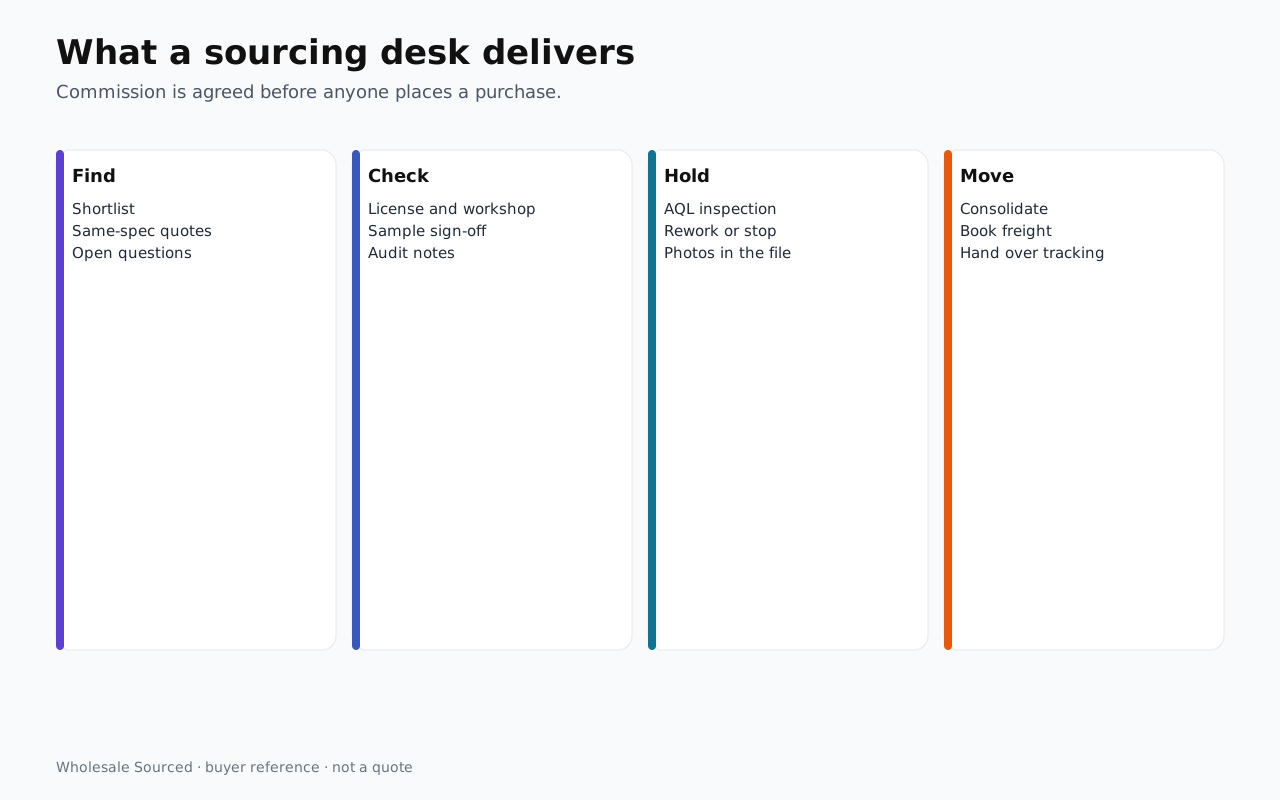
The private-label and OEM guide explains the sample, artwork, packaging, and first-run controls. The founder keeps the product decision. Whoever manages the supplier in China should follow the approved instruction and report where the supplier cannot meet it.
When the factory minimum is bigger than your first run
Check what a “no minimum order” offer actually covers: stock units, a standard color, a blank product, or your custom specification. Ask which production step limits the requested run before treating the offer as usable.
Ask each supplier to answer in writing:
- Which part of the order sets the minimum: raw material, dye or color, decoration setup, a custom component, printed packaging, or the production line itself?
- What is the minimum for the base product with your changes removed?
- Will the supplier accept a smaller first run at a higher unit price or with a separate setup charge, and how is that shown on the quote?
- Can colors or sizes share material and setup, or does each one carry its own minimum?
- Is the reorder minimum different from the first-order minimum?
Use those answers to price the routes in the opening table. Confirm setup, sample, tooling, packaging, and assembly charges separately. Compare freight on the finished cartons; a smaller run does not guarantee a lower total budget. Record the exclusions and the repeat-order specification as well as unit price.
Leave room for inspection and freight
Do not place inspection on the same date as the promised factory completion or carrier pickup. A failed lot needs time for sorting, repair, replacement, and another check. The pre-shipment inspection guide explains how to keep the release decision under buyer control.
Freight should be quoted on the finished cartons. Compare the delivery range with the campaign plan, and separate carrier delivery from final fulfillment to backers. Before choosing between express courier, air consolidation, or ocean LCL for your first batch, compare volumetric divisors (5,000 vs 6,000 cm3/kg), 50 kg to 2.00 CBM chargeable weight breakpoints, and CBP Form 7501 entry requirements in our Alibaba Express air courier vs DDP sea freight consolidation guide. The landed cost calculator helps record the extra charges that a unit quote leaves out.
Common problems to check for
- The quoted minimum exceeds the first-run budget
- The campaign photo is not a spec
- Tooling quotes arrive after the backers do
Frequently asked questions
How do I find out what sets a factory's MOQ?
Ask the supplier which material, color, print, component, or packaging step limits this order. Request the base-product minimum and a quote for each proposed change; a lower first-run quantity still needs supplier confirmation.
How do sample changes affect the production date?
Record the change, revised sample approval, and any affected tooling or material booking. Ask the supplier to confirm whether another sample or a new production slot is needed before updating the campaign delivery date.
Information graphic