Shipping from China Explained
How sea, air, and courier shipping from China works for importers: comparable forwarder quotes, a named Incoterm, documents, and tracking after cargo leaves.
A freight quote is useful only when it describes the same cargo and the same handoff. A low headline rate may exclude origin handling, destination charges, customs work, or final delivery. It may also use an estimated carton size that changes after packing.
Scroll horizontally to see all columns →
| Mode | Fits when | Ask the quote to name |
|---|---|---|
| Sea | The calendar allows it, or the cargo is heavy or bulky | Port, transit, and what is excluded at destination |
| Air freight | The need-by date is short and the cargo is weight-sensitive | Chargeable weight basis and the airport |
| Courier | The shipment is a small parcel with a door delivery | The service level and the delivery address |
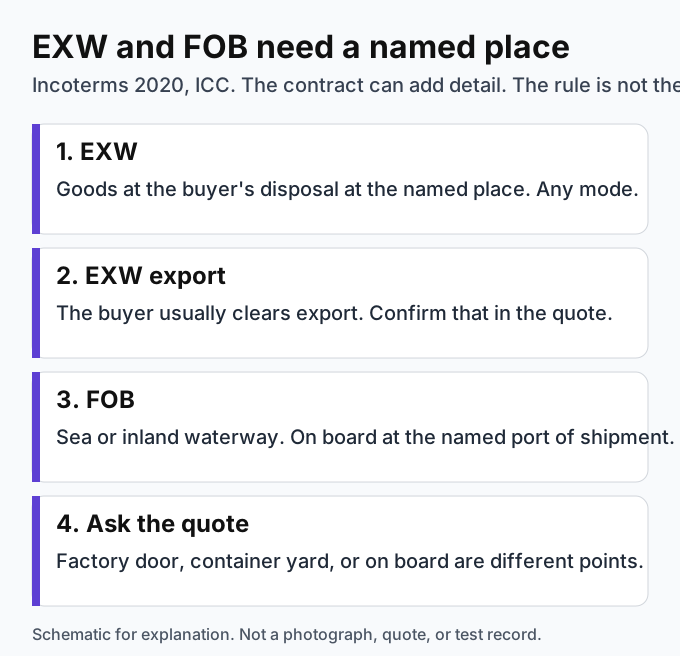
The International Chamber of Commerce publishes the Incoterms 2020 rules. EXW (Ex Works) means the seller delivers when the goods are placed at the buyer’s disposal at the named place, and it can be used with any mode. The buyer usually handles export clearance, so ask whether the quote includes that. FOB (Free On Board) is a sea and inland waterway rule: the seller delivers on board the vessel at the named port of shipment. A factory door, a container yard, and “on board” are different points. Ask which one the quote uses. The rule allocates some tasks, costs, and risk. It does not replace the rest of the contract. See the ICC Incoterms 2020 page, and keep duty in the landed cost formula.
Quote the finished cargo
Collect the final carton count, gross weight, dimensions, pickup address, destination, goods description, value, and required date. Ask the forwarder to state the chargeable basis and the points where its responsibility begins and ends. The quote should name the Incoterm and place rather than relying on a phrase such as “all included.”
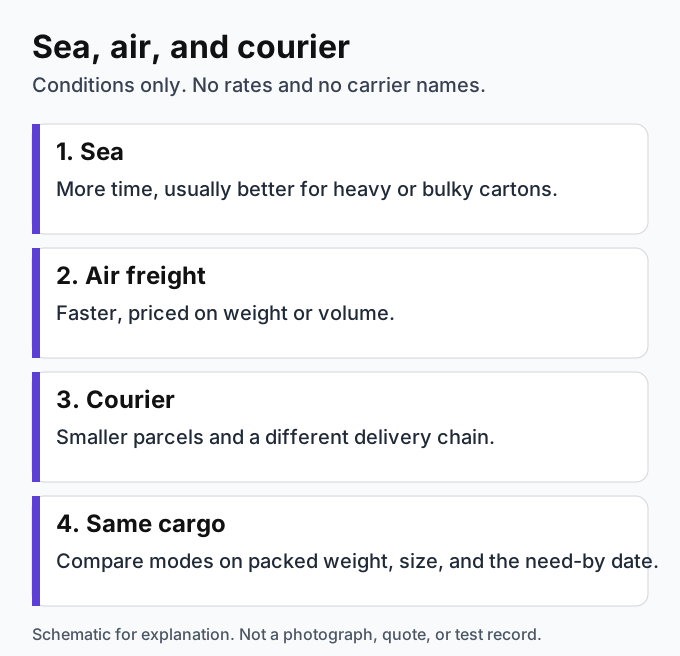
Sea, air, and courier solve different calendar and cost problems. Compare the full route, not only the main transport. Factory pickup, export handling, customs, destination handling, and final delivery can change the practical arrival date.
How to compare freight quotes before choosing the cheapest
Importers often ask which China shipping agent is the cheapest. There is no answer that holds for every shipment, because the cheapest quote depends on what it covers. A quote is cheaper only after it has been put on the same basis as the others. If you skip that step, you are comparing different services that happen to share a price column.
Put every quote on one basis before you compare totals:
- Same cargo. Each forwarder prices the same carton count, gross weight, and carton dimensions. If one quote used an estimate, ask it to reprice on the packed figures.
- Same Incoterm and named place. A quote from the factory door (EXW) and a quote from the loading port (FOB) start at different points. Restate each one from the same starting point to the same delivery address.
- Same mode and service level. Compare sea with sea and air with air. Courier, consolidated air, and direct air freight are different services even when the route is the same.
- Same chargeable basis. Ask each forwarder whether it priced on actual weight, volume, or volumetric weight, and on which carton figures.
- Same validity. Note the date each quote expires and whether surcharges can be added at booking.
Then look for charges the low quote leaves out. These are the line items that most often explain a gap between two quotes:
Scroll horizontally to see all columns →
| Charge type | Where it usually appears | What to ask |
|---|---|---|
| Factory pickup and origin handling | Before the main carriage | Is pickup from our supplier’s address included, and for how many cartons? |
| Export declaration and documents | At origin | Who files the export declaration and prepares the papers it needs? |
| Fuel and other surcharges | On top of the base rate | Is the rate all-in, or will surcharges be confirmed at booking? |
| Destination terminal and handling | On arrival | Which destination charges are billed by you, and which by a local agent? |
| Customs brokerage and entry | On arrival | Is a customs broker included, or must we appoint one? |
| Final delivery | After clearance | Does the price reach the delivery address, or stop at the port or airport? |
| Duty and import taxes | On entry | Are these excluded and billed at cost, or estimated in the quote? |
Mark each charge as included, excluded, or not stated. Ask about every “not stated” line in writing before booking. If the cheapest quote still wins after that, it is a real saving rather than a missing step.
The freight price is only one part of the cost per unit. Use the landed cost formula guide to add freight to the goods price, duty, and destination charges without counting a charge twice.
Keep customs responsibility visible
The importer owns the accuracy of the entry. A forwarder should not guess a duty rate or choose an HS code without the product facts. The buyer and customs broker need the material, function, construction, value, and origin information required to classify the goods.
The shipping file should also identify who provides the commercial invoice, packing list, and any product-specific documents. An Incoterms rule divides certain costs, tasks, and risk, but it does not replace the customs arrangement. Use the landed cost calculator to keep duty and destination charges separate from the factory price.
When several Chinese suppliers hand wholesale cartons to one forwarder, naming those documents is not the same as matching each line to the carton numbers. Use the invoice and packing list cross-check to record the quantities, the difference, and who corrects an error.
When the product needs a CPSC certificate, the CPSC eFiling requirements checklist matches the supplier file to the data the broker receives. That sheet does not file the entry.
Book after the release decision
Inspection should be complete before the cargo leaves factory control unless the buyer accepts a different sequence in writing. Once the booking is confirmed, compare the shipping marks and documents with the inspected carton count. Record the tracking reference and destination contact.
Amazon shipments need an additional data check because every box must match the live inbound plan. The China to Amazon FBA guide covers that handoff. Buyers who are still comparing suppliers should start with how to source products from China before requesting freight against an unfinished specification.
What a provider should deliver
- A mode recommendation with a calendar
- Draft shipping marks
- Booking and tracking
- A document set for the importer of record
How the work usually runs
- Choose. The forwarder matches cargo volume, value, and the need-by date to sea, air, or courier.
- Book. The booking follows a passed inspection unless the buyer overrides it in writing.
- Export. Documents are checked against the commercial invoice the buyer approved.
- Hand-off. The buyer receives tracking and the contacts for destination charges.
Frequently asked questions
Why does a freight quote change after packing?
Freight is often charged on actual or volumetric weight, whichever is higher, so a quote built on estimated cartons can change once the real carton dimensions and weights are known. Ask the forwarder to reprice on the packed figures.
How long is a freight quote valid?
Each forwarder sets its own validity period and surcharge rules. Note the expiry date on every quote and ask whether surcharges can be added at booking.
What if the cheapest quote leaves charges out?
List pickup, export documents, surcharges, destination handling, brokerage, final delivery, and duty as included, excluded, or not stated. Ask about every line that is not stated before you book. A missing line is not a saving.