Direct answer
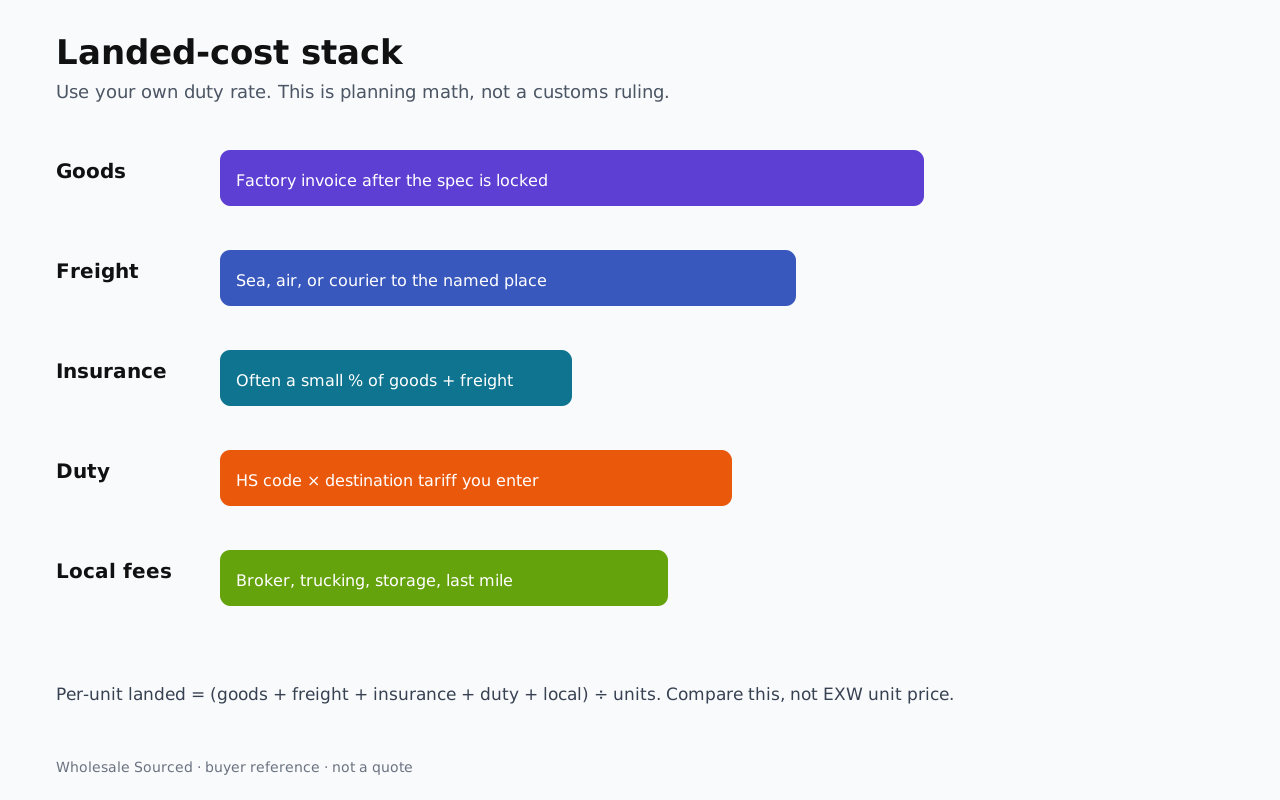
To calculate landed cost, add the product cost and every additional cost needed to bring the shipment to your chosen destination, counting each charge once. Include freight, insurance, confirmed duty, non-recoverable import taxes, clearance, and delivery. Divide the total by units received for a shipment-average unit cost.
Key takeaways
- Define the warehouse destination, quantity, quote scope, and currency before adding costs.
- A hypothetical $10,000 order plus $2,500 in import costs lands at $12.50 per unit for 1,000 units.
- Mark a charge as included, additional, or pending; an unknown amount is not zero.
- Allocate mixed-SKU costs by a documented basis and track recoverable taxes separately.
A supplier quotes $10 per unit. Before you compare that price with another factory, you need to know what each unit will cost when it reaches your warehouse. Freight, insurance, customs charges, and local delivery can change the result enough to reverse which supplier looks cheaper.
To calculate landed cost of imported goods, define the delivery endpoint, collect the costs for every stage, remove overlapping charges, and add the remaining amounts in one currency. Then divide the shipment total by the relevant quantity. In the worked example below, 1,000 units quoted at $10 each become a $12,500 shipment, or $12.50 per unit at the warehouse.
The arithmetic is straightforward. The work is making sure every number describes the same shipment, the same destination, and a charge that has not already been counted.
What is landed cost?
Landed cost is the combined cost of acquiring goods and bringing them to a defined destination. In this guide, that destination is the buyer’s warehouse, with the agreed delivery and receiving charges included. A port arrival, a warehouse delivery, and inventory ready for sale on Amazon are different endpoints. Write down which one you mean before comparing totals.
For a purchasing decision, the worksheet should show all relevant acquisition and transport spending. If you also use the figures for inventory accounting, confirm the treatment of items such as development, abnormal losses, and financing with your accountant. A buying budget and a financial reporting policy do not necessarily group every expense in the same way.
This tutorial stops at warehouse receipt. Selling expenses such as advertising, marketplace commissions, outbound customer shipping, and returns belong in the next stage of your margin calculation. For the wider ordering process, see our guide to sourcing products from China.
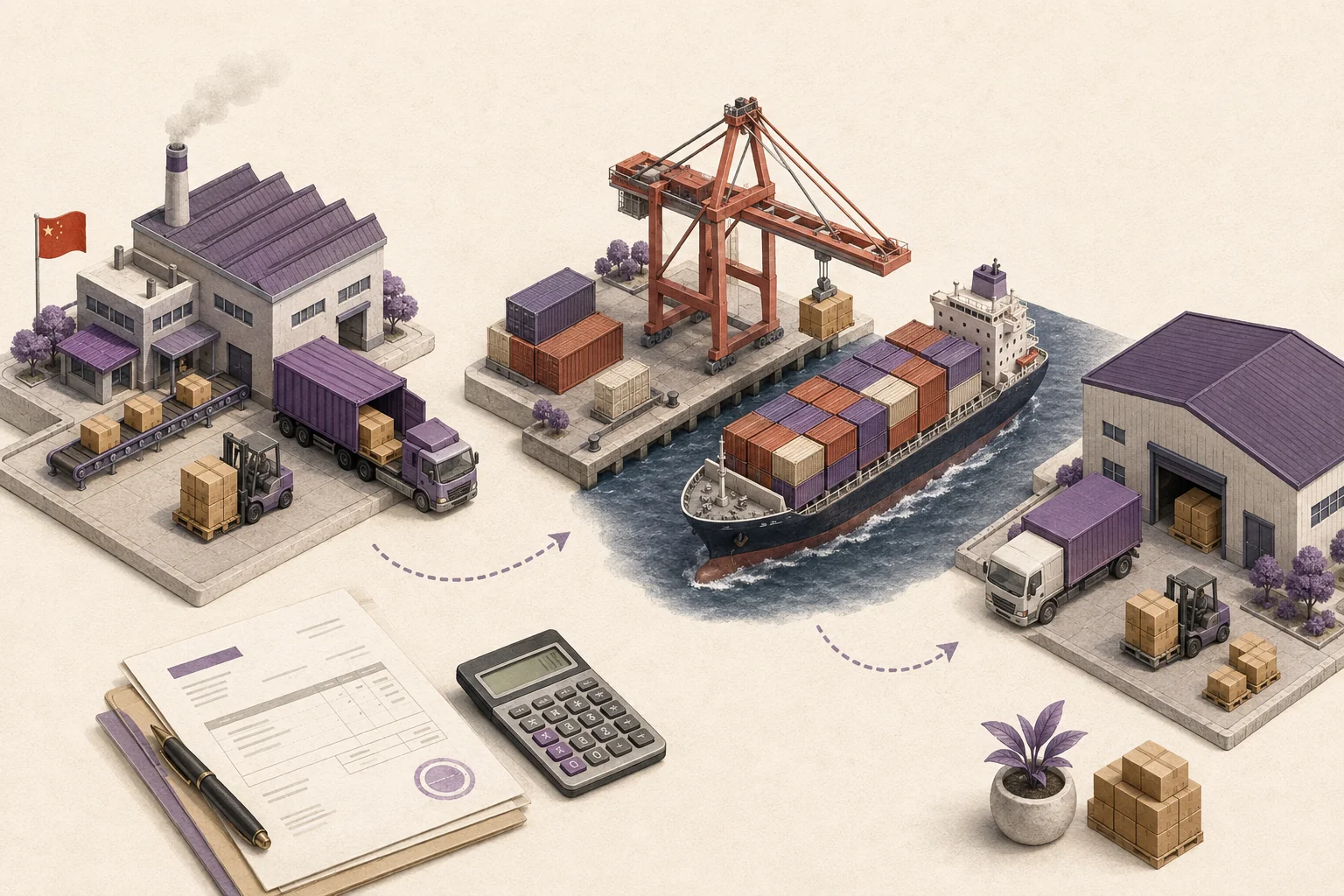
What is included in total landed cost?
Use this table as a collection list. A row can be a separate invoice, part of a bundled quote, or not applicable. Its presence here does not mean you should automatically add another charge.
| Cost item | What to check | Where to get the amount |
|---|---|---|
| Goods and agreed packaging | Quantity, specification, unit price, and packing scope | Supplier quotation and commercial invoice |
| Additional order preparation | Testing, inspection, labels, or tooling charged to this order | Laboratory, inspector, supplier, or prep provider |
| Origin transport and handling | Pickup, consolidation, export documentation, and loading outside the goods quote | Supplier and freight forwarder |
| International freight | Mode, route, packed weight, volume, surcharges, and quote validity | Written freight quotation |
| Cargo insurance | Insured value, premium, coverage, and whether already bundled | Insurer, supplier, or forwarder |
| Import duty and additional duties | Classification, origin, entry date, and customs value | Destination tariff and customs broker |
| Non-recoverable import taxes | Tax base, rate, and whether recovery is available | Destination tax guidance and accountant |
| Clearance and destination handling | Brokerage, entry fees, terminal charges, and scope | Broker and destination agent |
| Delivery and receiving | Address, appointment, unloading, and receiving requirements | Trucking provider and warehouse |
Small charges deserve a row when they are real. A pickup fee, transfer fee, pallet requirement, or second inspection can erase a small saving in the factory unit price. Keep uncertain charges visible as pending, with a named person responsible for confirming them.
Request freight using the finished master-carton dimensions and gross weights. Product weight alone is not enough to compare transport offers. Our shipping from China service explains the shipment information needed to scope a route and identify its remaining handoffs.
The landed cost formula
For a warehouse-level buying worksheet, use:
Total landed cost
= goods and agreed packaging
+ additional order preparation and origin costs
+ international freight and cargo insurance
+ import duty and non-recoverable import taxes
+ clearance and destination handling
+ delivery and receiving at the named warehouse

Landed cost per unit
= total landed cost ÷ units received
Every addition means an amount not already included elsewhere. If the supplier’s invoice includes freight, either keep that bundled amount and add only outstanding charges, or split the invoice into its components. Do not use both methods at once.
Keep recoverable taxes in a separate column, together with their expected payment and recovery timing. Also keep a clearly labeled contingency outside the base estimate. A reserve for a possible delay helps cash planning, but it is not an actual freight invoice.
How to calculate landed cost step by step
1. Fix the shipment and the endpoint
Record the SKU, quantity, specification, packaging, origin, destination country, warehouse address, and expected shipment date. Add the Incoterm and its named place exactly as quoted. “Delivered” without an address leaves too much room for disagreement.
For supplier comparisons, hold these fields constant. An order of 1,000 individually boxed units cannot be compared directly with 1,000 loose units if you need retail packaging. Use the wholesale RFQ template to collect consistent scope before asking suppliers for their best price.
2. Collect written quotes and mark overlaps
Request the supplier’s quote, the forwarder’s charge breakdown, the broker’s estimate, and the warehouse delivery requirements. Put a document reference beside each amount. Email dates or quotation numbers are more useful than a note saying “shipping estimate.”
Give every charge one of three statuses: included in another line, additional, or pending confirmation. Where two parties mention the same service, ask which party will invoice you. Check the underlying service, even if the charge labels differ.
3. Convert amounts into one currency
Choose a reporting currency and record the exchange rate and date used. If a local service costs CNY 3,600 and your planning assumption is CNY 7.20 per USD, enter $500. At CNY 7.00 per USD, the same service becomes $514.29. These are illustrative exchange rates, not current market quotes.
Check whether your payment provider’s rate already contains its conversion spread. Add separately charged transfer fees once. When reconciling the order, replace the planning conversion with the actual amount paid and retain the original estimate for comparison.
4. Confirm duty and tax separately
Do not apply an arbitrary percentage to the supplier’s price. Ask the broker to confirm the product classification, country of origin, valuation basis, and applicable additional duties. For an ad valorem duty, the basic calculation is customs value multiplied by the applicable rate; not every duty is structured that way.
Customs value is not automatically your full warehouse landed cost. For example, U.S. Customs and Border Protection explains that a CIF price including international freight and insurance is not the value to declare for CBP purposes. Use the destination’s valuation rules and supporting documents to establish the correct base.
Distinguish non-recoverable tax from recoverable tax. HMRC’s postponed import VAT guidance describes how eligible UK VAT-registered businesses can declare and recover import VAT on the same return, subject to normal recovery rules. That is a UK mechanism, not a global assumption. Record eligibility and evidence before treating a tax amount as recoverable.
5. Add the total and calculate unit cost
Sum the confirmed, non-overlapping costs. Divide by the quantity received for a shipment-average cost when the products are identical. Before arrival, use the expected quantity and label the result as an estimate.
For a quick scenario, our landed-cost calculator adds goods, freight, insurance, a duty estimate, and local fees. Its current duty calculation uses goods plus freight plus insurance as the base. Use it only when that assumption matches your scenario; otherwise use the worksheet below with the broker-confirmed duty amount. It does not determine tariff classification or recoverable tax treatment.
6. Reconcile after arrival
Keep estimated and actual columns side by side. Match supplier invoices, freight bills, customs statements, and warehouse receipts to the same order. Investigate the difference by line rather than simply replacing the estimated total.
If delivery cost more because the warehouse required an appointment or unloading service, add that requirement to the next RFQ. If the quantity received differs from the quantity ordered, reconcile the shortage and any credit before finalizing the order economics.
Landed cost calculation example: a 1,000-unit shipment
Assume you buy 1,000 identical products for $10 each. The endpoint is your warehouse. All amounts below are teaching assumptions, not an actual order, current freight offer, or recommended tariff rate.
The $1,200 freight line covers all relevant origin transport and international carriage. The $350 line covers clearance and port handling, while the $250 delivery line covers agreed warehouse delivery and receiving. There are no separate testing, tooling, inspection, or other tax charges in this scenario. Duty is a supplied $600 assumption, not a rate calculated from the freight-inclusive total.
| Cost item | Calculation or assumed amount | Shipment cost |
|---|---|---|
| Goods | 1,000 units × $10 | $10,000 |
| Origin and international transport | Assumed complete freight scope | $1,200 |
| Cargo insurance | Separate premium | $100 |
| Import duty | Assumed duty amount | $600 |
| Clearance and port handling | Combined, non-overlapping fees | $350 |
| Warehouse delivery and receiving | Agreed final delivery scope | $250 |
| Total landed cost | Sum of the six lines | $12,500 |
| Landed cost per unit | $12,500 ÷ 1,000 | $12.50 |
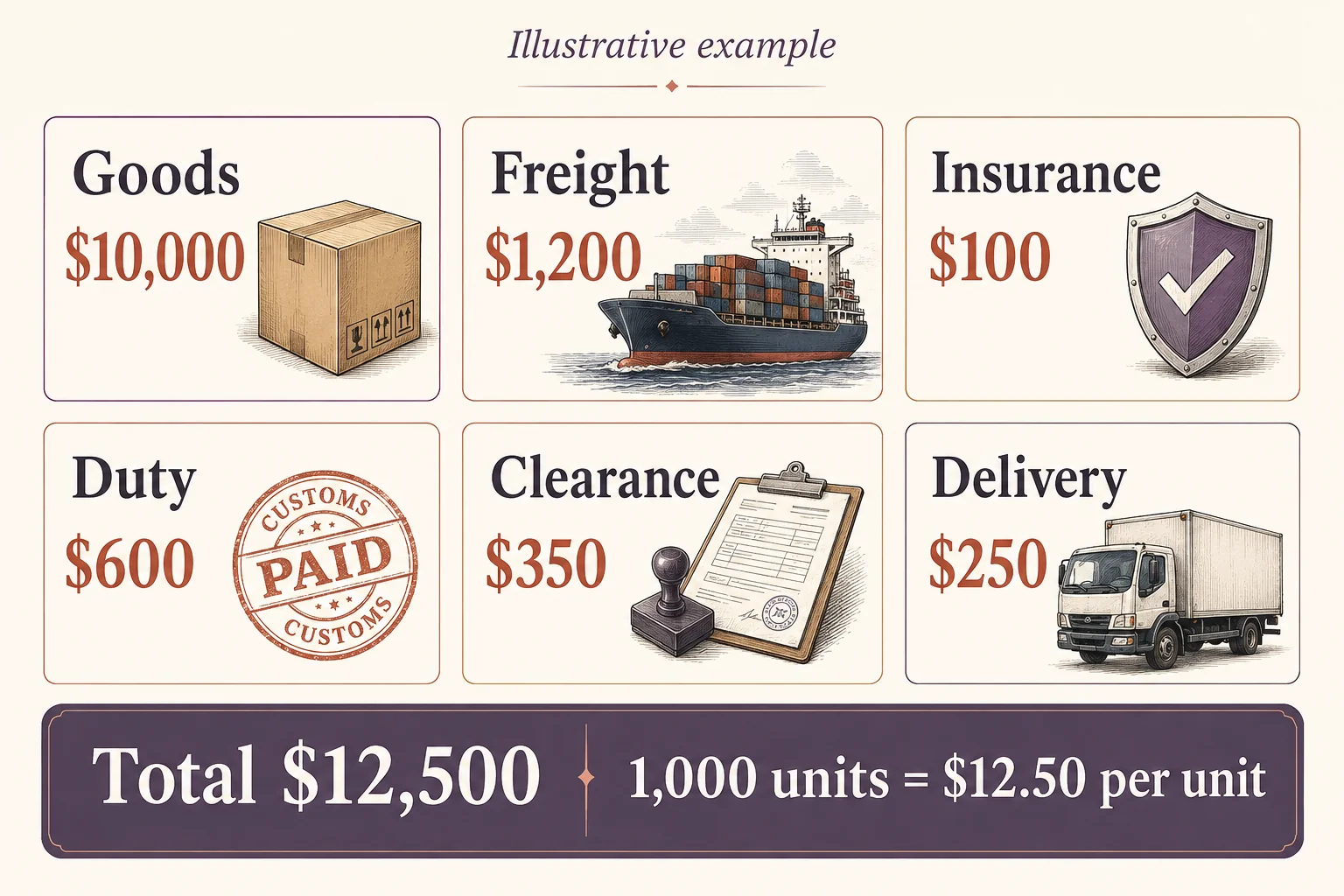
The full calculation is:
10,000 + 1,200 + 100 + 600 + 350 + 250 = $12,500
$12,500 ÷ 1,000 units = $12.50 per unit
($12.50 − $10.00) ÷ $10.00 × 100 = 25% above goods price
The 25% uplift belongs only to these assumptions. It is not a typical import markup you can copy into every order. A heavy product, unusual delivery location, or different duty treatment could produce a substantially different result.
Use a sensitivity check before approving the budget. If freight rises by $300 and everything else stays fixed, the total becomes $12,800 and unit cost becomes $12.80. If you provision a separate $200 reserve, the cash planning envelope becomes $13,000; the base landed estimate remains $12,800 until that reserve is actually spent on an included cost.
Avoid double-counting costs in supplier quotes
A bundle can hide both savings and missing charges. Read the named place, service scope, and exclusions together. An Incoterm is a starting point for the check, not a substitute for the quotation.
A CIF quotation
Under CIF, the seller arranges and pays for carriage and insurance to the named destination port. The buyer still needs to check import clearance and onward costs. CIF is for sea or inland waterway transport, and paying freight to the destination does not mean the seller carries transit risk all the way there. See ICC Academy’s CIF guidance.
Suppose the supplier instead quotes a $11,300 CIF bundle containing $10,000 goods, $1,200 freight, and $100 insurance. Add the outstanding $600 duty, $350 clearance, and $250 delivery: the total is still $12,500. Adding freight and insurance again would incorrectly raise it to $13,800.
A DDP quotation
DDP places import clearance and import duty responsibility on the seller. Delivery is to the named destination, with goods ready for unloading; unloading charges still require a contract check. See ICC Academy’s DAP and DDP explanation.
Start with the agreed DDP price and identify buyer-paid costs outside its scope. Do not automatically add another duty line. Ask who handles import documentation, which location is included, and whether the quote excludes appointments, unloading, or exceptional charges.
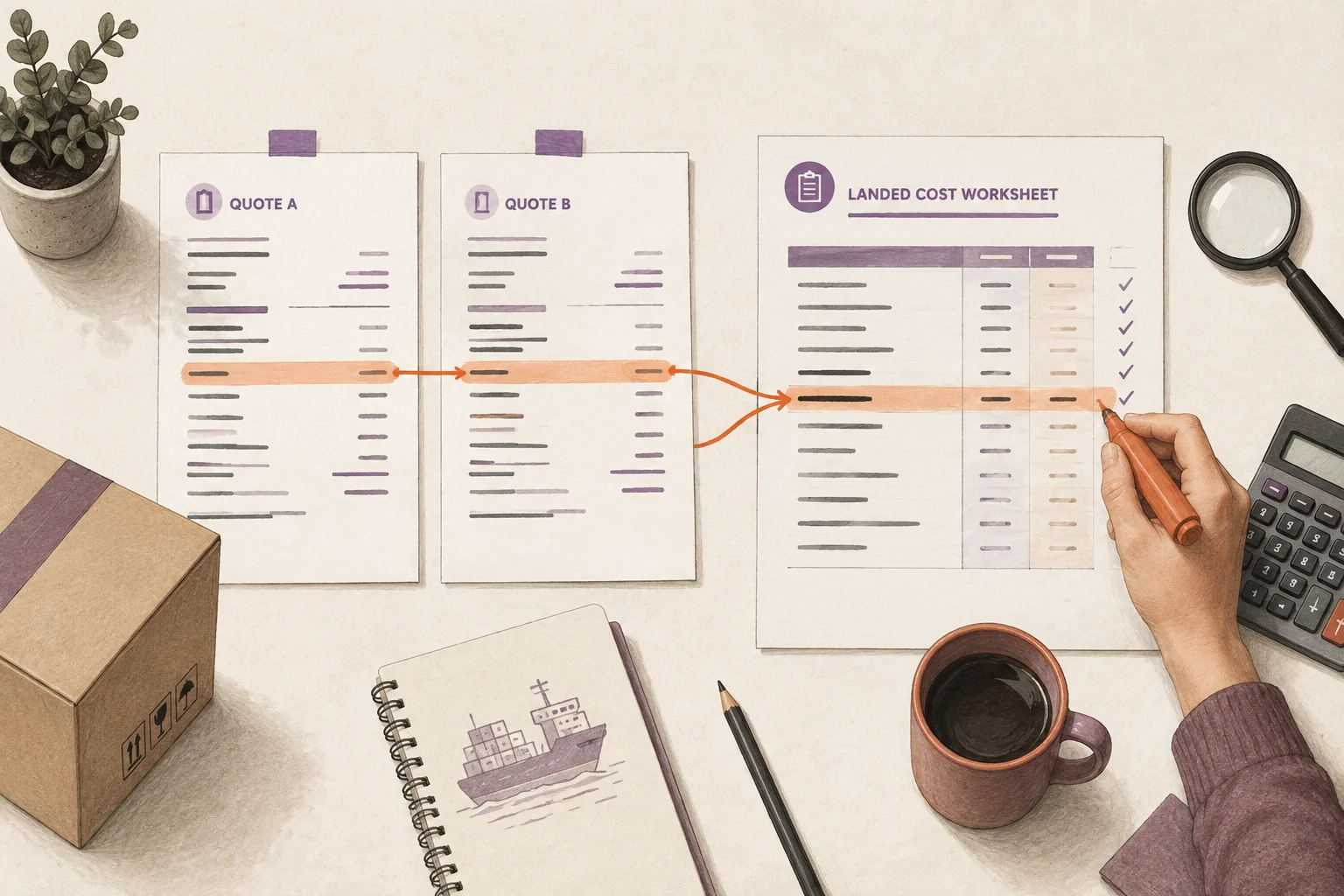
Keep the answer next to the amount: “included in supplier quote Q17” is actionable; “probably included” is not. If scope remains unclear, your result is provisional even when the spreadsheet produces a precise number.
Compare suppliers using the same warehouse endpoint
Consider another hypothetical comparison. Both offers cover 1,000 units of the same specification and packaging, delivered to the same warehouse within an acceptable time window.
| Comparison | Supplier A | Supplier B |
|---|---|---|
| Goods cost | $10,000 | $10,500 |
| All other costs to the same warehouse | $2,500 | $1,000 |
| Total landed cost | $12,500 | $11,500 |
| Cost per unit | $12.50 | $11.50 |
Supplier B’s goods cost $500 more, but its shipment costs $1,000 less overall. That result is valid only if both remaining-cost estimates are complete. Check why B’s transport or other charges are lower; a missing delivery leg is not a commercial advantage.
Compare the approved sample, payment terms, delivery commitment, and defect remedy alongside the total. If you need help coordinating offers, how a China sourcing agent works explains where supplier communication, samples, inspection, and freight coordination fit into the order.
How to calculate landed cost per unit for mixed products
Dividing the shipment by all units gives a blended average. It does not show a reliable SKU cost when products have different purchase values, sizes, weights, or duty treatment.
Assign directly attributable charges to the relevant SKU first. Then distribute shared charges using a documented basis that reflects how the charge arose. Oracle NetSuite documents allocation by weight, quantity, or value, including weight-based freight and value-based insurance examples.
For planning, choose the basis deliberately:
- Weight-based freight can follow each SKU’s share of the relevant shipment weight.
- Volume-driven freight can follow packed cubic volume when that reflects the quote.
- Value-based insurance can follow each SKU’s insured value.
- Uniform per-piece handling can follow quantity when units require comparable work.
- SKU-specific duty or testing should stay with the product that incurred it.
For example, two SKUs share $600 of weight-priced freight. SKU A contains 100 units weighing 200 kg altogether. SKU B contains 300 units weighing 100 kg altogether. The relevant total is 300 kg.
| Allocation | SKU A | SKU B |
|---|---|---|
| Share of weight | 200 ÷ 300 | 100 ÷ 300 |
| Allocated freight | $400 | $200 |
| Freight per unit | $4.00 | About $0.67 |
A quantity split would assign $1.50 freight to every unit and conceal the heavier SKU’s cost. Keep full precision in the worksheet and round displayed unit amounts at the end so allocated totals still reconcile to $600.
If you are combining suppliers, include consolidation pickup, handling, storage, and repacking. Our warehousing and consolidation service outlines those stages so the expected freight saving can be evaluated against the extra work.
Also distinguish received units from sellable units. If the earlier $12,500 order contains 1,000 received units but only 980 sellable units, its management cost per sellable unit is approximately $12.76 before credits or recoveries. Keep that loss visible; do not silently relabel it as higher freight cost. Confirm financial reporting treatment separately.
Landed cost worksheet and final checklist
Copy this table into a spreadsheet. Expand it with one row per charge and keep the original-currency amount alongside the reporting-currency figure. Do not total a column containing mixed currencies.
| Cost item | Original amount / currency | FX rate and date | Estimate in reporting currency | Actual in reporting currency | Included elsewhere? | Source / last checked |
|---|---|---|---|---|---|---|
| Goods and packaging | Pending | Pending | Pending | Pending | Confirm scope | Supplier quote |
| Preparation and origin costs | Pending | Pending | Pending | Pending | Quote reference | Service invoices |
| Freight | Pending | Pending | Pending | Pending | Quote reference | Forwarder |
| Insurance | Pending | Pending | Pending | Pending | Quote reference | Policy / invoice |
| Duty | Pending | Pending | Pending | Pending | Confirm payer | Broker / entry |
| Non-recoverable taxes | Pending | Pending | Pending | Pending | Confirm treatment | Tax evidence |
| Clearance and handling | Pending | Pending | Pending | Pending | Quote reference | Broker / agent |
| Delivery and receiving | Pending | Pending | Pending | Pending | Quote reference | Carrier / warehouse |
Below the table, record the total, quantity, unit cost, recoverable tax, contingency, and payment deadlines. If a fee is confirmed as included elsewhere, enter zero in the additional-cost column and reference the parent quote. If it is unknown, leave it pending and label the total incomplete.
Before approving the purchase, verify:
- Goods, packaging, quantity, and named warehouse match across all offers.
- Every transport leg has a provider, scope, and amount or an explicit open question.
- Bundled freight, insurance, and import charges are counted once.
- Duty and tax assumptions have a source, date, and responsible contact.
- Costs are converted into one reporting currency with a recorded rate.
- Shared costs use a consistent allocation method and quantities are clearly labeled.
- The estimate, recoverable taxes, and contingency are visible separately.
- Someone will reconcile actual invoices and receipt quantities after arrival.
For Amazon-bound goods, extend the endpoint to the required prep and receiving stage when comparing options. The China to Amazon FBA guide covers labels, cartons, and shipping handoffs that can create additional work.
You now have a buying number that can be traced back to its supporting documents. If you want help collecting comparable supplier and shipping information, send the product, quantity, packaging details, and destination. Those inputs let the sourcing desk identify which charges are known and which still need a written quote.
Information graphic
Frequently asked questions
What is the formula for total landed cost?
Total landed cost equals goods plus additional origin costs, freight, insurance, import duty, non-recoverable import taxes, clearance, handling, and delivery to the named destination. Add only amounts not already included in another quote.
How do I calculate landed cost per unit?
For identical goods, divide the total landed cost by the quantity received. A $12,500 shipment of 1,000 units costs $12.50 per unit. For mixed products, allocate shared charges to each SKU before dividing by that SKU's quantity.
Does a CIF quote include every landed cost?
No. CIF includes seller-arranged freight and insurance to the named destination port, but the buyer still needs to check import clearance, duty, destination handling, and warehouse delivery. Do not add the included freight and insurance again.
Should import VAT be included in landed cost?
Separate recoverable import VAT from non-recoverable taxes. Recovery depends on destination rules, business eligibility, and documentation. Track any upfront tax payment in the cash budget even when recovery is expected.
Is landed cost the same as the cost of selling a product?
No. This guide stops at the buyer's warehouse. Storage after receipt, customer fulfillment, marketplace commissions, advertising, returns, and financing may still affect profit and belong in a separate selling-cost model.
Sources
- CIF and CIP Incoterms 2020 explained: ICC Academy Accessed September 6, 2026.
- Incoterms 2020: DAP or DDP?: ICC Academy Accessed September 6, 2026.
- Duty: Cost Insurance and Freight: U.S. Customs and Border Protection Accessed September 6, 2026.
- Entering Landed Cost on a Transaction: Oracle NetSuite Accessed September 6, 2026.
- Check when you can account for import VAT on your VAT Return: HM Revenue & Customs Accessed September 6, 2026.