Direct answer
To source products from China, define the product and destination requirements first, send the same RFQ to several qualified suppliers, verify the legal counterparty, approve a physical sample, inspect the finished lot before final payment, and compare the full landed cost before choosing a shipping method.
Key takeaways
- Treat the written specification, not the marketplace listing, as the product you are buying.
- Compare quotes on the same quantity, packaging, Incoterm, lead time, and payment schedule.
- Keep an unpaid balance until the finished lot has passed the agreed inspection.
Sourcing from China is not one supplier search. It is a sequence of decisions that turns a product idea into an inspectable order. The sequence matters: buyers who negotiate price before defining the product usually spend the saved money on samples, rework, relabeling, or unexpected freight.
1. Define the product and the destination
Start with what the product must do and where it will be sold. A useful sourcing brief includes:
- Intended user and use case
- Material, dimensions, tolerances, color, finish, and performance
- Destination country and sales channel
- Target order quantity and expected reorder volume
- Unit packaging, master-carton limits, labels, and barcodes
- Required test reports, declarations, or factory documents
- Target delivery date and acceptable shipping modes
Do not copy a competitor listing and call it a specification. Photos do not define steel grade, wall thickness, battery cell, coating adhesion, carton strength, or the version of an app. If a field is unknown, mark it as an open question and require every supplier to answer it.
For regulated products, identify the destination requirements before asking for a final price. The importer remains responsible for admissibility and compliance in the destination market; a logo on a supplier certificate is not a substitute for checking the report, model number, laboratory, and standard.
2. Choose the right sourcing channel
Different channels solve different problems:
| Channel | Useful when | Main limitation |
|---|---|---|
| Alibaba or another export marketplace | You need English communication and a broad first shortlist | The listing may represent a factory, trader, or product the seller no longer makes |
| 1688 | You have Chinese-language support and want access to domestic suppliers | Many sellers do not handle export, foreign payment, or destination compliance |
| Trade fair or wholesale market | You need to compare physical samples quickly | A booth or market stall is a lead, not proof of manufacturing capacity |
| Referral or existing factory | You value a known working history | Capability in one category does not prove capability in another |
| Sourcing desk | You need local calls, payment, visits, consolidation, or inspection | Fees and scope must be agreed before the desk places an order |
The first objective is a shortlist, not a winner. Three to five comparable candidates are usually more useful than dozens of unanswered marketplace chats.
3. Send one RFQ to every candidate
Ask every supplier to quote the same specification and commercial assumptions. The RFQ should state the quantity breaks, packaging, sample cost, tooling, lead time, payment schedule, quote validity, and named Incoterm.
An EXW quote with loose cartons cannot be compared with an FOB quote that includes export packing. Normalize those differences before ranking suppliers. Use the wholesale RFQ template to make missing fields visible.
4. Verify the counterparty before paying
Collect the Chinese legal name, unified social credit code, business license, registered address, bank beneficiary, and the name of the entity issuing the invoice. Confirm whether the seller is the manufacturer, a trading company, or another intermediary. A trader is not automatically a problem; an undisclosed counterparty is.
Then check operational capability. Ask who owns the equipment, which steps are subcontracted, what similar products are running now, and how the supplier controls incoming materials and final inspection. For higher-risk orders, use a live workshop video or an on-site visit. The supplier verification guide provides a fuller checklist.
5. Use samples as a controlled approval
Approve the sample against the written specification, not against memory. Record measurements, materials, color references, firmware or artwork versions, packaging, and the date approved. Keep one signed reference with the buyer and, where practical, one with the inspector or sourcing desk.
A perfect sample does not prove production capacity. It proves that one unit can be made. Before bulk production, confirm which materials, molds, components, and subcontractors will be used for the lot.
6. Put payment behind evidence
A common first-order structure uses a deposit to start production and a balance after agreed evidence. The exact percentages depend on the product and negotiating position; the important part is the trigger.
Write down:
- What starts production
- What counts as an approved sample
- When the completion date is measured
- Which inspection standard and defect limits apply
- What happens after a failed inspection
- Which documents are required before shipment
Avoid sending payment to a personal account or a beneficiary that does not match the contracting entity unless the relationship and reason have been independently verified and documented.
7. Inspect before the leverage disappears
Production follow-up should confirm materials and schedule before the order is fully packed. For finished goods, inspect while the balance or shipping authorization is still under buyer control. The report should identify the lot, sample size, measurements, function checks, defects, packaging, and labels. A comment such as “looks good” is not an inspection result.
Use pre-shipment inspection in China for the sampling and evidence workflow. If the lot fails, agree on rework and re-inspection before release.
8. Compare landed cost, not factory price
The commercial decision is the cost of a compliant unit at the destination. Include:
goods + tooling + inspection + export packing
+ origin charges + freight + insurance
+ duty/tax estimate + destination charges
+ local delivery and marketplace prep
Name the Incoterm and location on every freight quote. Incoterms allocate tasks, costs, and risk between buyer and seller, but they do not determine product compliance, title transfer, or every destination charge. Use the landed-cost calculator before choosing between suppliers or shipping modes.
Follow the step-by-step landed cost calculation guide to check quote overlaps, calculate warehouse unit cost, and record estimated versus actual charges.
A sensible first-order gate
Before authorizing production, you should be able to answer five questions:
- Which legal entity receives the money?
- Which document defines the product?
- Which physical sample was approved?
- Which evidence releases the balance?
- Who owns customs entry and delivery at destination?
If one answer is missing, the order is not ready. Wholesale Sourced can handle the China-side search, comparison, receiving, inspection, consolidation, and shipping coordination through the product sourcing service; the buyer retains the product and acceptance decisions.
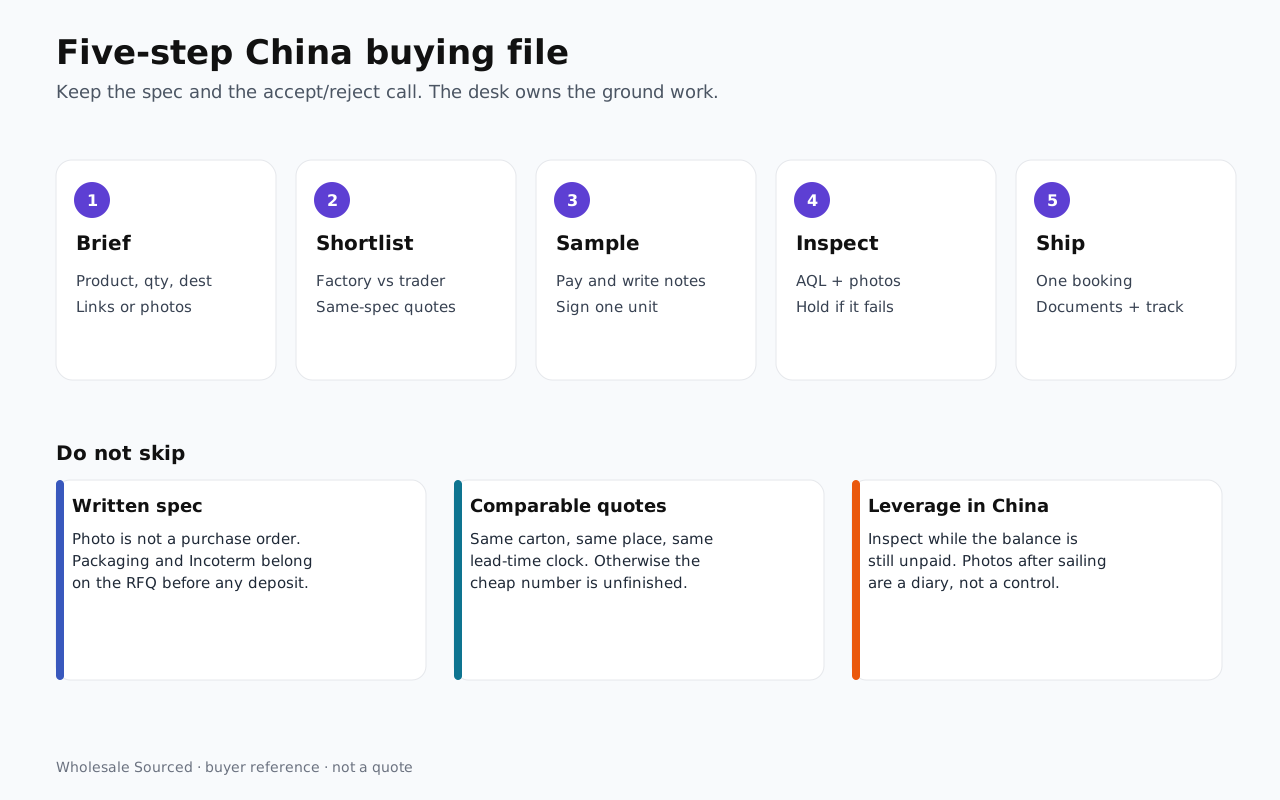
Information graphic
Frequently asked questions
What information do I need before contacting Chinese suppliers?
Prepare the intended use, destination country, materials, dimensions, target quantity, packaging, required tests, delivery date, and any reference sample or drawing. Unknowns should be listed as questions instead of silently left to the supplier.
Should a first order use the supplier with the lowest unit price?
Not automatically. Compare the legal entity, sample result, tooling, packaging, Incoterm, payment triggers, defect remedy, freight assumptions, and duty exposure. A lower unit price can produce a higher landed cost or more quality risk.
When should I use a sourcing agent?
Use one when supplier communication, local payment, sample collection, factory visits, consolidation, or inspection would otherwise have no owner in China. The buyer should still approve the specification, sample, budget, and accept-or-reject decision.
Sources
- Incoterms 2020: International Chamber of Commerce Accessed August 23, 2026.
- Basic Importing and Exporting: U.S. Customs and Border Protection Accessed August 23, 2026.