Direct answer
Verify a Chinese supplier by confirming the Chinese legal name and unified social credit code in the official company registry, matching that entity to the contract, invoice, and bank beneficiary, checking whether the seller is a factory or trader, validating relevant certificates with their issuer, and testing capability through a controlled sample or on-site review before a large deposit.
Key takeaways
- The license, contract, invoice, company chop, and payment beneficiary should describe one explainable counterparty.
- A trading company can be legitimate; hidden identity, unexplained account changes, and unverifiable capacity are the real risks.
- Verification is a snapshot, so repeat key checks when the beneficiary, factory, product category, or order size changes.
Supplier verification answers three different questions: does the company legally exist, does the person asking for money represent that company, and can the operation make or supply the product you are ordering? A business license answers only the first part.
1. Ask for the Chinese legal identity
Request a clear copy of the current business license and capture these fields in your file:
- Chinese legal company name
- Unified social credit code
- Legal representative
- Registered address
- Registration status and establishment date
- Registered capital and business term
- Business scope
Search the Chinese name or unified social credit code in the National Enterprise Credit Information Publicity System. Romanized English names are marketing labels and are not unique enough for a reliable registry search.
The registry may show administrative penalties, abnormal-operation listings, equity pledges, or changes. A change is not automatically disqualifying, but it should be explained when it affects the address, ownership, business scope, or person signing the order.
2. Make the transaction chain match
Create a one-page counterparty table before paying:
| Document or action | Name that should be checked |
|---|---|
| Business license | Registered Chinese legal entity |
| Quotation and purchase contract | Seller responsible for the goods |
| Company chop or signature | Authorized representative of that seller |
| Commercial invoice | Entity invoicing the transaction |
| Bank beneficiary | Entity receiving the buyer’s money |
| Export documents | Exporter or declared trading party |
These names are not always identical in a legitimate transaction. A mainland factory may use a related export company or Hong Kong entity. The requirement is an independently verified and documented relationship, not forced uniformity.
Treat a beneficiary change as a new verification event. Confirm it through a known phone number or existing contact channel, not by replying to the same email that announced the new account. Hold payment when the instruction arrives only as an image, names a personal account, or appears as a last-minute finance update.
3. Identify the supplier’s actual role
Factory, trading company, distributor, and market wholesaler are different operating models. They are not automatic quality grades.
A factory should be able to explain:
- Which processes happen at its address
- Which machines, lines, molds, or fixtures it controls
- Which materials and operations are subcontracted
- Normal capacity and current production load
- Incoming-material, in-process, and final checks
- How nonconforming material is segregated and reworked
A trader may be the better counterparty for mixed SKUs, low quantities, or categories spread across several factories. The risk appears when a seller claims factory control it does not have or refuses to identify where critical work is performed.
4. Verify the place and production flow
For a low-risk trial, a scheduled live video can confirm the signboard, street or industrial park, workshop, warehouse, and current production. Ask the camera operator to move from incoming material through production, QC, packing, and finished-goods storage.
For tooling, regulated products, a large deposit, or an unfamiliar process, use an on-site visit or factory audit. Record:
- Address and company sign
- Production and warehouse areas
- Equipment labels and condition
- Current products running on the line
- Quality records and measuring equipment
- Subcontracted operations
- Capacity constraints and maintenance
- Photos tied to the date and location
A showroom proves access to samples. It does not prove ownership of a production line.
5. Validate certificates and test reports
Do not evaluate a compliance file from the logo alone. Check:
- Issuing body or laboratory
- Report or certificate number
- Applicant and manufacturer names
- Exact model numbers and variants
- Standard and edition
- Issue and expiry dates
- Product photos and technical description
Use the issuer’s verification service or contact details obtained independently from the issuer. Confirm that the report covers the product you will import; a related model or different battery, radio module, material, or power supply may not be covered.
The supplier provides evidence, but the importer must determine which rules apply in the destination country. Verification of a document is not the same as a legal compliance opinion.
6. Test capability with a controlled sample
Paying for a sample is a small operational test. Watch whether the supplier:
- Confirms open specification questions
- Uses the agreed material and component
- Labels the sample and revision clearly
- Meets the promised sample date
- Explains deviations before shipping
- Provides packaging and measurement evidence
An approved sample proves that one unit can be made. Before bulk production, document the materials, artwork, component models, and process that must remain the same.
7. Review commercial behavior
Verification includes how the supplier handles ordinary questions. Pause when you see several of these together:
- Refusal to provide the Chinese legal name
- Pressure to pay before the specification is settled
- Bank beneficiary changes without a verifiable explanation
- Certificates cropped to hide the model or applicant
- Stock factory photos presented as a live workshop
- Quote far below comparable suppliers without a material explanation
- Contract terms that omit rework, inspection, or delivery responsibility
- Evasive answers about subcontracting or the physical address
One slow answer is not fraud. A pattern of identity, capability, and payment inconsistencies is the reason to stop.
What a useful verification report contains
The final output should separate facts from conclusions. Include the registry record, counterparty map, payment beneficiary, supplier role, facility evidence, capability gaps, certificate checks, sample result, and a clear recommendation: proceed, proceed with controls, hold for evidence, or walk away.
Verification reduces uncertainty; it does not guarantee future quality or delivery. Repeat the critical checks when the account changes, the order moves to another factory, the product category changes, or the commercial exposure becomes materially larger.
Wholesale Sourced can collect the license, cross-check the counterparty, visit or video the operating site, and document capability through the supplier verification service. Follow it with an approved sample and pre-shipment inspection before the first bulk shipment.
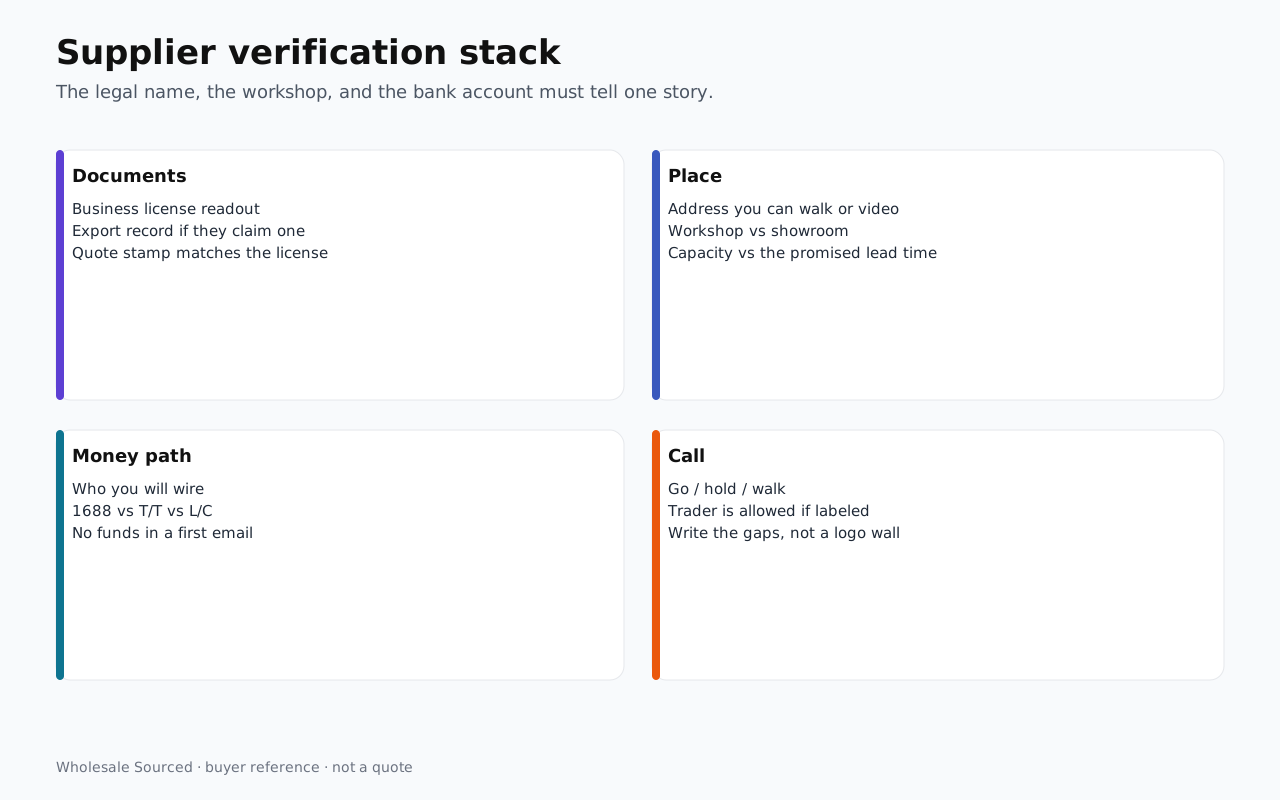
Information graphic
Frequently asked questions
Can I verify a Chinese supplier using only an Alibaba profile?
No. A marketplace profile is useful evidence but should not replace the Chinese legal name, official registration record, matching payment beneficiary, product-specific capability checks, and independent confirmation of important certificates or test reports.
How do I know whether the supplier is a factory or trading company?
Review the registered business scope, factory address, equipment and production flow, employee roles, subcontracted steps, and current production records. A video call or visit should follow materials through the workshop, not stop at a showroom.
Is a Hong Kong bank account always a red flag?
No, but it must be explained and documented. Confirm the relationship between the mainland supplier and the receiving entity, make sure the contracting and invoicing chain is consistent, and independently verify any beneficiary change before sending money.
Sources
- National Enterprise Credit Information Publicity System: State Administration for Market Regulation Accessed August 23, 2026.