Custom Packaging Sourcing in China Explained
How custom packaging is sourced in China, including dielines, print proofs, inserts, kits, packed samples, and options when a first run is smaller than the MOQ.
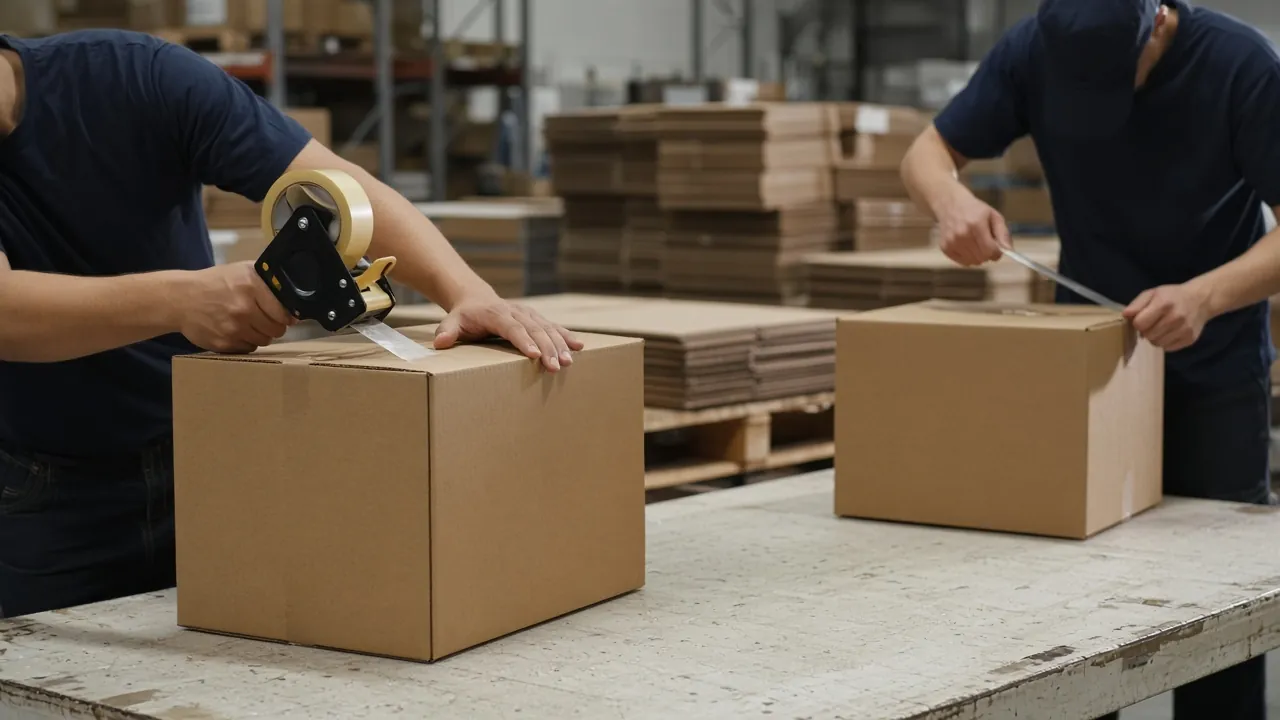
Packaging is part of the sellable unit. A product can work correctly and still be unusable if the insert has the wrong language, the barcode points to another SKU, or the carton does not protect the item in transit.
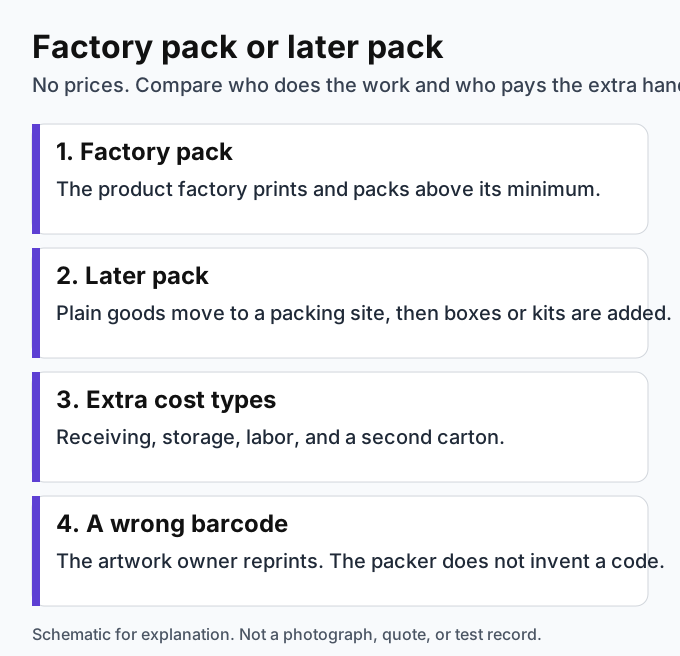
Factory pack or a later pack
Scroll horizontally to see all columns →
| Packed at the product factory | Packed later at another site | |
|---|---|---|
| Who packs | The factory that makes the goods | A packaging supplier or consolidation warehouse, after plain goods arrive |
| What you approve first | Dieline, print proof, and a packed sample | The same proofs, plus a written packing instruction for the second site |
| Cost types to ask about | The factory’s packaging minimum | Receiving, storage, labor, and a second carton |
| A wrong barcode | Reprint against the approved artwork version | The packer applies your file. It does not invent a code |
Copy a sign-off line into the order file: dieline version, barcode value, flat-proof result, packed-sample result, and the date you accepted each one.
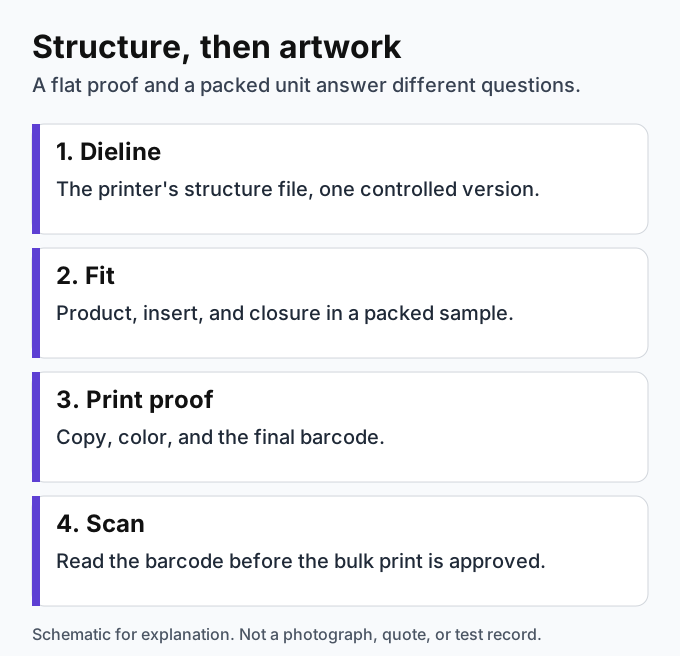
Separate structure from artwork
Start with the packaging job. Retail display, Amazon fulfillment, gift presentation, and basic export protection place different demands on the box. Record the product dimensions, weight, accessories, packing orientation, and destination before choosing a structure.
Artwork comes next. Work from the printer’s dieline and keep one controlled version. Check copy, barcode, logo position, color references, finish, and any required marks on a proof. A screenshot in a chat thread is not a production approval.
Decide where the packing happens
Some factories will only print custom packaging above their normal minimum. A separate packaging supplier or consolidation warehouse may suit a smaller first run. In that arrangement, the product factory ships plain goods to the warehouse, and the warehouse adds boxes, inserts, labels, or kits under a written packing instruction.
This extra handoff adds receiving, storage, labor, and repacking cost. Compare it with the factory-run option before deciding. The warehousing and consolidation guide explains how inbound goods are counted and held before kitting.
Approve a packed sample
Review the product inside the finished package, not just a flat print proof. Check fit, movement, scuff points, accessory placement, opening sequence, and master-carton arrangement. Keep photographs and the approved packed sample with the order file.
During bulk inspection, verify both the product and the package. The quality control checklist covers labels, cartons, and photo evidence. For a broader branded product program, see private label and OEM.
What a provider should deliver
- A dieline and print proof
- A kit contents list
- A decision on whether packing happens at the factory or a separate packing site
- Packed sample photos
How the work usually runs
- Brief. Retail, Amazon, or gift use changes the carton more than the product does.
- Proof. Print and structure are approved before a bulk paper order.
- Pilot. When the packaging MOQ is the blocker, a short run can be packed by a third-party packing site after the goods arrive.
- Bulk. Export packs are checked with the product inspection.
Frequently asked questions
How do I avoid a barcode printed in the wrong version?
Approve a printed proof that shows the final barcode, and scan it before the bulk print. Record the artwork version on the proof and in the order.
Is a flat print sample enough to approve packaging?
Not always. A flat sample shows color and print; a packed sample shows whether the product, inserts, and closure fit. Ask for a packed sample when the fit matters.
What if the packaging minimum is larger than the first order?
Ask which supplier sets that minimum: the box maker, the printer, or the product factory. A later pack at a third-party site can cover a short first run, and it adds receiving, storage, and labor that the factory-pack price does not include.