
An unnamed fee base, or a percent that leaves inspection and freight outside the remuneration, costs the gap between two quotes on the same order.
Compare China sourcing agent fees by the Civil Code contract the quote names, the remuneration it writes down, and the percent, expense, and lead-time cells it leaves blank.
This check sits with the other sourcing guides.
China sourcing agent fees are the remuneration the written contract sets, and the English Civil Code PDF prints no percent for that remuneration. The PDF, fetched 18 October 2026, was adopted on 28 May 2020 and comes into force on 1 January 2021 under Article 1260. Article 919 defines an entrustment contract as the principal and the agent agreeing that the agent handles the principal’s matters. Article 928 requires payment in accordance with the agreement once the matter is accomplished. Article 921 says the principal reimburses necessary expenses with interest, and the PDF prints no rate. Brokerage under Article 951 and intermediary services under Article 961 use different expense defaults, still with no percent. The ICC page fetched the same day lists 11 rules and places each rule’s costs at article A9/B9. The customs consignor-filing guide prints 不收费 and a 3-working-day limit for that filing.
Scroll horizontally to see all columns →
| Input or item | Typical value or source | Why it matters |
|---|---|---|
| Entrustment | Article 919. Remuneration follows the agreement once the matter is accomplished (Article 928). | The percent is whatever the agreement prints. This PDF prints none. |
| Entrustment expenses | The principal pays expenses in advance. Necessary expenses the agent has paid are reimbursed with interest (Article 921). | Expenses are a second line. The interest rate cell stays empty. |
| Brokerage | The broker trades in the broker’s own name, and the client pays remuneration (Article 951). The broker bears expenses unless the parties agree otherwise (Article 952). | A trading quote is a different expense default from entrustment. |
| Price difference | If the broker sells higher or buys lower, an increase in remuneration follows the agreement. If that agreement is missing or unclear, and Article 510 does not settle it, the benefit belongs to the client (Article 955). | A better buying price stays with the client until the agreement moves it. |
| Intermediary | The middleman reports an opportunity to contract, or provides services for concluding one, and the client pays remuneration (Article 961). Payment follows the agreement when the middleman contributes to conclusion (Article 963). | A search that produces no contract is Article 964, below. |
| Equal share | The parties to the facilitated contract equally share the disbursement of that remuneration (Article 963). | The article prints the word equally. It prints no amount and no percent. |
| Incoterms costs | 11 rules. Costs for a given rule appear at article A9/B9. ICC page, fetched 18 October 2026. | Delivery costs sit on the sale contract. |
| Consignor filing fee | 不收费. The yes/no field reads 否. | This is the filing charge the guide prints. |
| Consignor filing time | 3 working days promised, and 3 working days statutory. The guide prints 3个工作日 for both. | This is the filing clock. |
| Agent percent | ||
| Interest rate | Article 921 says with interest and prints no rate. | |
| Production lead time |
Which contract sets a China sourcing agent fee?
Name the chapter before you read the percent. The PDF uses three different contracts, and each one sets remuneration and expenses in its own articles.
Scroll horizontally to see all columns →
| Contract | Fee the PDF prints | Percent the PDF prints | Lead time the PDF prints | Expense default | Dominant failure mode | Prevention |
|---|---|---|---|---|---|---|
| Entrustment, Articles 919 to 936 | Principal pays expenses in advance and reimburses necessary expenses with interest (Article 921). | Two percents get ranked while the expense lines differ. | Write the chapter and the expense line, and leave a missing percent blank. | |||
| Brokerage, Articles 951 to 960 | The broker bears the expenses unless otherwise agreed (Article 952). | A lower buying price is treated as the broker’s fee. | The extra benefit belongs to the client unless the agreement increases the remuneration or Article 510 settles it (Article 955). | |||
| Intermediary, Articles 961 to 966 | The middleman bears the expenses of the intermediary activities (Article 963). | Remuneration is treated as earned when no contract was concluded. | Article 963 pays when the middleman contributes to conclusion. Article 964 bars a remuneration claim when that contribution is missing, and a necessary-expense payment then needs the agreement. |
Article 920 allows a specific entrustment of one or several matters, or a general entrustment. The scope line is what the percent later multiplies, when the agreement uses a rate. Article 922 requires the agent to follow the principal’s instructions. A change needs the principal’s consent, except an emergency in which the principal’s consent is hard to get. The agent then handles the matter and reports it promptly.
Article 927 requires the agent to hand the principal any property acquired while handling the matter. Article 924 requires a report on the matter while it is open, and a report on the result when the contract ends.
Article 962 bars remuneration, and imposes compensation, when a middleman intentionally conceals an important fact about concluding the contract or gives untrue information. That is a fee rule: the concealment is the failure, and the unpaid remuneration is the consequence the article states.
The person who handles the matter, the factory that makes the goods, and the forwarder who books the freight are different parties. The split is the subject of how a China sourcing agent works.
Takeaway: Write entrustment, brokerage, or intermediary on the quote before you compare any percent.
What do you record when the rate cell is blank?
Copy the remuneration only from the agreement. Article 928 ties the payment to that agreement after the agent accomplishes the matter. If the entrustment is rescinded, or the matter cannot be accomplished for a cause the article does not attribute to the agent, the principal pays the corresponding remuneration unless the parties agree otherwise. The PDF prints no corresponding amount.
Where the parties have not agreed on price or remuneration, or the agreement is unclear, Article 510 sends them to a supplementary agreement, then to the relevant clauses of the contract or the course of dealing. Where it is still unclear, Article 511(2) uses the market price at the place of performance at the time the contract is concluded, or a government-set or government-guided price where the law requires one. The PDF prints no market price, no government price, and no percent for a sourcing agent.
Article 511(4) covers an unclear period of performance. It allows the debtor to perform at any time, and it allows the creditor to request performance at any time after giving the necessary time for preparation. The article prints no day count. The production lead-time cell stays blank.
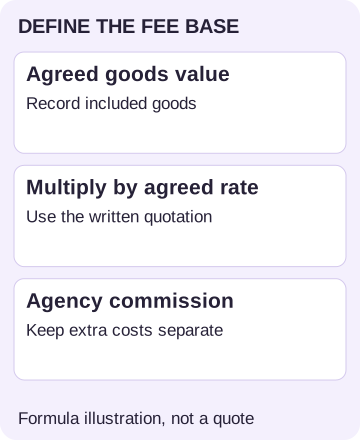
Formula, for an agreement that uses a rate:
Remuneration = agreed base × agreed rate
Both inputs are blank in the PDF, so the product is blank. A fixed fee has no rate. Record the fixed fee only when the agreement prints it.
Rule of thumb. If blank percent cells exceed 0, do not rank the fee totals.
Worked arithmetic, using the ICC page’s printed count of rules, not a quotation. The page lists 11 rules. Commission percents printed on that page = 0. Blank commission cells = 11 - 0 = 11. Each of those rules still has its own cost list at A9/B9. None of those lists is an agent percent.
The same arithmetic applies to the three service chapters in the table above. Chapters that print a percent = 0. The three percent cells stay empty.
Takeaway: A blank percent stays blank. Article 511(2) points at a market price and does not print one.
Which expenses sit outside the remuneration?
Article 921, Article 952, and Article 963 do not use the same expense default. Read the chapter you named, then list the lines the quote still has to price.
Under entrustment, the principal pays the expenses of the matter in advance. If the agent has paid necessary expenses, the principal reimburses those expenses with interest. The PDF does not list inspection, storage, sample freight, or a booking fee as the necessary set, and it does not print the interest rate. Those names belong on the quote. An omitted name stays off the remuneration.
Under brokerage, the broker bears the expenses of handling the matter unless the parties agree otherwise. A brokerage quote that is silent on expenses has already placed them on the broker, which is Article 952. The amount of those expenses is still unprinted.
Under an intermediary contract, the middleman bears the expenses of the intermediary activities (Article 963). If the middleman does not facilitate a contract, Article 964 bars a remuneration claim. A payment for necessary expenses in that case follows the agreement. Silence is an empty expense cell, which you do not fill with zero unless a document prints zero.
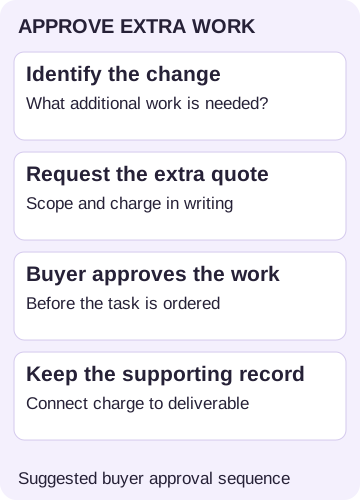
Article 923 allows a sub-agent when the principal consents or later ratifies the choice. Without that consent, the agent answers for the sub-agent’s acts, aside from an emergency step taken to protect the principal. A second company’s invoice needs that consent on the file before you treat it as part of the agreed remuneration.
Takeaway: Match the expense default to the chapter, and leave every unprinted amount blank.
Where do delivery costs and the customs filing charge go?
The ICC page describes a clear allocation of cost, risk, and obligations, and it says all costs for a given Incoterms rule now appear at article A9/B9 of that rule. The page also says those costs still appear in the articles that deal with each part of the sale. Fetched 18 October 2026, the page prints 11 rules and prints no freight amount, no agent percent, and no production lead time.
Put the named rule and the named place on the comparison. A freight line for a different place answers a different sale. Record the delivery amounts on the landed-cost worksheet, and enter only figures a quote actually prints in the landed cost calculator.
The customs guide for 进出口货物收发货人备案, fetched the same day, prints a different charge:
Scroll horizontally to see all columns →
| Item on that guide | Fee | Percent | Time |
|---|---|---|---|
| 进出口货物收发货人备案 | 不收费 (是否收费: 否) | 3 working days promised and 3 working days statutory | |
| Agent remuneration | |||
| Production lead time |
The fee cell is filled because the guide’s 收费标准 reads 不收费 and the yes/no field reads 否. The time cell is filled because both 承诺办结时限 and 法定办结时限 read 3个工作日. The guide also prints a visit count for that filing: online handling is 0 visits, or 1 visit at the window. It prints the filing’s validity as 长期有效. Those figures stay on the filing row.
The agent remuneration row stays empty. Copying 不收费 into that row would treat a filing charge as an agent percent. The production lead-time row stays empty because the guide prints no factory days.
The guide quotes Customs Law Article 11, including the sentence 报关企业和报关人员不得非法代理他人报关. That sentence sits in the legal basis for this filing, and it is about customs declaration. It does not print a sourcing commission.
An inspection you want before release is its own line. What the report has to show is covered in pre-shipment inspection in China. If the fee text omits that inspection, it joins the unpriced count in the next section.
Takeaway: A9/B9 holds the sale’s costs. The filing guide’s 不收费 and 3 working days hold the filing. The agent percent is a third row, and it is empty on both pages.
How do you compare two fee quotes?
Use one product specification, one quantity, and one named delivery rule for both quotes. Then copy only what each quote prints.
Scroll horizontally to see all columns →
| Field | Quote A | Quote B | If the cell is blank |
|---|---|---|---|
| Contract chapter | Name entrustment, brokerage, or intermediary before any ranking. | ||
| Remuneration base | Leave the product of base and rate blank. | ||
| Percent | Leave it blank. | ||
| Included tasks | Count each omitted task as unpriced. | ||
| Expense amount | Apply the chapter’s default as a label, and leave the amount blank. | ||
| Lead time | Leave it blank. | ||
| Incoterm and named place | Keep freight off the fee total. |
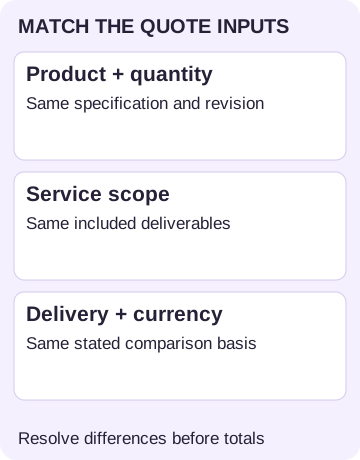
Unpriced lines = brief lines − included lines
Rule of thumb. If unpriced lines exceed 0, stop the ranking.
Worked arithmetic, with assumed counts, not a quoted fee. The brief names 5 lines: supplier follow-up, sample coordination, inspection, storage past the period the quote writes down, and freight booking. The fee text marks 2 of them as included, follow-up and sample coordination. Unpriced lines = 5 − 2 = 3. The 5 and the 2 are assumed counts for this arithmetic. They are not a market rate. The 3 cells stay blank. A blank is an empty cell. Zero is the word a document prints, the way the filing guide prints 不收费.
The hidden cost of ranking a percent first is those 3 lines, still unpriced. This page assigns them no dollar figure. Write the five lines, or your own list, on the wholesale RFQ template before a candidate prices them.
The company that receives the fee is a separate check from the percent. Match the contracting name to the register and the bank beneficiary with how to choose a China sourcing agent. For a mainland company, follow how to verify a Chinese supplier for the license and the code.
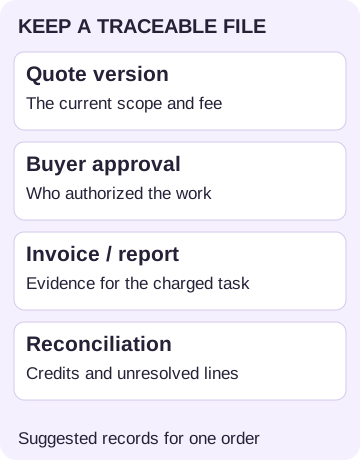
Keep the quote version, the approval of any changed instruction, the invoice or report for the charged task, and the reconciliation on the same order. Article 929 sets a compensation standard for loss caused by the agent’s fault under a non-gratuitous entrustment, and a narrower standard (intentional act or gross negligence) under a gratuitous one. The PDF prints no dollar threshold that turns one into the other. The agreement has to say which contract it is.
Takeaway: Rank quotes only after every percent cell is either printed or still visibly blank, and the unpriced count is zero.
When does this fee sheet stop?
The three chapters govern entrustment, brokerage, and intermediary contracts in the Civil Code PDF. A sale’s delivery costs follow the Incoterms rule named in that sale, at A9/B9. The consignor filing follows the customs guide, including 不收费, the 3-working-day limits, and 长期有效 for that filing.
Article 511(2) is a gap filler for an unclear remuneration. It is not a rate you can copy into the percent cell. A lawyer reviews the contract you sign. The buying sequence around a fee that has survived this sheet is how to source products from China.
Takeaway: Keep each printed figure on the row the source page actually filled.
Method and sources
Checked 18 October 2026 against the English Civil Code PDF linked from the State Council English page, the ICC Incoterms 2020 page, and the customs guide for 进出口货物收发货人备案. The PDF cover states adoption on 28 May 2020. Article 1260 states that the Code comes into force on 1 January 2021. 不收费, 否, 3个工作日 on both completion limits, the visit line 网上办理0次或窗口办理1次, and 长期有效 are printed on the customs guide. The ICC page prints 11 rules and article A9/B9. Blank commission cells = 11 − 0 = 11 is arithmetic on that page. Unpriced lines = 5 − 2 = 3 uses assumed counts and is labeled arithmetic. It is not a quotation. The local library had no text of these three documents. No new search-results page was purchased.
Sources
- Civil Code of the People's Republic of China (English PDF) : english.www.gov.cn, source noted as npc.gov.cn Accessed October 18, 2026.
- Civil Code of the People's Republic of China (landing page) : english.www.gov.cn Accessed October 18, 2026.
- Incoterms 2020 : International Chamber of Commerce Accessed October 18, 2026.
- 进出口货物收发货人备案办事指南 : General Administration of Customs Accessed October 18, 2026.