Landed Cost Calculator
Counting the same freight twice makes the landed cost wrong. Calculate from amounts you confirm, and keep the customs value as its own duty base.
A landed cost calculator on this page adds the goods amount once. Freight, insurance, local fees, and percentage duty are added only when you leave them unmarked. Estimated duty is the customs value you enter, multiplied by the rate you enter, divided by 100, then rounded to cents. For merchandise sold for exportation to the United States and appraised on transaction value, 19 USC 1401a(b)(4)(A) defines the price actually paid or payable as exclusive of transportation, insurance, and related services incident to the international shipment from the country of exportation to the place of importation in the United States. CBP makes the final duty-rate determination. This page publishes no price, no freight amount, and no duty rate. Leave an unconfirmed amount blank. Keep the sheet with the other buyer resources.
Scroll horizontally to see all columns →
| Input or item | Typical value or source | Why it matters |
|---|---|---|
| Goods amount | The seller's amount for this shipment, in USD. This page has no preset. | Starting cash. A charge already inside it is not added again. |
| Customs value | A duty base you confirmed. For a US transaction-value appraisal, 19 USC 1401a(b)(4)(A) excludes international transportation, insurance, and related services from the price actually paid or payable. | Duty uses this base. The base is not added again as a cost. |
| Duty rate | The ad valorem rate you confirmed for the classification and destination. CBP makes the final determination of the correct rate of duty. Checked on the CBP duty-rate page, last modified 25 November 2024. | The sheet multiplies this rate by the customs value and divides by 100. |
| Freight, insurance, local fees | An amount from your documents, or a tick that the goods amount already contains it. | A tick adds zero for that line. A blank field is unfinished. |
| Units | The unit count on this shipment. | Per unit is the total divided by this count. |
Enter each amount on its own line
The sheet has one goods amount and four additions. An addition marked already inside the goods amount stays in the record and contributes zero. An unmarked addition contributes the amount you type. Estimated duty is rounded to cents before it is added. The total is rounded to cents. The per-unit line is shown in cents.
Scroll horizontally to see all columns →
| Line | What you type | Dominant failure mode | Prevention |
|---|---|---|---|
| Goods amount | Seller's amount for this shipment, in USD | The same freight or insurance typed again on its own line | Tick the line when the goods amount already contains it |
| Customs value | The duty base you confirmed | Pasting the goods amount into this field when international freight and insurance sit inside that amount | For a US transaction-value entry, keep the 19 USC 1401a(b)(4)(A) exclusion out of this field |
| Duty rate | The ad valorem rate you confirmed | A specific or mixed duty forced through a percentage | Stop. A specific duty does not use customs value |
| Freight, insurance, local fees | The amount, or a tick | A blank read as free | Leave the field blank until the document shows the amount. Type 0 only when the document shows zero |
| Units | Units in this shipment | Dividing by a count the packing list does not show | Use the count for this shipment |
Estimate landed cost
Money fields are USD. Convert any other currency on one recorded basis before you type. Leave a field blank while the amount is still unconfirmed.

Keep customs value off the cost stack
19 USC 1401a(b)(1) defines transaction value as the price actually paid or payable for the merchandise when sold for exportation to the United States, plus five additions: packing costs incurred by the buyer, any selling commission incurred by the buyer, the apportioned value of any assist, any royalty or license fee the buyer must pay as a condition of the sale for exportation to the United States, and the proceeds of any subsequent resale, disposal, or use that accrue to the seller. Those additions are made only to the extent each amount is not already in the price and is based on sufficient information. If sufficient information is missing for any of them, the statute treats transaction value as one that cannot be determined.
19 USC 1401a(b)(4)(A) then defines the price actually paid or payable as the total payment, direct or indirect, exclusive of costs, charges, or expenses for transportation, insurance, and related services incident to the international shipment from the country of exportation to the place of importation in the United States. Example 4 in 19 CFR 152.103 states that transaction value excludes C.I.F. charges. 19 CFR 152.103(a)(5)(i) says foreign inland freight and other charges for services incident to the international shipment are not added when the price does not include them. When the price does include foreign inland freight, 19 CFR 152.103(a)(5)(ii) keeps that charge in the transaction value to the extent it is included in the price. The same paragraph allows those charges to be treated as incident to the international shipment when they are identified separately and they occur after the merchandise has been sold for export to the United States and placed with a carrier for through shipment to the United States.
19 USC 1401a(b)(3) also keeps two groups out of transaction value when they are identified separately: reasonable charges for construction, erection, assembly, maintenance, or technical assistance after importation, and transportation after importation; and customs duties and other Federal taxes currently payable by reason of importation, plus any Federal excise tax on or measured by the value for which US vendors are ordinarily liable. The landed-cost formula is where warehouse landed cost and this duty base part ways. Type a customs value you have already confirmed. This sheet does not build that base, and it does not add the base again as a cost.
Tick a cost only when the goods amount already contains it
Incoterms 2020 is a set of eleven three-letter trade terms. The ICC page for the 2020 rules says they allocate cost, risk, and obligations, and that all costs for a given rule appear at article A9/B9 of that rule. CIF keeps Institute Cargo Clauses (C) as the default cover, and the parties can agree a higher level. CIP requires cover compliant with Institute Cargo Clauses (A) or similar clauses. Read A9/B9 for the named rule, then tick a line only when that cost is already inside the goods amount. The insurance field still needs the amount on your contract, or that tick.
Rule of thumb. If included lines sit above 0, keep the customs value as its own confirmed base. Do not paste the goods amount into the duty base when international freight or insurance is already inside the goods amount.
Close those inclusion marks on the wholesale RFQ template before you type the goods amount here. A charge that sits beside the price on that sheet is an additional line here. A charge inside the price is a tick.
Use the percentage formula only for an ad valorem duty
The WTO technical note on customs valuation says duties can be specific, ad valorem, or a mix. A specific duty is a concrete sum for a quantitative description of the good, and the customs value does not need to be determined. An ad valorem duty depends on the value of the good: customs value is multiplied by the rate. This sheet does only that multiplication, with the rate you type.
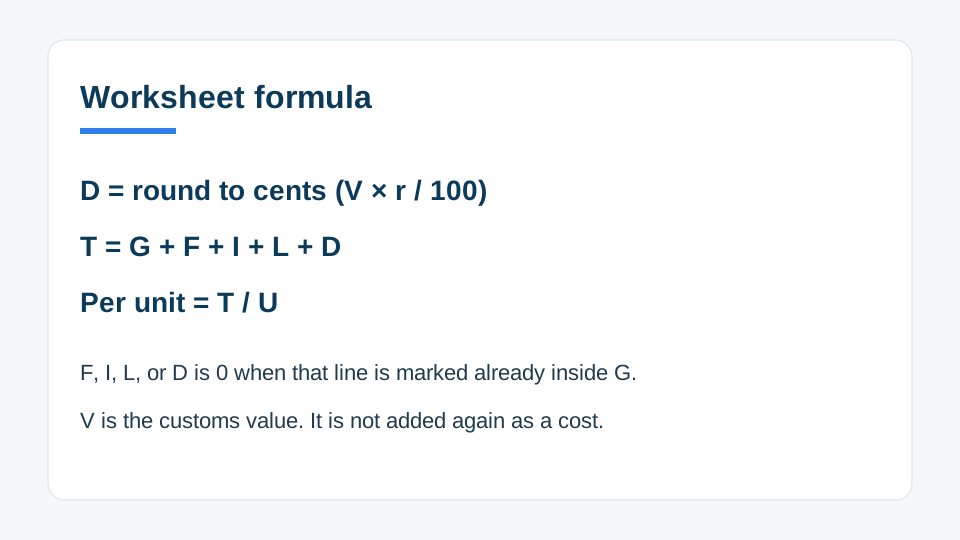
Worked example. G is the goods amount, V is the customs value, r is the rate you type, and U is the unit count. F, I, and L are freight, insurance, and local fees. Estimated duty D = round to cents (V × r / 100). In this run freight and insurance are marked already inside the goods amount, so F = 0 and I = 0. Duty is unmarked, so D is added. Local fees stay L. Total T = G + F + I + L + D = G + 0 + 0 + L + D. Per unit = T / U. The zeros are inclusion marks.
Takeaway: Leave the total unfinished while any line is still blank. A specific or mixed duty does not go through this percentage. If you already have a confirmed amount for that duty, put it in local fees. The US exclusion of international transportation and insurance applies to merchandise sold for exportation to the United States. For another destination, type the customs value that destination's rules require. The trade.gov summary of the WTO Customs Valuation Agreement says importing-country legislation may include or exclude transport to the place of importation, loading, unloading, handling, and insurance. Changing the rate field does not switch the sheet from one statute to another.
The same double count is the hidden cost on this sheet. A freight line added twice moves every per-unit figure for the shipment. A fee left blank stays off the total, so the total is unfinished. Storage after receipt, marketplace charges, returns, and financing stay off the sheet unless you type a confirmed amount into local fees.
Compare two routes on the same units
Run one record per route. Hold the goods amount, the unit count, and the destination still, and change only the lines that the route actually changes. Use how shipping from China compares freight quotes for the cargo and the named place, and the five parts of the import-from-China playbook for the documents around this sheet.
Method and sources
Checked 18 October 2026. Transaction value, the five additions, the sufficient-information stop, the post-importation and duty exclusions, and the exclusion of international transportation, insurance, and related services are from 19 USC 1401a(b), as published on the Legal Information Institute. The C.I.F. exclusion in Example 4 and the foreign-inland-freight rules are from 19 CFR 152.103. The duty-rate determination sentence is from CBP's Determining Duty Rates page, last modified 25 November 2024. The eleven Incoterms 2020 rules, the A9/B9 cost list, and the CIF and CIP insurance levels are from the ICC Incoterms 2020 page. Specific, ad valorem, and mixed duties are from the WTO customs valuation technical note. The permission for a country to include or exclude transport, handling, and insurance is from the trade.gov summary of the WTO Customs Valuation Agreement. No price, freight amount, or duty rate is stated, because this sheet asks you to enter your own.