Import from China Playbook
A balance paid before the release record exists wastes the hold on the lot. This import from China playbook keeps five records and prints no price or duty rate.
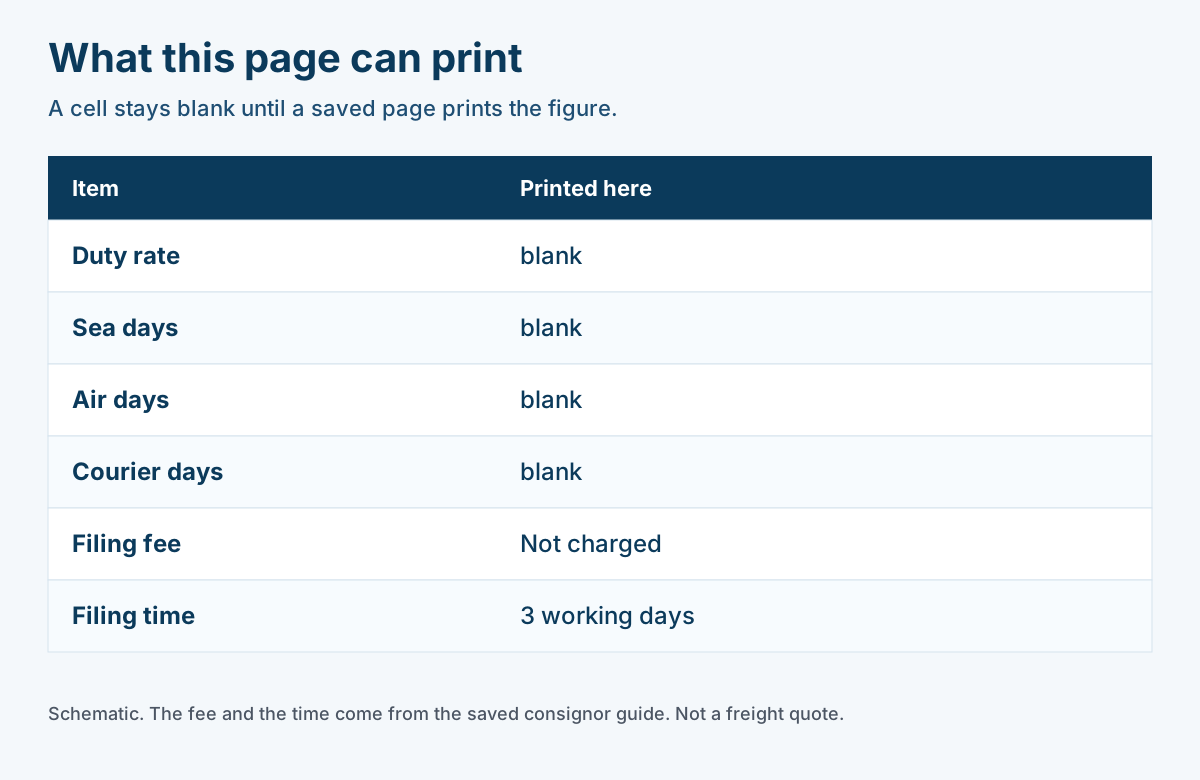
You use this import from China playbook by closing five records in order and leaving every number cell empty until a saved page prints the figure. For merchandise entered into the United States, CBP does not require an importer license or permit. 19 U.S.C. 1484 requires the importer of record to use reasonable care and to file the declared value, the classification, and the rate of duty. The saved consignor guide states that the Chinese export filing is not charged and that both time limits are 3 working days. This page prints no product price, no duty rate, and no sea, air, or courier transit figure. Copy a number only after a saved official page or your booking prints it. The text sits on this URL as HTML, with no PDF and no form. Keep the file with the other buyer resources.
Scroll horizontally to see all columns →
| Input or item | Typical value or source | Why it matters |
|---|---|---|
| Page format | This HTML page, revised 18 October 2026. No PDF and no form. | You do not send a product, a quantity, or a supplier link to read it. |
| U.S. importer license | CBP tips: CBP does not require an importer license or permit. Other agencies may require a permit for the commodity. A state or local business license may also apply. | The commodity permit is a separate record from this file. |
| Entry filing | 19 U.S.C. 1484, 2023 edition: the importer of record files the declared value, the classification, and the rate of duty, using reasonable care. A broker files only when designated in writing. | The importer of record stays responsible for the entry documents and for the duties, taxes, and fees. |
| Consignor filing fee | Saved consignor guide: 不收费 (not charged). | A fee printed on a quote is a different charge. Copy it only from that quote. |
| Consignor time limit | Saved consignor guide: 3 working days, both the promised limit and the statutory limit. The FAQ states that the filing remains valid for the long term. | This clock is the filing, not a factory lead time and not a transit time. |
| Duty rate | Blank. CBP's duty-rate page, last modified 25 November 2024, prints no rate for a product. | CBP makes the final determination. A factory invoice is not that determination. |
| Sea, air, and courier days | Blank. | Copy the figure from the booking you saved. |
Close the open record before the next payment
Hold the next payment while any required field in the current record is still empty. Type 0 only when a saved document prints zero.
Scroll horizontally to see all columns →
| Record | What closes it | Dominant failure mode | Prevention |
|---|---|---|---|
| Brief | One specification, one Incoterms rule, one named place | Ranking a unit price whose cost list is a different A9/B9 article | Stop the ranking until both replies name one rule and one place |
| Payee | The same Chinese legal name on the license, the contract, the invoice, and the bank instruction | Money sent to a Chinese name the license does not show | Keep the deposit until the four names are the same name |
| Sample | Measurements, material, color, function, labels, packaging, and the date | Production that swaps a material after the sample date | List the materials and components that have to stay with the sample |
| Release | Lot, inspection result, invoice parties, and the document that releases the balance | The balance paid while the duty cell or the transit cell is still empty | Leave those cells blank and hold the balance |
| Freight | A mode chosen from packed weight, carton size, destination, and a saved day count | A blank day count read as a fast sailing | Record the confirmed transit window directly from the carrier booking |
Rule of thumb. If blank required fields B exceed 0, hold the next payment. The empty field is where the deposit or the balance would move against an open record.
Let R be the required fields in the record you are closing. Let F be how many of those fields already have a saved source. Then B = R - F.
Worked example. The release record on this page uses R = 6: lot identity, inspection result, seller name, duty rate, carrier transit figure, and the document that releases the balance. A saved inspection note fills the lot and the result. A commercial invoice that already names the seller fills the third field. F = 3. B = 6 - 3 = 3. The duty rate, the transit figure, and the release document stay open, so the balance stays held. The inputs are field counts. They are not a price, a duty rate, or a lead time.
Takeaway: hold the next payment while B is above 0. Fill a number cell only from a page or a booking you saved.
Write one brief before you rank two quotes
Write who will use the goods, what the goods have to do, the materials, and the dimensions you can measure. Add the destination country, the quantity, the unit pack, the carton limits, the labels, and any test the destination requires. An empty field becomes a question, and every candidate answers that question.
Copy those fields into the wholesale RFQ template so two replies name the same Incoterms rule and the same place. The ICC page for Incoterms 2020 describes eleven three-letter rules for business-to-business sales of goods. It says the rules allocate cost, risk, and obligations, and that all costs for a given rule appear at article A9/B9 of that rule. A lower unit price on a different rule is a different cost list. If a three-letter rule on the quote is unfamiliar, check it in the sourcing glossary before you copy it into the brief.
Match the payee, then name the consignor
Before any deposit, the Chinese legal name on the business license has to be the name on the contract, the invoice, and the bank beneficiary. Use how to verify a Chinese supplier for the license and the unified code, and record what you found on the supplier scorecard.
The export declaration uses its own filer. The consignor guide, saved 18 October 2026, quotes Customs Law Article 11: the consignor or consignee of import and export goods, and a customs declaration enterprise, must file with customs in order to handle customs formalities. The same guide quotes Customs Order No. 253, Article 4. An applicant needs market-entity status. A consignor applicant also needs a foreign-trade operator filing unless another rule applies. The guide's acceptance conditions name these consignors: a company or other enterprise legal person, a sole proprietorship, a partnership, a farmer cooperative, an individual industrial and commercial household, a branch of a foreign company, and any other market entity the law names. A branch files only after the parent consignor has filed. Your name, as a buyer outside China, is not one of those types.
That guide prints the figures this file is allowed to copy. The fee line reads 不收费, which is not charged. Both the promised time limit and the statutory time limit are 3 working days. The FAQ states that the filing remains valid for the long term. Online handling is 0 visits to the counter, or 1 visit when the applicant uses the window. The guide says the approved filing is published on 中国海关企业进出口信用信息公示平台. A filing records the entity as a declarant. The workshop and the machines stay off that record.
Who files the U.S. entry, and how the eight buying steps sit around this file, is in how to source products from China.
Date the sample the later check will use
On one note, write the measurements, material, color, function, accessories, labels, and packaging you accepted, plus the date. The later check reads that note. A photograph leaves steel grade, wall thickness, coating, and label version unstated.
The accepted unit is evidence that this seller produced one unit at that version. Before production starts, list the materials and components that have to stay with it. The bulk count stays empty until the packing list states it.
Build the release packet from the invoice rule
19 CFR 141.86, on the eCFR display current as of 15 October 2026, requires each invoice of imported merchandise to set forth the items below. eCFR marks that display as authoritative but unofficial, and points to the annual CFR for the official edition.
Scroll horizontally to see all columns →
| Invoice item | What 141.86 requires | Dominant failure mode | Prevention |
|---|---|---|---|
| Port and parties | The port of entry, and the time, place, seller, and buyer. If there is no purchase, the place shipped from, the time, and the shipper and recipient | A chat name where the seller line should be | Copy the parties from the contract you matched to the license |
| Description | The name, the grade or quality, the trade marks, numbers, and symbols, and the marks and numbers of the packages | A catalog photo standing in for the grade | Use the dated sample note |
| Quantity and price line | Quantities in the measures of the shipping country or of the United States, and, for a purchase, the price of each item in the currency of the purchase | One total and no unit line | Keep the currency kind on the invoice. This page prints no price |
| Charges | Freight, insurance, commission, cases, containers, coverings, and packing, itemized by name and amount, plus the charges from alongside the export carrier to alongside the carrier at the first U.S. port | A charge sitting inside the price and typed again on its own line | 141.86(a)(8) lets packing, cases, containers, and inland freight to the export port stay inside the price when the invoice says they are included |
| Origin and assists | The country of origin, and dies, molds, tools, or engineering work furnished for production and left out of the price. Goods or services furnished in the United States are excluded | A mold the buyer paid for and never listed | List the assist, or state that none was furnished |
| Language and packages | English, or an accurate English translation, and a statement of what merchandise is in each package. Discounts from the base price have to be set out for each class of merchandise | A packing list that names the shipment and not the package | State the contents of each package. 141.86(i) allows the required information on the invoice or on an attachment |
| Responsible person | The name of an employee of the exporter who knows the transaction, or who can readily obtain that knowledge | A signature block with no name | Keep the name on the invoice |
Section 141.86(f) says that when the invoice or the entry omits a weight, gage, or measure needed to ascertain duties, the consignee pays the expense of weighing, gaging, or measuring before CBP releases the merchandise. The section states no fee amount.
Cross-check the invoice lines against the packing list in the commercial invoice and packing list cross-check. Before the balance moves, fill the quality control checklist for the lot and follow the pre-shipment inspection guide for when a person can sample packed cartons.
A vessel shipment has a filing that air and courier do not. CBP's importer tips say that before merchandise arriving by vessel can be imported into the United States, the Importer Security Filing importer, or their agent, must electronically submit advance cargo information. That rule covers cargo arriving by ocean vessel and leaves other modes out. The tips page says failure to comply could ultimately result in monetary penalties, increased inspections, and delay of cargo. Those tips point to another CBP page for the data elements. The elements are not copied here.
The duty cell stays blank. CBP's Determining Duty Rates page, last modified 25 November 2024, says the Harmonized Tariff System provides duty rates for virtually every item, that an approximate figure from the U.S. International Trade Commission database is only as good as the information you provide, and that CBP makes the final determination of the correct rate of duty. A binding ruling is available for a specific item. Enter the duty rate only after confirming the HTSUS classification or CBP binding ruling.
Compare freight from saved figures only
Put two offers side by side after both name one Incoterms 2020 rule and one place. On the ICC page, CIF keeps Institute Cargo Clauses (C) as the default cover, and the parties have the option to agree a higher level. CIP requires cover compliant with Institute Cargo Clauses (A) or similar clauses. The premium still comes from the contract. This page prints no premium.
Scroll horizontally to see all columns →
| Mode | Days this page prints | Cost this page prints | Dominant failure mode | Prevention |
|---|---|---|---|---|
| Sea | A blank day count treated as a fast sailing | Copy the figure from the booking, or leave the cell empty | ||
| Air | A courier price compared with an air price that names a different place | Hold the Incoterms rule and the named place still | ||
| Courier | A small-parcel offer ranked against a carton the booking has not measured | Use the packed weight and the carton size |
Use how shipping from China compares sea, air, and courier once the cartons exist. When a document prints a freight amount, a duty amount, or a local fee, enter that amount in the landed cost calculator. Leave the calculator field empty while the document is missing. The landed-cost formula is where the customs value and the warehouse stack part ways.
The hidden cost on this file is a blank freight cell read as zero. That reading drops the charge out of every unit that ships. A second sample, delay after a missing vessel filing, and exam preparation are the other lines. CBP's tips page says CBP has a right to examine any shipment imported into the United States and cites 19 U.S.C. 1467. It quotes 19 CFR 151.6: the importer bears the expense of preparing the merchandise for examination and of closing the packages. The tips page says exam rates vary and gives one dollar example. This playbook leaves that example out.
When these U.S. entry rules do not apply
The CBP license sentence, 19 U.S.C. 1484, the duty-rate page, the invoice rule, and the vessel filing govern merchandise entered into the United States. A purchase that never arrives in the United States falls outside those sentences. Goods that still depart China remain under the consignor guide for the export filing. Identify a commodity permit with the agency that regulates the goods. More of the buying sequence sits with the other pages under Guides.
Method and sources
Checked 18 October 2026. The importer-license sentence, the importer number, broker responsibility, the ocean Importer Security Filing, and the exam-expense quotation are from CBP's Tips for New Importers and Exporters. The duty-rate determination is from CBP's Determining Duty Rates page, last modified 25 November 2024. Entry filing is from 19 U.S.C. 1484 in the 2023 edition on GovInfo. Invoice contents are from 19 CFR 141.86 on eCFR, displayed as current on 15 October 2026. The eleven Incoterms 2020 rules, article A9/B9, and the CIF and CIP insurance levels are from the ICC Incoterms 2020 page. The filing fee, the 3-working-day limits, the long-term validity, the visit counts, the market-entity list, Customs Law Article 11, and Customs Order No. 253 Article 4 are from the General Administration of Customs guide 进出口货物收发货人备案. No product price, duty rate, or transit time is stated. None of those saved pages prints one for this file.