A commercial invoice and packing list cross-check fails when the quantities disagree, and that mismatch wastes the broker review and leaves the wrong count on the US import file. Match each SKU to the converted quantity and the carton numbers, then name who corrects a difference and which document version the broker receives.
Use this commercial invoice packing list template as one row per SKU. Record the invoice quantity, the packing-list quantity, the unit on each side, the carton numbers, the difference after both sides use one unit, the person who corrects a gap, and the document version you will hand over. 19 CFR 141.86(e) is titled Packing list and requires the invoice to state in adequate detail what merchandise is contained in each individual package. Paragraph (i) allows that detail on the invoice or on an attachment. The saved Common Export Documents page says a packing list is not a substitute for a commercial invoice. Copy the blank rows. The filled rows under them are assumed inputs for the arithmetic, not a shipment, and every price, duty rate, HS classification, and lead time stays blank.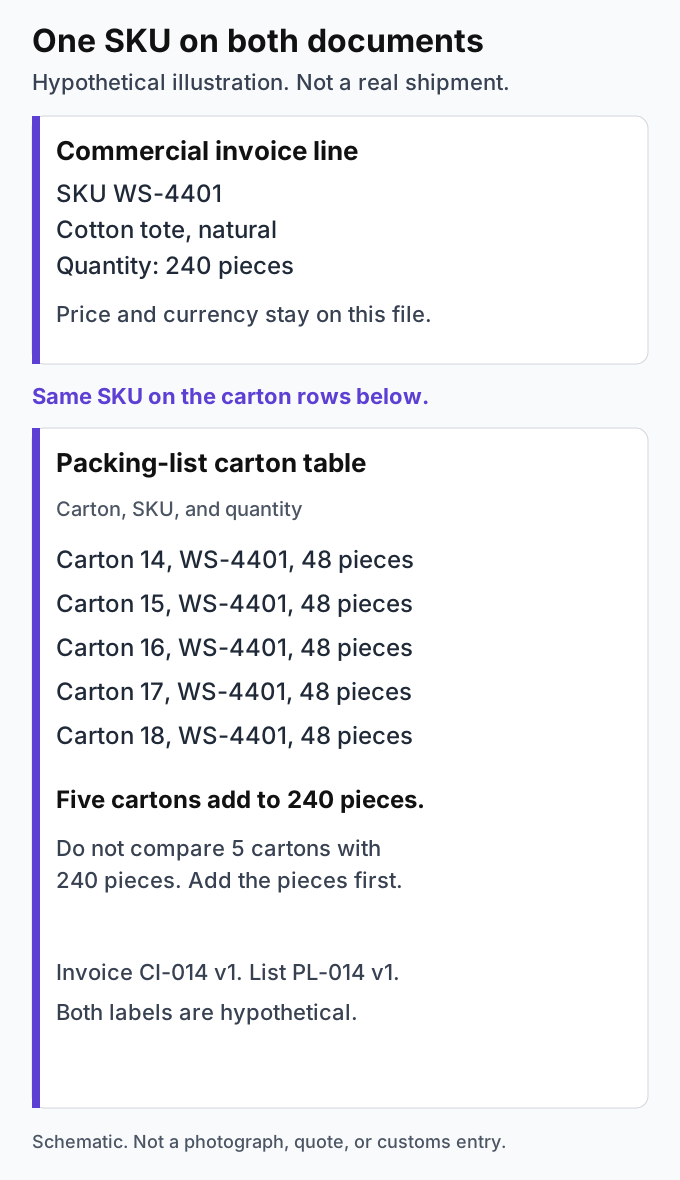
Copy the worksheet
Copy one row per SKU. Write the unit beside each quantity so a later reader subtracts pieces from pieces. Leave the correction owner empty when the converted difference is 0. When the difference exceeds 0, name the person who will issue the next file, and write the version you are looking at.
The header and the blank rows are the commercial invoice packing list template. The filled table under them uses assumed labels so the arithmetic has inputs. Delete those filled rows before you use the sheet on a live order.
Scroll horizontally to see all columns →
| Invoice number | Packing list id | Purchase order | Who handed the cartons to the forwarder |
|---|---|---|---|
Scroll horizontally to see all columns →
| SKU | Description | Unit of measure | Invoice quantity | Packing-list quantity | Carton numbers | Difference | Correction owner | Document version |
|---|---|---|---|---|---|---|---|---|
Scroll horizontally to see all columns →
| Mismatch | Dominant failure mode | Prevention |
|---|---|---|
| The two files use different units | A false shortage, because the raw numbers were subtracted | Convert to one unit, then subtract |
| A carton count is used as the quantity | The piece total inside those cartons is never added | Sum the pieces in the cartons named for that SKU |
| Price sits only on the packing list | The invoice drops out of the file | Keep the price and the kind of currency on the invoice or on an attachment |
| Package contents are missing | 19 CFR 141.86(e) has no per-package detail | Map each SKU to its carton numbers |
| A measure needed for duty is missing | The consignee pays an unprinted weighing expense before release | Copy the measure the invoice prints. Leave a silent source blank |
| The forwarder’s old file is the one the broker sees | The review uses the superseded version | Pass the current version and name the file it replaces |
Assumed inputs for the arithmetic
Header for the example only: invoice CI-014, packing list PL-014, purchase order PO-88. Supplier A packed WS-4401. Supplier B packed WS-4410. Both lots sit with one forwarder. None of these identifiers is a live order.
Scroll horizontally to see all columns →
| SKU | Description | Unit of measure | Invoice quantity | Packing-list quantity | Carton numbers | Difference | Correction owner | Document version |
|---|---|---|---|---|---|---|---|---|
| WS-4401 | Cotton tote, natural | Piece on the invoice. Dozen on the packing list. | 240 pieces | 20 dozen | 14, 15, 16, 17, 18 | 0 pieces after 20 dozen is converted to 240 pieces | CI-014 v1 and PL-014 v1 | |
| WS-4410 | Cotton tote, navy | Piece on both files | 120 pieces | 100 pieces | 19, 20 | 20 pieces short on the packing list | Supplier B export contact, named on the revised file | CI-014 v1 and PL-014 v1, before the correction |
Read WS-4401 as a match. Five cartons hold 48 pieces each, and 5 times 48 is 240. The packing list wrote 20 dozen. One dozen is 12 pieces, so 20 times 12 is 240. The difference cell is 0 pieces, and the correction owner stays empty.
Read WS-4410 as a gap in the same unit. Cartons 19 and 20 hold 50 pieces each, and 2 times 50 is 100. The invoice says 120 pieces. The difference is 20 pieces. The correction owner is Supplier B’s export contact.
Keep the money fields on the invoice
The commercial invoice carries what the buyer is paying. On the eCFR page for 19 CFR 141.86 fetched 18 October 2026, paragraph (a)(5) requires the purchase price of each item in the currency of the purchase when the merchandise is shipped in pursuance of a purchase or an agreement to purchase. Paragraph (a)(7) requires the kind of currency, whether gold, silver, or paper. Paragraph (a)(8) requires all charges on the merchandise, itemized by name and amount, including freight, insurance, commission, cases, containers, coverings, and cost of packing. Paragraph (i) allows any information this subpart requires to sit on the invoice or on an attachment.
The saved Common Export Documents page calls the commercial invoice a bill for the goods from the seller to the buyer, and one of the main documents customs uses in determining customs duties. The same page says a packing list is not a substitute for a commercial invoice, and that U.S. and foreign customs officials may use the packing list to check the cargo, so the commercial invoice should reflect the information on the packing list. Leave the purchase price, the kind of currency, and the named charges on the invoice or on an invoice attachment. Copying the prices onto the packing list and then dropping the invoice removes the bill.
Paragraph (a)(8) also covers charges, costs, and expenses incurred in bringing the merchandise from alongside the carrier at the port of exportation in the country of exportation and placing it alongside the carrier at the first US port of entry, when those charges are not already in the list above. The cost of packing, cases, containers, and inland freight to the port of exportation need not be itemized by amount if it is included in the invoice price and the invoice says so. When required charge information is missing from the invoice as first prepared, show it on an attachment.
When the shipment is not a purchase and not an agreement to purchase, paragraph (a)(6) requires a value for each item in the currency in which the transactions are usually made, or, if that value is absent, the price in that currency that the manufacturer, seller, shipper, or owner would have received, or was willing to receive, for the merchandise if sold in the ordinary course of trade and in the usual wholesale quantities in the country of exportation. That price stays on the invoice. This page prints no figure for it.
Paragraph (a)(9) requires rebates, drawbacks, and bounties, separately itemized, that were allowed on the exportation. Paragraph (a)(10) requires the country of origin. Paragraph (a)(11) requires goods or services furnished for the production of the merchandise, such as dies, molds, tools, and engineering work, when they are not included in the invoice price. Goods or services furnished in the United States are excluded. Leave each of those cells blank when the invoice prints nothing. Paragraph (a)(2) still requires the time, the place, and the person by whom and the person to whom the merchandise is sold or agreed to be sold. When the goods are imported other than under a purchase, it requires the place from which they shipped, the time, and the person to whom and the person by whom they shipped. The header on this worksheet is only your file index.
19 CFR 141.86(f) assigns the weighing, gaging, or measuring expense to the consignee and prints no amount. If the invoice or the entry does not disclose the weight, gage, or measure necessary to ascertain duties, the consignee pays that expense before CBP releases the merchandise. The saved export-document page says an export packing list itemizes total net and gross weight in kilograms. Copy the weight your list already prints. Leave the expense cell blank.
This worksheet does not add freight, insurance, commission, or packing into a landed cost. Carry a charge into the landed cost formula once the invoice names it. When the invoice already prints an amount, enter that amount in the landed cost calculator. Leave the calculator field empty while the invoice is silent. That guide does not check carton numbers.
If the invoice quantity itself was wrong, the revised quantity and its price stay on the next invoice version. Changing only the packing list would hide the gap. The worksheet records which file changed. It does not recompute duty.
Convert the unit before you call it a shortage
A different unit of measure is a conversion, and the difference comes after that conversion. Write both units in the row, convert to one unit, and only then fill the difference.
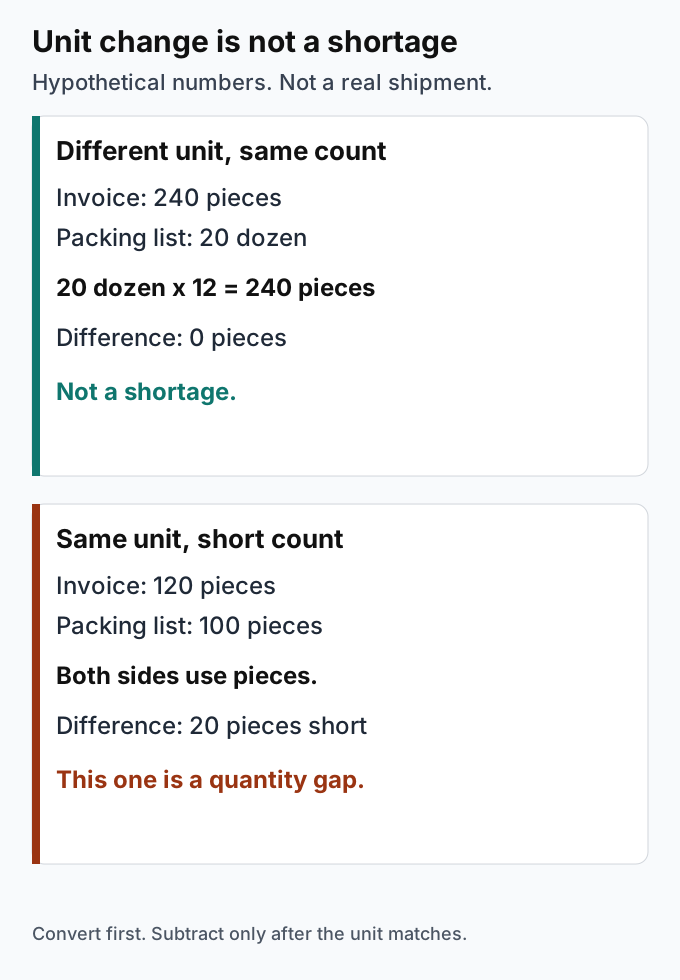
Rule of thumb. If the piece difference exceeds 0 after both quantities use the same unit, name a correction owner and keep the old file. A difference of 0 leaves the correction owner blank.
The formula is:
Piece difference = invoice pieces - (packing-list count x pieces per unit)
Worked example, with the assumed inputs in the table above. One dozen is 12 pieces, so pieces per unit is 12. The packing list says 20 dozen.
20 x 12 = 240 pieces.
The invoice says 240 pieces.
Piece difference = 240 - 240 = 0.
The second line is already in pieces on both files.
Piece difference = 120 - 100 = 20.
A carton count is a location, not a third unit you subtract from pieces. Carton piece total = 48 + 48 + 48 + 48 + 48, which is 240 for WS-4401. Cartons 19 and 20 explain where the 100 pieces of WS-4410 are. They are not a quantity of 2 set against an invoice of 120.
19 CFR 141.86(a)(4) requires the invoice quantities in the weights and measures of the country or place from which the merchandise is shipped, or in the weights and measures of the United States. The paragraph does not print a conversion between a dozen and a piece. Convert the packing-list unit into the invoice unit before you call the line short. Paragraph (d) requires the invoice and its attachments to be in English, or to carry an accurate English translation with enough detail to examine the merchandise and determine duties. Record that translation as part of the version. Keep the original file beside it.
Map the SKU to the carton numbers
Paragraph (a)(3) requires a detailed description, including the name of each item, the grade or quality, the marks and numbers under which the seller or manufacturer sells it in the country of exportation, and the marks and numbers of the packages in which the merchandise is packed. Paragraph (e) requires adequate detail of what merchandise is contained in each individual package. The carton-number cell is that link for the forwarder’s handoff.
On the assumed WS-4401 line, cartons 14, 15, 16, 17, and 18 each contain that SKU and nothing else. The diagram at the top is that map: one invoice line, five carton rows, one piece total. If a carton held two SKUs, split the row or write both SKUs in that carton cell so the piece total for each SKU still adds.
WS-4410 is the unmatched map. Cartons 19 and 20 account for 100 pieces. The invoice line of 120 pieces has no carton for the other 20 until the corrected packing list adds one. Keep the WS-4401 cartons on the WS-4401 row. Those cartons already add to a different SKU.
A pre-shipment inspection checks the goods against the order while the cartons can still be opened. This worksheet checks the two documents against each other. Use the pre-shipment inspection guide for the inspection plan, and keep its carton count beside this cross-check when both exist.
Amazon box labels are a different mark. The carton numbers here are the numbers on the packing list the forwarder received. The China to Amazon FBA guide covers the barcode the seller account requires and one box label per carton. Keep that label out of the carton-number cell.
Move the corrected version to the broker
When the piece difference exceeds 0, the next file needs a new version id. Keep the version the forwarder already holds. The correction owner is the person who issues the change. 19 CFR 141.86(j) requires each invoice to identify by name a responsible employee of the exporter who has knowledge of the transaction, or who can readily obtain that knowledge. The worksheet cell does not replace that name on the invoice. Write the same person in both places when that employee is the one who corrects the line.
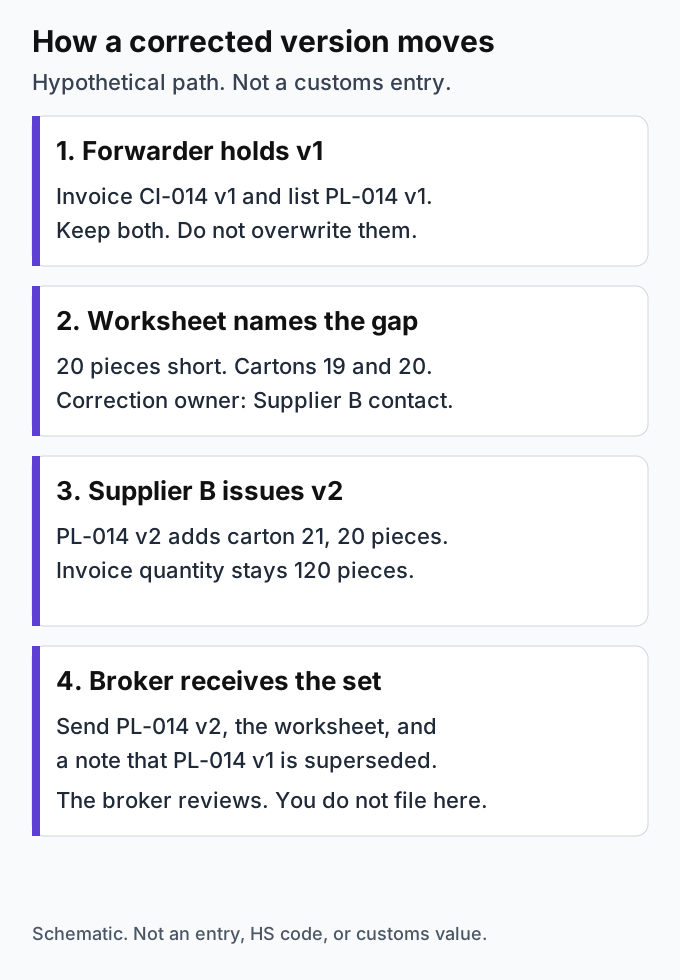
In the assumed example, Supplier B’s export contact issues PL-014 v2. Version 2 keeps cartons 19 and 20 and adds carton 21 with the missing 20 pieces. The invoice stays CI-014 v1 at 120 pieces, because the goods catch up to the invoice. The invoice price line is not revised on this page, and no price is printed in the example. The difference on the worksheet becomes 0 pieces, and the document-version cell becomes CI-014 v1 and PL-014 v2. The note you keep with the file says PL-014 v1 is superseded.
If the recount shows the invoice was the file that overstated the quantity, Supplier B issues CI-014 v2 instead, with the revised piece count and the price for that count on the invoice. The packing list can stay at 100 pieces. You still do not calculate a new duty amount on this page.
Paragraph (h) is a different number. Except when electronic invoice data are transmitted to CBP under part 143, the importer numbers each invoice in an entry that contains more than one, and numbers the pages in one series when the invoices run past two pages. The example on the eCFR page reads Inv. 1, p. 1, then Inv. 2, p. 2, then Inv. 2, p. 3. The version id on this worksheet is the revision the forwarder holds. It is a separate series from that entry pagination.
Hand the US customs broker four things: the current invoice, the current packing list, this worksheet, and a one-line note of which version replaces which. The broker reviews that set. You are not creating the entry here, and the forwarder’s receipt of the cartons is not the review.
Where the US import check stops
This cross-check ends when the two documents agree on SKU, description, converted quantity, and carton numbers, and when the worksheet names the correction owner or leaves that cell empty because the difference is 0, and names the document version. It stops there.
The eCFR page fetched on 18 October 2026 says it is displaying title 19, up to date as of 15 October 2026, and that title 19 was last amended 26 August 2026. The same page says the eCFR is not an official legal edition of the CFR. Read 19 CFR 141.86(a)(2) through (a)(11), (d), (e), (f), (h), (i), and (j) for the parties, the description, the quantity, the price and currency, the charges, the English-language rule, the per-package detail, the weighing expense, the entry pagination, the attachment rule, and the named exporter employee. This article is not a restatement of every invoice rule in the subpart.
The Trade.gov page is a list of common export documents. It opens by telling an exporter to start with the foreign customer or a freight forwarder. It is not a complete statement of US import requirements.
The section you just used does not generate a customs entry, choose an HTS classification, or set a duty rate. Public forms already exist for writing the two documents. This page is the cross-file record: the difference, the unit conversion, and the person who issues the next version.
When the cartons themselves arrive with incorrect items, that claim is a different file. The Alibaba.com Trade Assurance page saved on 16 October 2026 says you can claim a refund if the order has not been shipped, goes missing, or arrives with defects, incorrect items, damages, or other product-related issues. That sentence prints no award amount. Use the Trade Assurance dispute evidence guide for that claim, and keep this worksheet as the document comparison.
More shipping records sit in the freight and logistics category. The rest of the buying sequence sits with the other sourcing guides.
How this page was checked
The invoice statements follow the eCFR text of 19 CFR 141.86 fetched on 18 October 2026. The banner on that page says title 19 is up to date as of 15 October 2026 and was last amended 26 August 2026, and the page says the eCFR is not an official legal edition of the CFR. The export-document sentences follow the International Trade Administration Common Export Documents page saved on 18 October 2026. The refund sentence follows the Alibaba.com Trade Assurance page saved on 16 October 2026, and only the money-back line quoted above. CI-014, PL-014, PO-88, WS-4401, and WS-4410 are assumed labels for the diagrams. Updated 18 October 2026.
Frequently asked questions
Is a packing list a substitute for the commercial invoice?
No. The International Trade Administration's Common Export Documents page says a packing list is not a substitute for a commercial invoice. For a US import, 19 CFR 141.86(a)(5) and (a)(7) keep the purchase price and the kind of currency on the invoice when the goods move under a purchase, and paragraph (i) allows required invoice information on an attachment. The packing list is the package record.
Does a different unit of measure mean the shipment is short?
No. Convert both sides to one unit, then subtract. In the assumed arithmetic on this page, 20 dozen times 12 is 240 pieces. Against an invoice of 240 pieces, the difference is 0.
Can this worksheet be filed as the US customs entry?
No. Give the worksheet to your US customs broker with the current invoice and packing list. The broker reviews that set. This page does not create an entry, choose an HTS classification, or decide customs value.
Does 19 CFR 141.86 print a weighing expense amount?
No. Paragraph (f) says that if the invoice or the entry omits the weight, gage, or measure needed to ascertain duties, the consignee pays the expense of weighing, gaging, or measuring before CBP releases the merchandise. The paragraph prints no amount. Leave the cell blank.
Sources
- 19 CFR 141.86 Contents of invoices and general requirements : eCFR Accessed October 18, 2026.
- Common Export Documents : International Trade Administration Accessed October 18, 2026.