Direct answer
FBA-bound cargo needs the correct FNSKU, carton labels, and appointment-ready packing before it leaves China. Choose air, sea, or a hybrid after you know dimensional weight and the Amazon receiving window, not from a single freight screenshot.
Key takeaways
- Label at origin. Relabeling in a US warehouse is slower and more expensive.
- Consolidate multi-supplier orders in one export shipment when SKUs share a destination.
- Incoterms decide who owns delay and damage; name the term on the quote.
Shipping from China to Amazon FBA is not a single freight booking. It is a handoff between the factory, the seller’s Amazon account, the prep team, the forwarder, customs, the final-mile carrier, and the assigned fulfillment center. A shipment can travel on time and still be delayed at receiving because the units, cartons, or shipment record do not agree.
The practical objective is simple: release cargo from China only after the physical goods match the live shipment plan in Seller Central. That means the right units are in the right cartons, each required barcode is scannable, carton weights and dimensions are recorded, and the party responsible for every remaining step is named.
Freeze the product before creating the shipment
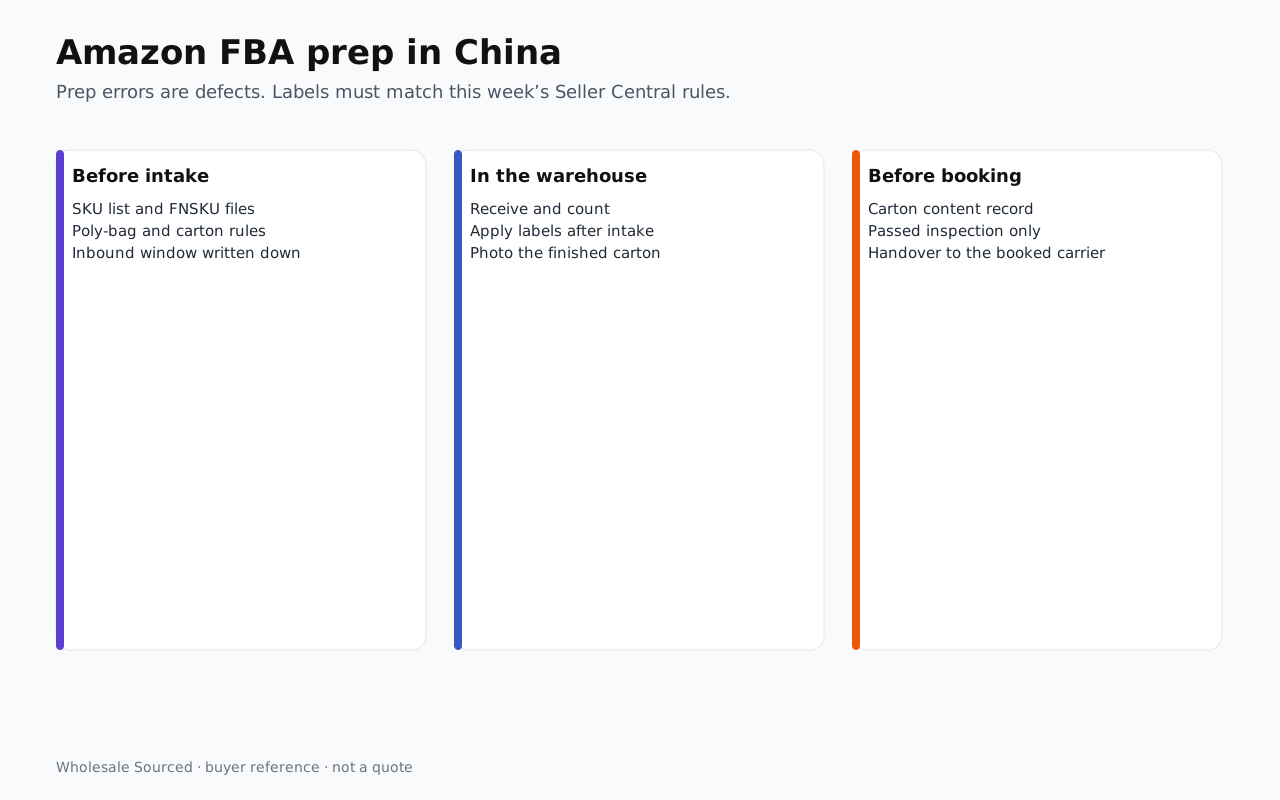
Do not build an inbound plan from a provisional packing list. First confirm the sellable unit, pack quantity, packaging, barcode method, and total ready quantity for each SKU. If a factory changes the master-carton quantity after labels are generated, the box-content data and the physical carton can diverge.
For a first order, keep one approved production sample and a signed specification available during packing. The check should cover both marketplace requirements and ordinary product quality: correct variation, accessories, language, warnings, country-of-origin marking, retail packaging, and protective materials. Amazon compliance does not replace a pre-shipment inspection.
Create the shipment only when the final destination allocation and box-content instructions are available in the seller account. Amazon can change workflows and receiving requirements, so a label file saved from an earlier shipment is not an authority for the next one.
Prep at origin
Unit preparation should happen where mistakes are still cheap to correct. The prep team needs the current SKU-to-ASIN mapping, the barcode decision shown in the seller account, and the packaging rules for the product type. Polybags, suffocation warnings, set labels, expiration data, fragile protection, and other requirements are product-specific; they should be verified against the live account and help pages rather than copied from another seller’s checklist.
When an Amazon barcode is required, place the correct FNSKU on the correct sellable unit and cover other scannable product barcodes that could cause a receiving error. Then scan a sample from every SKU with an ordinary barcode scanner. A label that looks readable in a photograph may still fail because of print scaling, low contrast, curvature, glare, or abrasion.
Keep three forms of evidence before release:
- A clear photograph of every finished SKU and its visible barcode.
- A carton-level packing list that connects carton numbers to SKU quantities.
- Photographs of representative sealed cartons with their final labels and marks.
This evidence does not guarantee acceptance, but it makes a mismatch easier to diagnose before the goods cross an ocean.
Match every carton to the live shipment plan
Amazon’s shipment-label guidance says that each box needs its own unique FBA box ID label generated by the shipment workflow. Those labels should not be photocopied, reused, or edited for additional cartons. The carrier label and FBA box ID must remain visible and scannable on a flat surface rather than wrapping around a seam or edge.
The factory or consolidation warehouse should work from a controlled label register. Record which unique label was applied to which physical carton, together with the carton number, SKU contents, gross weight, and dimensions. Reconcile the final carton count to the shipment record before pickup. If one carton is repacked, regenerate or reassign the documentation deliberately; do not move labels casually between boxes.
Accurate measurements matter twice. Amazon uses the inbound data for receiving, while the forwarder uses actual or dimensional weight for freight pricing. Capture dimensions after the carton is sealed, not from an early packaging estimate.
Consolidation
When several suppliers are shipping to the same market, a China consolidation warehouse can receive, count, inspect, relabel, and combine their cartons. This creates one control point between factories and export. It is especially useful when suppliers finish on different dates or when no single factory should see another supplier’s details.
Consolidation is not automatically cheaper. Add the inbound trucking, handling, storage, repacking, and possible delay to the comparison. It works best when the warehouse has a clear receiving manifest and an exception process. Unknown cartons, short quantities, damaged packaging, and label mismatches should be quarantined instead of silently loaded.
For a stockout risk, consider splitting the order: send a smaller replenishment quantity by air and the balance by sea. Compare the full landed cost and expected availability date of each split, including the extra origin and destination handling. The fastest headline transit time is not necessarily the fastest route to sellable inventory.
Choose the mode after weight, cube, and deadline
Choose air courier, air freight, sea freight, or a mixed plan only after the forwarder has the final carton data and destination. A useful quote separates origin charges, main transport, customs-related services, duties and taxes, destination handling, appointment or delivery charges, and any storage exposure. It should also state whether pricing is based on actual weight, chargeable weight, volume, or a minimum shipment charge.
Ask for a transit range rather than a guaranteed-looking single number. Factory pickup, export handling, sailing or flight schedules, customs examination, deconsolidation, appointment availability, and Amazon receiving are different stages. Define where the quoted clock starts and stops. A quote of ten days may mean port to port while the seller assumes factory to available inventory.
Your replenishment plan should include receiving variance. Delivery to an Amazon facility is not the same event as units becoming available for sale. Keep enough buffer stock or use a staged destination warehouse when the business cannot absorb an uncertain receiving interval.
Assign customs and delivery ownership
Every commercial quote should name an Incoterms 2020 rule and the named place or port. The rule allocates defined delivery tasks, costs, and risk between buyer and seller; it does not by itself identify the importer of record, guarantee customs compliance, transfer title, or describe Amazon appointment obligations.
Do not treat DDP as a complete compliance plan. Ask who will appear in customs records, whose bond or account is used where applicable, who classifies the goods, who pays an adjustment, and what documents the buyer will receive. Amazon generally should not be assumed to act as the importer of record for the seller’s merchandise. Confirm the arrangement with a qualified customs broker for the destination country.
Use a written ownership matrix for the shipment:
| Control point | Named owner | Evidence before release |
|---|---|---|
| Unit prep and FNSKU | Factory or prep warehouse | Scans and SKU photos |
| Carton contents | Packing team | Carton-level packing list |
| Box ID and carrier labels | Prep warehouse or forwarder | Label register and carton photos |
| Export documents | Exporter and forwarder | Commercial invoice and packing list review |
| Import clearance | Importer and broker | Classification and importer confirmation |
| Final delivery | Forwarder or carrier | Appointment and proof of delivery |
| Receiving reconciliation | Seller | Shipment status and discrepancy log |
If a row has no named owner, it is a likely delay rather than a small administrative gap.
Release checklist for the first shipment
Before authorizing pickup, confirm all of the following:
- Production quantity and sellable-unit packaging match the approved specification.
- The shipment plan is current and the assigned destinations have not been replaced by an old file.
- Required unit barcodes scan and belong to the correct SKU.
- Each carton has the unique box ID generated for that shipment and the required carrier label.
- Carton contents, weights, dimensions, and totals reconcile across the packing list and shipment record.
- Product-specific prep, warnings, and compliance documents have been checked.
- Inspection findings are closed or accepted in writing.
- The Incoterms rule, named place, importer, broker, and duty responsibility are documented.
- The freight quote states its scope, exclusions, chargeable basis, and transit range.
- The team has retained photographs, label files, packing data, and final commercial documents.
Release is a decision gate, not a ceremonial email. If the physical cartons and the data disagree, hold the shipment until one version is corrected.
After delivery
Track three milestones separately: carrier delivery, Amazon check-in, and units available for sale. Reconcile shortages, unexpected prep charges, damage, or receiving delays against the retained carton evidence. Then update the packing specification and shipment checklist before the next production run.
The repeatable asset is not an old label PDF. It is the controlled process that produces correct labels and carton data from the current shipment plan. For multi-supplier orders, pair that process with warehousing and consolidation; for a complete cost comparison, use the landed-cost calculator.
Information graphic
Frequently asked questions
Can goods go factory-direct to an Amazon fulfillment center?
Yes, if labels, carton marks, and booking data match Amazon’s current inbound requirements. Many first orders still stage in a China warehouse for a final check.
How long can goods sit in a consolidation warehouse?
Wholesale Sourced offers 30 days of free temporary storage on active files. Longer holds are quoted so storage does not silently eat margin.
Sources
- Amazon Seller Central shipment label requirements: Amazon Accessed August 23, 2026.
- Incoterms 2020: International Chamber of Commerce Accessed August 23, 2026.