China Sourcing for Retail Buyers
A guide to multi-SKU China buying for retailers: one consolidator, mixed cartons, and a production calendar planned around Chinese New Year.

Built for: Stores, chains, and distributors running many SKUs
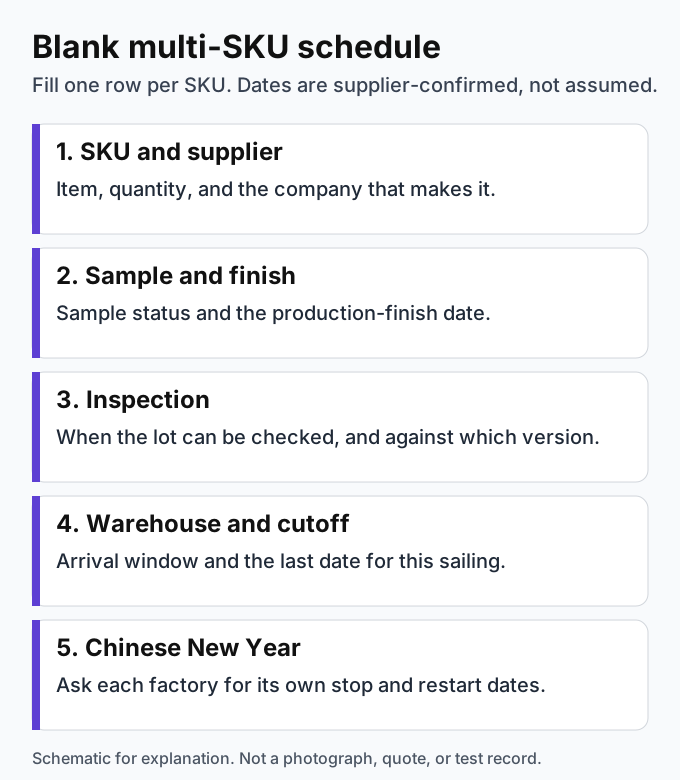
Retail and distribution orders often combine several suppliers, lead times, and carton formats. The buyer needs one calendar and one inventory view even when the factories work independently. Chinese New Year dates are not one national shutdown you can paste onto every row. Ask each factory for its own stop and restart.
Copy a blank master schedule
Leave the date cells empty until that supplier confirms them.
Scroll horizontally to see all columns →
| SKU | Supplier | Sample | Finish | Inspection | Warehouse arrival | Cutoff |
|---|---|---|---|---|---|---|
Build one master order list
Record every SKU, supplier, quantity, sample status, production date, inspection requirement, and expected carton count in the same file. The list should show dependencies. A gift set cannot be packed until every component arrives, and a mixed container cannot close while one supplier is still producing.
Use the supplier scorecard to track performance by vendor. Keep late delivery, repeat defects, communication gaps, and document problems attached to the supplier record. A low price on one SKU should not hide the cost of delays elsewhere in the assortment.
Inspect repeat orders against the approved reference
Repeat production can drift when a factory changes material, subcontractor, packing method, or line setup. Keep the approved sample and current specification available for each run. The quality control checklist helps define the measurements, functions, labels, and packaging evidence required before release.
Not every SKU needs the same inspection intensity. New products and past failures may need more attention than stable repeats. The buyer should make that choice before the inspector visits.
Consolidate with a receiving plan
Send each supplier a warehouse reference and expected delivery window. At intake, count cartons, record damage, and update the SKU-level inventory. Hold incomplete kits and mismatched labels instead of allowing them into the final export load. A U.S. retail buyer is often the ultimate purchaser, so a China-origin article still needs a readable country-of-origin mark. The 19 CFR 134 marking guide separates an article mark from a carton mark.
Warehousing and consolidation explains that handoff. Once every released SKU is present, compare one combined shipment with separate routes, as the shipping from China guide explains, using the final weight, cube, and destination schedule.
Common problems to check for
- Each vendor ships a trickle
- Nobody owns the master carton calendar
- Repeat orders drift in quality
Frequently asked questions
What if one factory delivers late in a multi-supplier order?
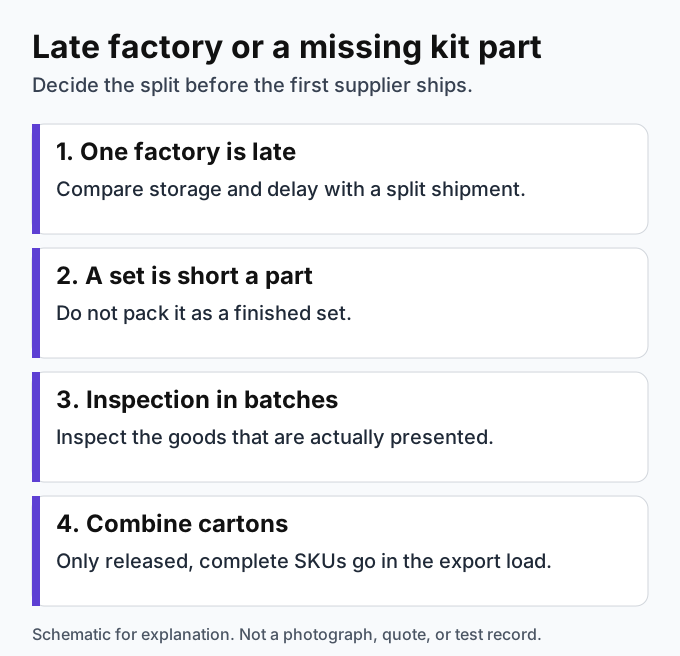
Decide in advance whether the other suppliers' goods wait or ship without the late SKU. Compare the storage and delay cost with the extra freight of a split shipment.
Can a gift set ship if one component is missing?
Not as a finished set. Hold incomplete kits at intake and decide whether to wait for the missing part or repack the available components under a different SKU.
Can I inspect and consolidate in one visit when suppliers finish on different days?
Only for the goods that are actually presented. Inspect a finished batch on its own, and put only released, complete SKUs into the combined export load.