Compare the full cost of a sourcing arrangement, including service fees, merchandise price, customs treatment and tooling ownership. In the conditional examples below, a 20% duty assumption and a 17% combined price spread produce a 7.2%–12.0% cost difference. Use your quoted prices and applicable tariff treatment to make the same comparison for an actual order. Start with the agency or sales agreement, original factory quote, itemized fees and independent inspection scope.
Counterparty Legal & Financial Matrix: Independent Sourcing Agent vs Trading Company vs Kickback Middleman
In China export procurement, the label printed on a supplier’s website or business card (“sourcing agency,” “supply chain partner,” or “group manufacturer”) carries zero legal weight. Counterparty rights, factory price transparency, and anti-kickback remedies are governed by which specific contract chapter of Book Three (Contracts) of the Civil Code of the People’s Republic of China (adopted May 28, 2020; effective January 1, 2021 under Article 1260, archived via the State Council official portal) governs the written agreement.
Scroll horizontally to see all columns →
| Audit Dimension | Independent Buying Agent (Entrustment Contract / 委托合同) |
Trading Company / Reseller (Sales / 买卖合同 or Brokerage / 行纪合同) |
Disguised “Low-Fee” Kickback Agent (Intermediary / 中介合同 or Violated Agency) |
|---|---|---|---|
| PRC Civil Code Statutory Basis | Chapter XXIII (Articles 919–936): Agent handles entrusted procurement matters on the buyer’s instructions (Art. 922) and reports progress/results (Art. 924). |
Chapter IX (Articles 595–596 Sales) or Chapter XXV (Articles 951–960 Brokerage): Counterparty sells goods or trades in its own name as principal/broker. |
Chapter XXVI (Articles 961–966 Intermediary) or breached Art. 919 agency where middleman conceals factory rebates. |
| Statutory Anti-Kickback & Rebate Rule | Article 927 Strict Turnover: “An agent shall hand over to the principal any property acquired in handling the entrusted matter.” All factory rebates, volume discounts, and samples belong legally to the buyer. |
No Fiduciary Turnover (Art. 595): As a seller transferring ownership for a price, the trading company retains 100% of its EXW-to-FOB spread and export VAT rebate. Under Art. 955 (Brokerage), price savings belong to the client only if not otherwise agreed. |
Article 962 Forfeiture: A middleman who intentionally conceals material pricing facts or colludes on kickbacks harming the client “may not request for remuneration and shall bear the liability for compensation.” |
Factory Identity & Raw EXW RMB Visibility |
Full Disclosure (Art. 924–926): Agent provides 3 competing raw factory quotes in RMB (13% VAT included) plus the factory’s 18-digit Unified Social Credit Code. |
Opaque / Masked: Issues a single USD FOB commercial invoice under its own trading company name; conceals the actual mainland workshop to prevent buyer circumvention. |
Selectively Distorted: Risk to investigate: undisclosed supplier payments or price differences between the factory quotation and buyer invoice. |
U.S. Customs Valuation (19 U.S.C. § 1401a, 19 CFR § 152.103) |
Non-Dutiable Buying Commission: Excluded from dutiable transaction value when governed by a bona fide buying agency agreement and itemized/invoiced separately (19 CFR § 141.86(a)(8), § 152.102(b)). |
100% Dutiable Markup: Trader’s 10%–20% gross margin is embedded inside the “price actually paid or payable” (19 CFR § 152.103(a)(1)), inflating U.S. ad valorem tariffs. |
Dutiable Selling Commission / Inflated FOB: Rebate-funded price padding and seller-linked fees (19 CFR § 152.102(b)) are taxed inside transaction value (19 CFR § 152.103(b)(1)(ii)). |
Custom Mold & Tooling Title (19 CFR § 152.103(d)) |
Buyer-Owned Tripartite Bailment: Buyer contracts directly with the factory (Art. 925); mold is engraved as buyer property and declared as a § 152.103(d)(2) assist. |
Captive Trader Custody: Trading company pays the mold shop in its own name (often marking up tooling 15%–25%) and refuses to release the mold if the buyer switches suppliers. |
Unrecorded / Hostage Tooling: Mold deposit is routed through the middleman’s account without a factory bailment deed, leaving legal title disputed. |
| Fault Liability & QC Release Alignment | Statutory Fault Liability (Art. 929): Under a paid (non-gratuitous) entrustment contract, the buyer can claim damages for losses caused by the agent’s ordinary fault. |
Seller Warranty Only (Art. 596): Enforced only against the trading shell; once the 70% balance is wired, recovering defect losses requires litigating in China. |
Narrow Gratuitous Standard (Art. 929): A “0% fee” agent claiming gratuitous entrustment is liable only for intentional acts or gross negligence, while its factory kickback rewards shipping defective lots. |
Why Statutory Contract Classification Determines Your Real Cost
Before ranking commission percentages on our China sourcing agent fees worksheet, verify which statutory role the counterparty occupies under Chinese contract law:
- The Trading Company Seller (
PRC Civil Code Article 595):- Under
Article 595, a sales contract transfers ownership of goods from seller to buyer in exchange for a price. When a foreign importer accepts a single pro forma invoice and commercial invoice from a Shenzhen, Ningbo, or Yiwu trading company (外贸公司or进出口有限公司), no agency relationship exists. - Because the trading company is legally the seller, adding
12%to25%onto the factory’s gate price is lawful commercial margin—not a breach of duty. The buyer has no right underArticle 595to demand the factory’s name, audit the rawRMBpurchase order, or claim China’s9%–13%export VAT refund (出口退税).
- Under
- The Bona Fide Buying Agent (
PRC Civil Code Articles 919–936):- Under
Article 919, an entrustment contract binds the agent to handle procurement matters on behalf of the principal (buyer).Article 922requires the agent to follow the buyer’s explicit instructions,Article 923requires personal performance (barring unauthorized sub-entrustment to a secondary broker), andArticle 924mandates full reporting on supplier quotes and order execution upon request. - Crucially,
Article 927establishes a strict fiduciary property-turnover rule: “An agent shall hand over to the principal any property acquired in handling the entrusted matter.” Under a written Entrustment Contract, any cash rebate, volume discount, free production overage, golden sample, or paid mold acquired from the factory belongs by statute to the buyer. - Furthermore,
Article 929differentiates between paid (non-gratuitous) and unpaid (gratuitous) entrustment: when the buyer pays an explicit commission underArticle 928, the agent is legally liable for losses caused by ordinary fault (such as failing to verify a supplier’s manufacturing license or falsifying an in-line check). When an agent claims to work “for free” (0%fee to the buyer),Article 929lowers the agent’s statutory liability to intentional misconduct or gross negligence.
- Under
- The Broker (
Articles 951–960) and the Intermediary (Articles 961–966):- Under a Brokerage Contract (
Article 951), a broker trades in its own name for a client and bears operating expenses by default (Article 952). UnderArticle 955, if a broker buys goods at a price lower than the target price set by the client, that price savings belongs to the client unless the contract explicitly grants the difference to the broker. - Under an Intermediary Contract (
Article 961), a middleman introduces contracting parties or facilitates contract signing. UnderArticle 962, if the middleman intentionally conceals material facts (such as a secret price-padding arrangement with the factory) or supplies false supplier data that harms the buyer, the middleman forfeits all right to remuneration and is liable for resulting damages.
- Under a Brokerage Contract (
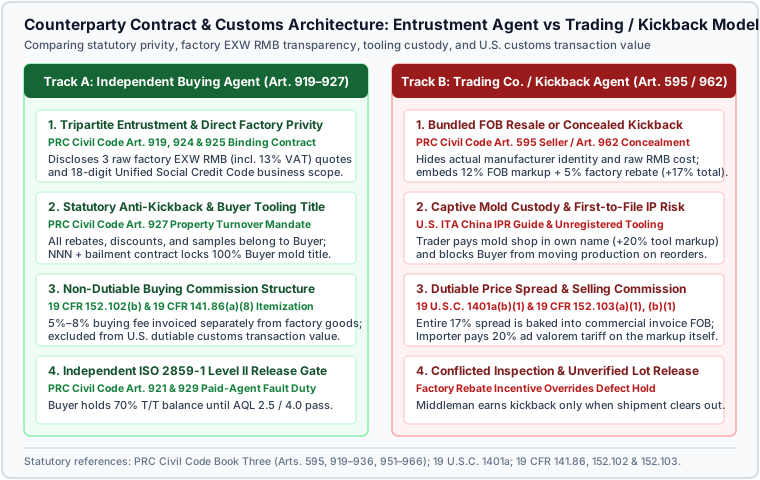
Selection takeaway: Never hire a China sourcing representative without naming PRC Civil Code Chapter XXIII (Entrustment Contract, Articles 919–936) in the written agreement; if the counterparty insists on issuing a single commercial invoice in its own name without disclosing the factory’s raw RMB contract, you are buying from an Article 595 trading reseller, not a fiduciary agent.
Worked Landed-Cost & Customs Valuation Audit Across $10,000, $50,000, and $150,000 Order Profiles
The financial gap between an independent buying agent and a trading company extends beyond the headline fee percentage. Under U.S. customs valuation law—codified in 19 U.S.C. § 1401a (Section 402 of the Tariff Act of 1930) and implemented through 19 CFR § 141.86, 19 CFR § 152.102, and 19 CFR § 152.103—how a middleman’s compensation and production tooling are structured directly alters the dutiable transaction value declared to U.S. Customs and Border Protection (CBP).
Statutory U.S. Customs Valuation Rules Governing Commissions and Tooling
- Dutiable Selling Commissions vs Non-Dutiable Bona Fide Buying Commissions (
19 CFR § 152.102(b)&§ 152.103(b)(1)(ii)):- Under 19 CFR § 152.103(a)(1), the transaction value of imported merchandise is the “price actually paid or payable for the merchandise when sold for exportation to the United States”, plus mandatory statutory additions listed in
19 CFR § 152.103(b)(1)and19 U.S.C. § 1401a(b)(1). - Under
19 CFR § 152.103(b)(1)(ii), the importer must add to transaction value “any selling commission incurred by the buyer with respect to the imported merchandise.” 19 CFR § 152.102(b) defines a selling commission as “any commission paid to the seller’s agent, who is related to or controlled by, or works for or on behalf of, the manufacturer or the seller.” - When an importer buys from a trading company, the trader’s gross price spread is embedded directly inside the commercial invoice unit price (
price actually paid or payable). The importer therefore pays U.S. ad valorem customs duties (including base Normal Trade Relations / MFN duty plus Section 301 China tariffs) on the trading company’s markup. Similarly, if a purported “buying agent” shares common ownership with the factory or collects a commission/kickback from the manufacturer, CBP reclassifies the agent’s fee as a dutiable selling commission or part of dutiable merchandise value. - Conversely, a bona fide buying commission paid to an independent agent acting exclusively under the buyer’s control (
PRC Civil Code Art. 919–927)—where the agent never takes title on its own account, receives zero rebate from the seller (Art. 927), and its commission is either billed on a separate service invoice or separately itemized on the commercial invoice under 19 CFR § 141.86(a)(8)—is excluded from dutiable transaction value. - Note also that under
19 CFR § 152.103(a)(4), any rebate or decrease in price effected between buyer and seller after the date of importation is disregarded by CBP in determining transaction value.
- Under 19 CFR § 152.103(a)(1), the transaction value of imported merchandise is the “price actually paid or payable for the merchandise when sold for exportation to the United States”, plus mandatory statutory additions listed in
- Production Tooling, Dies, and Molds as Dutiable “Assists” (
19 CFR § 152.102(a)(1)(ii)&§ 152.103(d)(2), (e)):- Under
19 CFR § 152.102(a)(1)(ii), tools, dies, molds, and similar production items supplied directly or indirectly by the buyer (free of charge or at reduced cost) for use in producing exported goods are statutory assists. - Under
19 CFR § 141.86(a)(11), every commercial invoice must disclose all assists (such as dies, molds, tools, and foreign engineering work) not included in the unit invoice price. Under19 CFR § 152.103(d)(2), the dutiable value of a mold assist is its acquisition or production cost plus transport to the foreign factory (engineering or CAD design performed inside the United States is excluded under§ 152.102(a)(1)(iv)and§ 152.103(d)(2) Example 1). - Under
19 CFR § 152.103(e)(1)–(2), the importer may apportion the dutiable value of the mold assist in accordance with Generally Accepted Accounting Principles (GAAP) over: (i) the first shipment (full lump-sum declaration), (ii) the number of units produced up to the time of the first shipment, or (iii) the entire anticipated production volume under the contract.
- Under
Core Landed-Cost & Customs Valuation Formulas
- Model A Dutiable Transaction Value (Independent Buying Agent — Written Entrustment Contract):
Dutiable Value_A = True Factory FOB Merchandise Value + Apportioned Tooling Assist (19 CFR 152.103(d)(2))- (Bona fide buying commission and independent third-party inspection fees are excluded from
Dutiable Value_Awhen separately invoiced/itemized under19 CFR § 141.86(a)(8)).
- Model B Dutiable Transaction Value (Trading Company or Kickback Middleman):
Dutiable Value_B = True Factory FOB x (1 + Trader Markup % + Factory Kickback Cushion %) + Marked-Up Tooling Assist
- Excess U.S. Customs Tariff Paid on Middleman Spread:
Excess Tariff Paid = (Dutiable Value_B - Dutiable Value_A) x Combined Ad Valorem Duty Rate
- Total Out-of-Pocket Landed Cost (Ex-International Freight):
Total Cost_A = True Factory FOB + Tooling Assist + Non-Dutiable Buying Commission + Independent QC Fee + (Dutiable Value_A x Duty Rate)Total Cost_B = Invoiced Trader FOB + Marked-Up Tooling Assist + (Dutiable Value_B x Duty Rate)
Conditional 3-Tier Cost & Customs Comparison ($10,000, $50,000, and $150,000 Profiles)
The table below evaluates three conditional import profiles for custom-molded commercial hardware imported from Ningbo/Shenzhen to the United States at a baseline $10.00/unit true factory FOB price (EXW RMB inclusive of 13% VAT plus China origin port drayage, net of export VAT rebate) and a 20.0% combined U.S. ad valorem customs duty rate (representing a 3.9% base MFN rate plus 16.1% effective Section 301 tariff benchmark; actual duty depends on your specific 10-digit HTSUS classification).
- Model A (Independent Buying Agent —
Art. 919–927Entrustment): Charges a stepped transparent buying commission of8.0%on Tier 1 ($10,000),6.0%on Tier 2 ($50,000), and5.0%(or a negotiated$6,000fixed project retainer) on Tier 3 ($150,000), plus at-cost third-partyISO 2859-1Level II pre-shipment inspection ($300per man-day on Tiers 1–2;$600for 2 man-days on Tier 3) underArticle 921. - Model B (Trading Company / Kickback Middleman —
Art. 595Sales / ViolatedArt. 962): Quotes a bundledUSD FOBprice embedding a12.0%trader markup plus a5.0%undisclosed factory rebate cushion (17.0%combined FOB inflation, raising invoice price from$10.00/unitto$11.70/unit), and marks up Tier 2 custom mold fabrication by20.0%($4,800vs$4,000actual mold shop cost).
Scroll horizontally to see all columns →
| Cost & Customs Valuation Line Item | Tier 1: $10,000 Trial Order (1,000 units @ $10.00 True Factory FOB) |
Tier 2: $50,000 Scaling Order (5,000 units @ $10.00 FOB + $4,000 Mold Assist) |
Tier 3: $150,000 Repeat Container (15,000 units @ $10.00 True Factory FOB) |
|---|---|---|---|
| True Factory FOB Merchandise Value | $10,000.00 ($10.00/unit) |
$50,000.00 ($10.00/unit) |
$150,000.00 ($10.00/unit) |
Custom Mold Assist (19 CFR § 152.103(d)(2)) |
$0.00 (existing stock tool) |
$4,000.00 (100% buyer-owned in Model A vs $4,800.00 trader-captive in Model B) |
$0.00 (declared on Tier 2 or repeat run) |
| MODEL A: Buying Commission (Non-Dutiable) | $800.00 (8.0% separate agency invoice) |
$3,000.00 (6.0% separate agency invoice) |
$7,500.00 (5.0% rate; or $6,000.00 fixed retainer) |
MODEL A: Independent ISO 2859-1 Level II QC |
$300.00 (1 man-day, Code J, n = 80) |
$300.00 (1 man-day, Code L, n = 200) |
$600.00 (2 man-days, Code M, n = 315) |
MODEL A: U.S. Dutiable Value (19 CFR § 152.103) |
$10,000.00 (buying fee excluded) |
$54,000.00 ($50,000 FOB + $4,000 mold assist declared on first shipment) |
$150,000.00 (buying fee excluded) |
MODEL A: U.S. Customs Duty @ 20.0% Benchmark |
$2,000.00 ($2.00/unit) |
$10,800.00 ($2.16/unit incl. assist duty) |
$30,000.00 ($2.00/unit) |
| MODEL A: Total Landed Cost (Ex-Ocean Freight) | $13,100.00 ($13.10/unit) |
$68,100.00 ($13.62/unit) |
$188,100.00 ($12.54/unit; or $186,600.00 @ $6k cap) |
| MODEL B: Bundled Trader / Kickback FOB Invoice | $11,700.00 ($11.70/unit invoice) |
$58,500.00 ($11.70/unit) + $4,800.00 mold (+20% markup) |
$175,500.00 ($11.70/unit invoice) |
MODEL B: U.S. Dutiable Value (19 CFR § 152.103) |
$11,700.00 (+$1,700 spread is dutiable) |
$63,300.00 ($58,500 FOB + $4,800 mold assist) |
$175,500.00 (+$25,500 spread is dutiable) |
MODEL B: U.S. Customs Duty @ 20.0% Benchmark |
$2,340.00 (+$340.00 excess tariff) |
$12,660.00 (+$1,860.00 excess tariff) |
$35,100.00 (+$5,100.00 excess tariff) |
| MODEL B: Total Landed Cost (Ex-Ocean Freight) | $14,040.00 ($14.04/unit) |
$75,960.00 ($15.19/unit) |
$210,600.00 ($14.04/unit) |
| Net Buyer Overpayment in Model B | +$940.00 (+7.2% higher cost) |
+$7,860.00 (+11.5% higher + captive mold) |
+$22,500.00 (+12.0% higher; +$24,000 vs retainer) |
Step-by-Step Audit of the Three Order Profiles
- Tier 1 (
$10,000Trial Order — Why an8%Transparent Agent Beats a “No-Fee” Quote by$940):- First-time importers frequently reject a transparent buying agent quoting an
8.0%commission ($800) plus$300for an independentCode J (n = 80)pre-shipment inspection ($1,100in explicit service lines) in favor of a trading company or “free/low-fee” middleman quoting$11.70/unitFOB with “zero commission.” - In reality, Model B’s
17.0%embedded spread adds$1,700to the merchandise invoice and forces the importer to pay$2,340in U.S. customs duties instead of$2,000(+$340in extra tariff paid to CBP on the middleman’s margin). Model A delivers verified factory privity and independentAQL 2.5inspection at$13,100($13.10/unit), saving$940compared to Model B’s$14,040($14.04/unit).
- First-time importers frequently reject a transparent buying agent quoting an
- Tier 2 (
$50,000Scaling Order +$4,000Custom Injection Mold Assist):- Scaling to
5,000 unitswith a dedicated steel injection mold introduces two compounding exposures under Model B: assist valuation inflation and captive tooling lock-in. - Under
19 CFR § 152.103(d)(2)and§ 141.86(a)(11), the custom mold is a dutiable assist. If apportioned 100% onto the first scaling shipment under19 CFR § 152.103(e)(1), Model A declares$50,000FOB plus the$4,000at-cost mold ($54,000dutiable base →$10,800duty, or$0.80/unitin amortized mold cost plus$0.16/unitassist duty; if apportioned over10,000anticipated units under§ 152.103(e)(2), only$2,000of the assist attaches to the first5,000-unitentry). - Under Model B, the trading company marks up both the merchandise (
$58,500) and the mold ($4,800), raising the dutiable base to$63,300($12,660duty, including+$1,860in excess tariff) for a total of$75,960vs$68,100(+$7,860overpayment). Worse, because the trading company contracted the mold shop in its own name, the buyer cannot move the$4,800mold to another factory when prices rise on Tier 3.
- Scaling to
- Tier 3 (
$150,000Repeat Container Program — Percentage Compression vs Fixed Retainer):- On a
15,000-unitfull-container reorder, supplier vetting and sample development are already complete. An independent buying agent either steps down its commission rate to5.0%($7,500) or converts to a fixed container management retainer ($6,000) plus2 man-days($600) for aCode M (n = 315)inspection. - A trading company or kickback middleman locked into a
17.0%unit spread quietly extracts$25,500in hidden margin plus$5,100in excess U.S. tariff ($35,100vs$30,000duty), costing the buyer$22,500to$24,000per container.
- On a
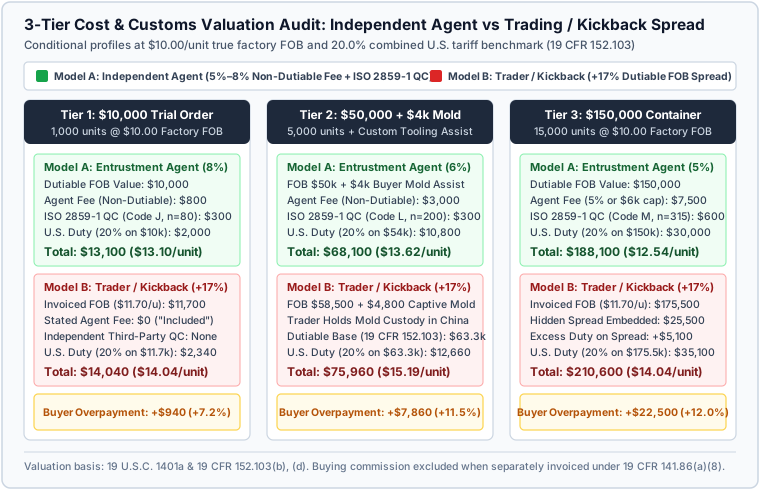
Calculation takeaway: Always model sourcing fees together with U.S. ad valorem tariffs in your landed cost calculation worksheet and landed cost calculator: every $1.00 of hidden trading markup or factory kickback baked into the commercial invoice FOB price costs $1.20 out of pocket at a 20% tariff rate, whereas a properly documented buying agency commission (19 CFR § 152.102(b)) carries zero customs duty.
Four-Gate Counterparty Audit: Raw EXW RMB Quotes, Tripartite Contracts, NNN Tooling Bailment, and Export VAT
To qualify a buying commission as non-dutiable under 19 U.S.C. § 1401a and prevent off-book factory kickbacks in China, importers must enforce four documentary verification gates before wiring any deposit.
Gate 1: Bilingual Entrustment Contract (Art. 919 / 927) & Corporate Registry Match
- Verify Entity Registration Before Signing:
- If the sourcing agent contracts through a Hong Kong company, run the 8-digit Business Registration Number (
BRN) and match the certificate name, Companies Register record, contract party, and bank beneficiary using our Hong Kong sourcing agent verification guide. - If the agent or factory is a mainland Chinese enterprise, verify its 18-digit Unified Social Credit Code (
统一社会信用代码) and registered business scope (经营范围) via our Chinese supplier verification procedure. Confirm that the shortlisted factory’s business scope explicitly lists manufacturing/processing (生产,加工, or制造), not solely wholesale or import/export trade (批发,贸易, or进出口).
- If the sourcing agent contracts through a Hong Kong company, run the 8-digit Business Registration Number (
- Execute an Explicit PRC Civil Code Chapter XXIII Entrustment Agreement (
委托合同):- Cite PRC Civil Code Articles 919, 922, 923, 924, 927, 928, and 929 directly in the contract text.
- Include a mandatory Article 927 Anti-Kickback & Rebate Turnover Clause stating that
100%of any vendor discount, cash rebate (回扣), sample credit, or tax-refund sharing belongs to the Principal (Buyer), and stipulate contractual liquidated damages (forfeiture of all commission underArticle 962principles plus3xthe undisclosed payment) if any unapproved payment flows between the factory and the agent.
Gate 2: Raw Factory EXW RMB (13% VAT) Quote & Export VAT Rebate Bridge
Never allow a sourcing agent to present a self-typed USD spreadsheet as “factory pricing.” Exercise your statutory reporting right under PRC Civil Code Article 924 to require:
- Three Original Factory Quotation Sheets (
原始出厂含税报价单):- Each quote must be issued on the manufacturer’s own letterhead in Chinese Yuan (
RMB), stamped with the factory’s official company chop (公章) or quotation chop (报价专用章), stating the Ex-Works (EXW) unit price inclusive of13%PRC Value-Added Tax (含13%增值税出厂价), minimum order quantity (MOQ), lead time, and packaging specs recorded on your wholesale RFQ template.
- Each quote must be issued on the manufacturer’s own letterhead in Chinese Yuan (
- Transparent
EXW RMBtoFOB USDBridge Formula:- Reconcile the factory’s domestic
13%VAT quote against the exportUSD FOBcommercial invoice using the export VAT rebate bridge: Net Export FOB (USD) = [Factory EXW (RMB incl. 13% VAT) + Origin Port Drayage & Customs Docs (RMB) - Export VAT Rebate Credited (RMB)] / Agreed Spot FX Rate (RMB/USD)- How Export VAT Rebates (
出口退税) Work: When manufactured goods are formally exported from China accompanied by a13%special VAT invoice (增值税专用发票), China’s tax authority refunds a statutory percentage of the VAT base (commonly9%or13%depending on the product’s HS code). Trading companies routinely charge foreign buyers the full13%tax-inclusive price plus a12%markup while pocketing the9%–13%export tax rebate internally. Under an open-bookArticle 927Entrustment Contract, the export VAT rebate is explicitly netted against the factory price or itemized on the settlement sheet.
- Reconcile the factory’s domestic
Gate 3: Tripartite Purchase Contract, China Trademark Filing & NNN Tooling Bailment
According to the U.S. International Trade Administration’s China Country Commercial Guide on Protecting Intellectual Property, China operates a first-to-file trademark registration system where bad-faith actors frequently register foreign buyers’ marks to hold exports hostage, and U.S. IP registrations confer no automatic rights in mainland China. Moreover, under U.S. ITA Common Export Documents standards, the final Commercial Invoice and Packing List establish the legal audit trail between seller and buyer.
To prevent a middleman or factory from capturing your custom molds or selling replicas of your product on 1688.com:
- Sign a Tripartite Purchase & Entrustment Contract (
PRC Civil Code Article 925):- Structure the production contract among Party A (Foreign Buyer / Principal), Party B (Mainland Manufacturing Factory / Seller), and Party C (Independent Sourcing Agent / Supervisor).
- Under
Article 925, because the factory has direct notice of the agency relationship and signs directly with the buyer, the contract binds the buyer and the factory directly. The buyer wires the30%deposit and70%balance directly to the factory’s verified bank account (or through an itemized dual-invoice structure) and pays the agent’s5%–8%commission on a separate invoice.
- Execute a Bilingual NNN (Non-Disclosure, Non-Use, Non-Circumvention) & Tooling Bailment Deed:
- Standard Western NDAs only restrict public disclosure. A China-enforceable NNN Agreement bars the factory and agent from using your CAD files, molds, or bill of materials to produce goods for any third party (
Non-Use), disclosing specs to sub-contractors (Non-Disclosure), or soliciting your customers (Non-Circumvention). - Attach a Tooling Ownership & Bailment Schedule covering all
19 CFR § 152.102(a)(1)(ii)molds and dies: state that100%legal title vests in the Buyer upon payment, require permanent steel stamping ("PROPERTY OF [BUYER LEGAL NAME] - MOLD #[ID]"), and grant the Buyer the unconditional right to retrieve the mold within5 working dayswithout penalty.
- Standard Western NDAs only restrict public disclosure. A China-enforceable NNN Agreement bars the factory and agent from using your CAD files, molds, or bill of materials to produce goods for any third party (
Dominant Failure Modes, Statutory Violations & Preventive Controls
Scroll horizontally to see all columns →
| Failure Mode | Root Cause in Counterparty Setup | Statutory / Regulatory Rule Violated | Financial & Operational Loss to Buyer | Preventive Verification Control |
|---|---|---|---|---|
| Undisclosed FOB Spread + Additional Duty | Buyer accepts a single bundled USD FOB invoice from a trading company or “low-fee” agent |
PRC Civil Code Art. 595 (treated as Seller) + 19 CFR § 152.103(a)(1) dutiable invoice price |
In the stated model: +$940, +$7,860 and +$22,500 for the three order profiles, using the specified spread and 20% duty assumption |
Require a written Art. 919–927 Entrustment Contract, 3 raw EXW RMB (13% VAT) factory quotes, and separate commission billing (19 CFR § 141.86(a)(8)) |
Factory Kickback (回扣) & Resin Substitution |
Agent demands a secret 5% rebate from the factory while advertising a 0%–2% fee to the buyer |
PRC Civil Code Art. 927 (property turnover) and Art. 962 (concealment forfeiture) |
Factory recovers the 5% kickback by substituting recycled resin, thinner gauge steel, or single-wall cartons |
Insert an Art. 927 zero-kickback audit clause (3x liquidated damages) and pay the factory directly under a tripartite Art. 925 contract |
| CBP Reclassification of Buying Fee as Dutiable | Purported agent takes title to goods, shares ownership with seller, or bundles fee into goods invoice | 19 U.S.C. § 1401a(b)(1)(B), 19 CFR § 152.102(b), and 19 CFR § 152.103(b)(1)(ii) |
CBP reclassifies all historical commissions as dutiable selling commissions, assessing back duties and penalties | Maintain a written Buying Agency Agreement, separate factory vs agent invoices, and proof that the agent is controlled solely by the buyer |
Undeclared or Captive Custom Mold ($4,000+ Assist) |
Trader pays mold shop in its own name and omits tooling from commercial invoice entry disclosures | 19 CFR § 141.86(a)(11) mandatory assist disclosure & 19 CFR § 152.103(d)(2) assist valuation |
Trader holds mold hostage when buyer tries to switch factories; undeclared assist triggers CBP entry violation | Sign a tripartite tooling bailment deed stamping buyer’s name on the mold, and apportion the assist on the commercial invoice under 19 CFR § 152.103(e) |
| Conflicted QC Release & Defective Container | Commission or kickback middleman acts as sole inspector and ships lot to collect its percentage fee | PRC Civil Code Art. 929 fault standard + ISO 2859-1 Level II lot acceptance rules |
Buyer wires 70% balance before discovering 8%–15% major defects upon U.S. warehouse arrival |
Appoint an independent third-party inspector under ISO 2859-1 Level II (AQL 2.5 / 4.0) and hold the 70% T/T balance until written pass |
Buying takeaway: Lock down the counterparty chain in three sequential documents before any deposit leaves your bank: (1) a bilingual PRC Civil Code Art. 919–927 Buying Agency / Entrustment Agreement, (2) three chopped EXW RMB (13% VAT) factory quotes reconciled to the export VAT rebate, and (3) a tripartite Art. 925 purchase and tooling bailment contract signed directly by the manufacturer.
ISO 2859-1 / ANSI Z1.4 General Inspection Level II (AQL 2.5 / 4.0) Release Gates
Even when a sourcing agent operates under a transparent 5%–8% commission, a structural conflict of interest arises at the end of production: if the agent’s commission (PRC Civil Code Article 928) is payable only upon shipment—or if an unvetted middleman is waiting on a 5% factory kickback—delaying a shipment to rework defective units delays the middleman’s own payday.
To eliminate this conflict, separate production follow-up (performed by the sourcing agent) from final lot release authority (held exclusively by the buyer based on an independent third-party Pre-Shipment Inspection report).
Statistical Equivalence & Operational Protocol (NIST / ISO 2859-1 / ANSI Z1.4)
As documented by the National Institute of Standards and Technology (NIST) in NIST/SEMATECH e-Handbook Section 6.2.1 (Acceptance Sampling) and Section 6.2.3.1 (Choosing a Sampling Plan: MIL-STD-105D / ANSI Z1.4 / ISO 2859), attribute lot acceptance sampling tables across MIL-STD-105D / MIL-STD-105E, ANSI/ASQ Z1.4, and ISO 2859-1 share the exact same mathematical master tables (Table I for Sample Size Code Letters and Table II-A for Single Sampling Plans under Normal Inspection).
When 80% to 100% of the production lot is manufactured, assembled, and packed into export cartons, an independent inspector draws a random sample (n) across the cartons according to General Inspection Level II (Normal Single Sampling) and evaluates units against three defect severity classes (detailed in our pre-shipment inspection in China guide and quality control inspection standard):
- Critical Defects (
AQL 0/ Zero Tolerance): Any defect that poses a safety hazard to the end user or violates mandatory destination regulations (e.g., sharp burrs on commercial kitchen hardware, electrical short risk, missing mandatory country-of-origin marking). Finding1Critical defect (Re = 1) automatically rejects the entire lot. - Major Defects (
AQL 2.5Standard Commercial Tolerance, orAQL 1.5Tightened): Functional, dimensional, or structural failures that reduce usability, durability, or marketability (e.g., hinge misalignment, failed drop test, dimensional deviation exceeding drawing tolerance). - Minor Defects (
AQL 4.0Standard Commercial Tolerance): Slight workmanship or cosmetic departures from the approved golden sample that do not impair function or saleability (e.g., minor surface scratch< 3 mmon an interior non-visible surface).
Master Lookup Table: ISO 2859-1 / ANSI Z1.4 General Inspection Level II (Normal Single Sampling)
Scroll horizontally to see all columns →
| Production Lot Size (Units) | Matching Order Profile on This Page | Level II Code Letter (Table I) |
Random Sample Size (n Units) |
Critical Defects (AQL 0) Ac / Re |
Major Defects (AQL 1.5 High-Precision) Ac / Re |
Major Defects (AQL 2.5 Standard) Ac / Re |
Minor Defects (AQL 4.0 Standard) Ac / Re |
|---|---|---|---|---|---|---|---|
| 281 – 500 units | Small pilot / pre-trial batch | Code H | 50 units |
Ac = 0 / Re = 1 |
Ac = 2 / Re = 3 |
Ac = 3 / Re = 4 |
Ac = 5 / Re = 6 |
| 501 – 1,200 units | Tier 1 (1,000 units @ $10,000 FOB) |
Code J | 80 units |
Ac = 0 / Re = 1 |
Ac = 3 / Re = 4 |
Ac = 5 / Re = 6 |
Ac = 7 / Re = 8 |
| 1,201 – 3,200 units | Initial reorder / split LCL lot | Code K | 125 units |
Ac = 0 / Re = 1 |
Ac = 5 / Re = 6 |
Ac = 7 / Re = 8 |
Ac = 10 / Re = 11 |
| 3,201 – 10,000 units | Tier 2 (5,000 units @ $50,000 FOB) |
Code L | 200 units |
Ac = 0 / Re = 1 |
Ac = 7 / Re = 8 |
Ac = 10 / Re = 11 |
Ac = 14 / Re = 15 |
| 10,001 – 35,000 units | Tier 3 (15,000 units @ $150,000 FOB) |
Code M | 315 units |
Ac = 0 / Re = 1 |
Ac = 10 / Re = 11 |
Ac = 14 / Re = 15 |
Ac = 21 / Re = 22 |
How to Enforce the Ac / Re Payment Hold Across the Three Order Tiers
- Tier 1 (
1,000 units→Code J,n = 80 units, 1 Inspector Man-Day =$300):- The inspector pulls
80 unitsat random from packed cartons. UnderAQL 2.5(Major) andAQL 4.0(Minor), the lot passes only if Critical defects equal0, Major defects are5or fewer (Ac = 5), and Minor defects are7or fewer (Ac = 7). - The moment the inspector records a
6thMajor defect (Re = 6) or an8thMinor defect (Re = 8), the lot fails statistically.
- The inspector pulls
- Tier 2 (
5,000 units→Code L,n = 200 units, 1 Inspector Man-Day =$300):- The inspector pulls
200 units. The lot passes at<= 10Major defects (Ac = 10) and<= 14Minor defects (Ac = 14), and fails automatically at11Major (Re = 11) or15Minor (Re = 15) defects.
- The inspector pulls
- Tier 3 (
15,000 units→Code M,n = 315 units, 2 Inspector Man-Days =$600):- The inspector pulls
315 units. The lot passes at<= 14Major defects (Ac = 14) and<= 21Minor defects (Ac = 21), and fails automatically at15Major (Re = 15) or22Minor (Re = 22) defects.
- The inspector pulls
- Mandatory Failed-Lot Hold & Re-Inspection Chargeback:
- Write into the tripartite contract (
PRC Civil Code Art. 596&Art. 922) that if any defect class reachesRe, the buyer freezes the70%T/T balance wire and places a booking hold on the freight forwarder. The factory must perform100%sorting and rework of all cartons and pay the$300re-inspection man-day fee before the lot is re-sampled.
- Write into the tripartite contract (
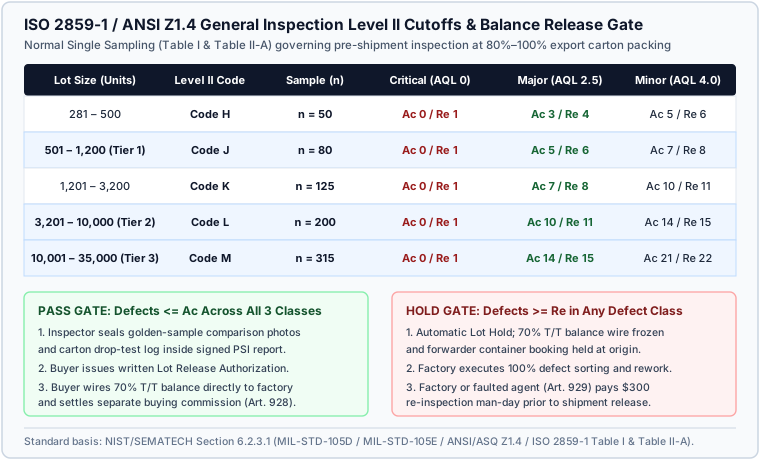
Key takeaway: Never delegate final shipment release authority to a commission agent or trading company; write ISO 2859-1 General Inspection Level II (AQL 0 Critical / 2.5 Major / 4.0 Minor) directly into the factory purchase contract and make the 70% balance wire strictly conditional on a signed third-party PASS report.
Engineering Rules of Thumb and Copyable Commission & Counterparty Audit Worksheet
Apply these four quantitative threshold rules of thumb when screening sourcing candidates and supplier quotes:
- Rule of Thumb 1 (The
< 3%Commission Kickback Warning Threshold): If a China sourcing agent advertises a commission rate below3.0%(or"0% free sourcing") on orders under$50,000while refusing to hand over raw factoryEXW RMB(13%VAT) quotes with the factory’s 18-digit Unified Social Credit Code, treat the counterparty as a disguised trading reseller or kickback broker embedding10%–17%into the unit price (PRC Civil Code Art. 595/Art. 962). - Rule of Thumb 2 (The
1.20xTariff Multiplier on Bundled FOB Markups): At a20.0%combined U.S. customs duty rate (19 U.S.C. § 1401a&19 CFR § 152.103), every$1,000of trading company markup or factory kickback bundled inside the commercial invoice FOB price costs the importer$1,200out of pocket ($1,000price spread +$200excess tariff), whereas$1,000paid as a documented, separately invoiced bona fide buying commission (19 CFR § 152.102(b)&§ 141.86(a)(8)) costs$1,000flat ($0customs duty). - Rule of Thumb 3 (The
>$50,000Commission Compression / Retainer Threshold): Once repeat order volume exceeds$50,000to$150,000per SKU run, auditing and follow-up labor scales with inspection man-days rather than order value. Step the buying agency commission down from8%(trial) to5%–6%(scaling) or transition to a fixed project retainer ($5,000–$6,000per container) so repeat production does not leak$20,000+per shipment. - Rule of Thumb 4 (The
0 / 2.5 / 4.0AQL Balance-Wire Freeze Threshold): If anISO 2859-1Level II pre-shipment inspection records>= 1Critical defect,>= 6Major defects on a1,000-unitlot (Code J,n = 80),>= 11Major defects on a5,000-unitlot (Code L,n = 200), or>= 15Major defects on a15,000-unitlot (Code M,n = 315), freeze the70%balance T/T wire immediately and require100%factory rework plus a vendor-paid re-inspection.
Copyable Buyer Counterparty, Commission, Customs Assist & AQL Audit Worksheet
Copy the verification worksheet below into your procurement file before selecting a sourcing agent or trading counterparty. Record only verified figures and statutory identifiers printed on the counterparty’s written contract, raw factory RMB quotation sheets, or customs broker entry file. Browse our full China sourcing guide library for companion verification checklists.
Scroll horizontally to see all columns →
| Audit Verification Field | Statutory or Standard Reference | Candidate A (Independent Buying Agent) | Candidate B (Trading Co. / Alternative Quote) |
|---|---|---|---|
| Registered legal entity name & 8-digit HK BRN or 18-digit Mainland Credit Code | HK Companies Registry / Mainland Business License | ||
| Named PRC Civil Code contract chapter in written agreement | Entrustment (Art. 919–936) vs Sales (Art. 595) vs Brokerage (Art. 951) vs Intermediary (Art. 961) | ||
| Written Article 927 anti-kickback & 100% rebate/sample turnover clause included | PRC Civil Code Art. 927 & Art. 962 forfeiture rule | ||
| Three raw factory EXW RMB quotes (incl. 13% VAT) & factory manufacturing scope verified | PRC Civil Code Art. 924 reporting duty | ||
| Export VAT rebate (9%–13%) treatment & RMB/USD exchange rate formula disclosed | Transparent EXW-to-FOB bridge reconciliation | ||
| Tripartite factory purchase contract signed directly with manufacturer | PRC Civil Code Art. 925 direct privity | ||
| Bona fide buying commission rate (%) or fixed fee & separate invoice structure | 19 U.S.C. 1401a(b)(1)(B), 19 CFR 152.102(b) & 19 CFR 141.86(a)(8) | ||
| Custom mold / tooling assist cost ($), steel property engraving & bailment titleholder | 19 CFR 152.102(a)(1)(ii), 19 CFR 152.103(d)(2) & trade.gov IPR guidance | ||
| GAAP apportionment method selected for tooling assist on U.S. commercial invoice | 19 CFR 141.86(a)(11) & 19 CFR 152.103(e)(1)–(2) | ||
| Calculated U.S. dutiable transaction value ($) & estimated ad valorem tariff ($) | 19 CFR 152.103(a)–(b) transaction value base | ||
| Independent third-party PSI inspector, Level II Code Letter (H/J/K/L/M) & sample size (n) | ISO 2859-1 / ANSI Z1.4 / MIL-STD-105E Table I & II-A | ||
| Written Ac/Re cutoffs (AQL 0 Critical / 2.5 Major / 4.0 Minor) & 70% T/T balance hold authority | PRC Civil Code Art. 922 & NIST Section 6.2.3.1 |
Information graphic
Frequently asked questions
What is the legal difference between a China sourcing agent and a trading company under the PRC Civil Code?
Under Book Three of the PRC Civil Code, an independent sourcing agent operates under an Entrustment Contract (Chapter XXIII, Articles 919–936), acting on the buyer's instructions (Article 922), reporting on progress (Article 924), and turning over to the buyer all property, rebates, or discounts acquired in handling the procurement (Article 927). A trading company selling on its own commercial invoice operates under a Sales Contract (Chapter IX, Article 595) or Brokerage Contract (Chapter XXV, Article 951), transferring title for a bundled price with no statutory obligation to reveal the manufacturer's identity or raw EXW RMB cost.
Are China sourcing agent commissions subject to U.S. customs duty?
Under 19 U.S.C. 1401a(b)(1)(B), 19 CFR 152.102(b), and 19 CFR 152.103(b)(1)(ii), selling commissions paid to an agent controlled by or working on behalf of the manufacturer or seller are dutiable additions to transaction value. Conversely, a bona fide buying commission paid to an independent buying agent under a written buying agency agreement—where the agent acts solely for the buyer, takes no kickback from the factory, and invoices or itemizes the commission separately from the factory price under 19 CFR 141.86(a)(8)—is excluded from U.S. dutiable value.
How should you compare a low advertised fee with a transparent buying-agent fee?
A low advertised fee does not explain how the provider is paid. Request an itemized service agreement, original factory quotation, disclosure of supplier-paid commissions or rebates, and a comparison of the complete landed cost. The worked examples below use a specified 17% combined spread and 20% duty assumption; actual costs depend on the contract, merchandise and applicable customs treatment.
How must custom injection molds and tooling be declared to U.S. Customs and protected in China?
Under 19 CFR 152.102(a)(1)(ii) and 19 CFR 152.103(d)(2), molds, dies, and tools supplied directly or indirectly by the buyer for foreign production are dutiable assists that must be disclosed under 19 CFR 141.86(a)(11) and apportioned over the first shipment, units produced to date, or total anticipated production under 19 CFR 152.103(e). Operational protection requires a tripartite tooling bailment and NNN agreement signed directly with the mainland factory, stamping the buyer's legal name on the mold steel so a trading company cannot hold the tool hostage.
Which ISO 2859-1 AQL sample sizes and accept/reject numbers apply to $10k, $50k, and $150k orders?
Under ISO 2859-1 / ANSI/ASQ Z1.4 / MIL-STD-105E General Inspection Level II (Normal Single Sampling, Table I and Table II-A), a 1,000-unit trial lot uses Code J (sample size n = 80, Major AQL 2.5 Ac 5 / Re 6, Minor AQL 4.0 Ac 7 / Re 8). A 5,000-unit scaling lot uses Code L (n = 200, Major AQL 2.5 Ac 10 / Re 11, Minor AQL 4.0 Ac 14 / Re 15). A 15,000-unit container lot uses Code M (n = 315, Major AQL 2.5 Ac 14 / Re 15, Minor AQL 4.0 Ac 21 / Re 22), with zero tolerance (Ac 0 / Re 1) for Critical defects across all tiers.
Sources
- Civil Code of the People's Republic of China (Official English Full Text PDF) : State Council of the People's Republic of China (npc.gov.cn) Accessed October 25, 2026.
- Civil Code of the People's Republic of China (Official Archive Landing Page) : State Council of the People's Republic of China Accessed October 25, 2026.
- 19 CFR 141.86 - Contents of invoices and general requirements : Legal Information Institute, Cornell Law School Accessed October 25, 2026.
- 19 CFR 152.102 - Customs valuation definitions (Assists and Selling Commissions) : Legal Information Institute, Cornell Law School Accessed October 25, 2026.
- 19 CFR 152.103 - Transaction value and assist apportionment : Legal Information Institute, Cornell Law School Accessed October 25, 2026.
- 19 U.S.C. 1401a - Value (Tariff Act of 1930, Section 402) : Legal Information Institute, Cornell Law School Accessed October 25, 2026.
- NIST/SEMATECH e-Handbook of Statistical Methods - 6.2.1 What is Acceptance Sampling? : National Institute of Standards and Technology (NIST) Accessed October 25, 2026.
- NIST/SEMATECH e-Handbook of Statistical Methods - 6.2.3.1 Choosing a Sampling Plan: MIL Standard 105D / ANSI Z1.4 / ISO 2859 : National Institute of Standards and Technology (NIST) Accessed October 25, 2026.
- China Country Commercial Guide - Protecting Intellectual Property : U.S. International Trade Administration (trade.gov) Accessed October 25, 2026.
- Common Export Documents (Pro Forma Invoice, Commercial Invoice, Packing List) : U.S. International Trade Administration (trade.gov) Accessed October 25, 2026.