Paying the wrong company, or releasing goods before an inspection record exists, wastes the money and the lot.
Choose a China sourcing agent by matching one registered company to the contract and the bank payee, then reading the written task list, the approved sample revision, and the single name allowed to release a trial.
This check sits with the other sourcing guides.
Choose a China sourcing agent by matching the registered company to the contract and the bank payee before you compare any fee. On the Companies Registry e-Search page, fetched 18 October 2026, the Business Registration Number replaced the company registration number as the key number for searching and identifying a company or entity. That search covers current data of registered companies and image records of documents on the Companies Register. The Registry flyer from October 2023 defines the number as the first 8 digits of the Business Registration Certificate number. A mainland contracting company follows how to verify a Chinese supplier for the license and the code. The saved registry pages print no commission, duty rate, or lead time.
Scroll horizontally to see all columns →
| Input or item | Typical value or source | Why it matters |
|---|---|---|
| Hong Kong key number | BRN: the first 8 digits of the Business Registration Certificate number. UBI flyer, October 2023. | The e-Search page says this replaced the company registration number as the key search number. |
| Former number on an older certificate | Quick Search > CR No. / BRN Mapping. Mapping page, fetched 18 October 2026. Certificates from before UBI were not re-issued. | The number on that certificate can still be the former company number. |
| Dummy number example | Flyer example: CR Number 12345 with no IRD record becomes C0012345. CR Number F1234 becomes F0001234. | The flyer says an entity with a dummy BRN has no business record in the IRD Business Register. |
| Letter of Confirmation | HK$130 application fee. UBI flyer, October 2023. | Optional evidence of the change to the BRN. This is a Registry fee, not an agent commission. |
| Information Sheet fee | The flyer says the sheet can be purchased and points to a price pamphlet. It does not print the amount. | |
| Agent commission | The registry pages do not print a sourcing commission. | |
| Duty rate | The registry pages do not print a duty rate. | |
| Lead time | The registry pages do not print a production lead time. | |
| Sampling plan | The registry pages do not print a sample size or an acceptance limit. |
Which Hong Kong number do you search?
Search the Business Registration Number. The e-Search page says it replaced the company registration number as the key number for searching and identifying a company or entity. The October 2023 flyer and the mapping page, fetched 18 October 2026, both define that number as the first 8 digits of the Business Registration Certificate number. The Business Registration Office of the Inland Revenue Department assigns it.
The mapping page says that after the Unique Business Identifier, the BRN is the No. on the Certificate of Incorporation, the Certificate of Registration, or the Certificate of Change of Name. For a company incorporated or registered before that change, the Registry does not re-issue the certificate. An older certificate can be genuine and still show the former company number.
The function on the e-Search services is Quick Search > CR No. / BRN Mapping. The same function runs from the BRN back to the former number. The flyer also states a padding rule for an entity that has no BRN in the IRD records, such as a company exempted from registration under the Business Registration Ordinance (Cap. 310). A local company gets the prefix C. Another entity keeps its alphabetic prefix. If the old numeral has fewer than 8 digits, zeros go between the prefix and the numeral.
Zeros added = 8 - digits in the old numeral
Worked arithmetic, using the flyer’s printed examples. The numeral 12345 has 5 digits. Zeros added = 8 - 5 = 3. With the prefix C, the flyer prints C0012345. The numeral in F1234 has 4 digits. Zeros added = 8 - 4 = 4. The flyer prints F0001234. Those strings are the Registry’s examples of the conversion rule. They are not sourcing companies.
The flyer states that a company with a dummy BRN has no business record in the Business Register kept by the IRD. The prefixed number does not exempt the entity from business registration. A former number such as F1234 is the input to that mapping, and F0001234 is the flyer’s dummy result. Search the Companies Register with the BRN the mapping returns.
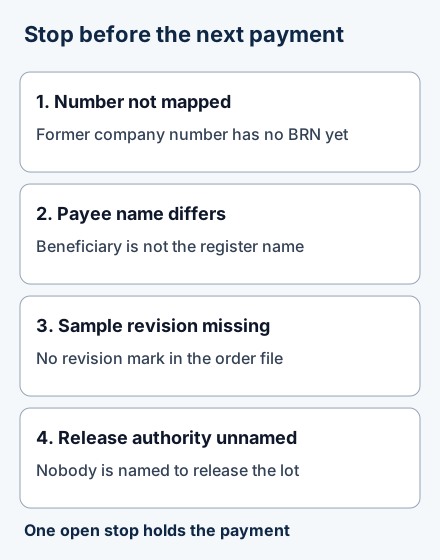
Rule of thumb. If mapped BRNs are under 1, stop. A former company number you have not run through CR No. / BRN Mapping is not yet the key number.
The e-Search page lists the ordinances it covers: Companies Ordinance (Cap. 622), Limited Partnerships Ordinance (Cap. 37), Money Lenders Ordinance (Cap. 163), Registered Trustees Incorporation Ordinance (Cap. 306), the Securities and Futures Ordinance (Cap. 571) for open-ended fund companies, Limited Partnership Fund Ordinance (Cap. 637), and miscellaneous incorporation ordinances. A company incorporated or registered under the Companies Ordinance is Cap. 622. If the candidate names one of the other ordinances on that list, search that register.
External Circular No. 4/2023, dated 10 November 2023, says information of shareholders of a local company will be included in the Company Particulars Search. The e-Search page fetched on 18 October 2026 says a user can search current data of registered companies and image records of documents registered and kept in the Companies Register. The same page says a user can order certified copies of those image records and search reports, or apply for a Certificate of Continuing Registration and Commemorative Records of Registration. The page does not list every field inside current data. Leave directors, a status word, and addresses blank in your notes until the extract you obtain shows them.
The flyer sets the Letter of Confirmation application fee at HK$130. That is the Registry’s fee for the letter in the October 2023 flyer, as evidence of the change to the BRN. It is not a sourcing commission. The same flyer says an Information Sheet can be bought as an image record and sends the reader to a price pamphlet for that fee. The pamphlet amount is not in the flyer, so the Information Sheet cell above stays empty.
Takeaway: Map the old number to the BRN before you pay a company that still prints the former number on its certificate.
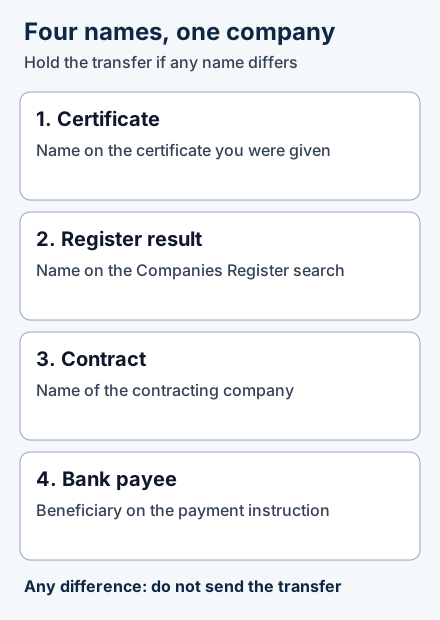
Which four names have to match before you pay?
Line up the name on the certificate you were given, the name on the Companies Register result, the contracting company, and the bank beneficiary.
Name differences = the count of those four that differ from the register name.
Rule of thumb. If name differences exceed 0, hold the transfer.
Worked arithmetic, with assumed names, not a real order. The certificate, the register result, and the contract use one company name. The bank beneficiary is a different name. Name differences = 1. The transfer waits until that beneficiary is the same company, or a second company you have searched under its own number.
Scroll horizontally to see all columns →
| Check | What you compare | Dominant failure mode | Prevention |
|---|---|---|---|
| Number | The quoted number against the BRN | An old certificate is treated as already showing the key number | Map the former number before you compare names |
| Payee | Certificate, register, contract, and beneficiary | Money reaches a different company | Hold the transfer while name differences exceed 0 |
| Fee text | Brief tasks against tasks the fee includes | Two rates are ranked while the task lists differ | Leave the rate blank and count unpriced tasks |
| Report | Checks and defects against your specification revision | Photographs stand in for the acceptance record | Release waits for the report you specified |
| Sample | Revision mark and named custodian | Bulk goods follow a different version | Pause until both are written down |
| Trial release | The person allowed to release the lot | Two people can each release it | Name one release authority before the trial payment |
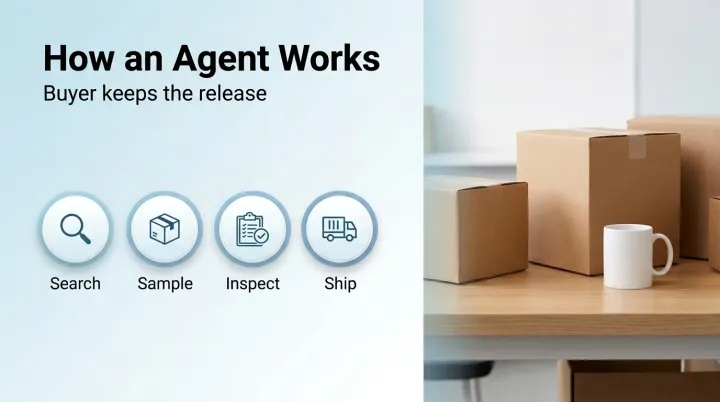
A register match shows a company on the Companies Register. It does not show that the person in the email works for that company, and it does not show which workshop will make the goods. The split between the agent, the factory, the broker, and the laboratory is the subject of how a China sourcing agent works.
A mainland contracting company uses a different record. Follow how to verify a Chinese supplier for the license and the unified code. A direct request to www.gsxt.gov.cn on 18 October 2026 returned HTTP 521, so this page does not describe that screen.
What should you do with a fee the registry does not print?
None of the Companies Registry pages used here print a sourcing commission, a duty rate, or a production lead time. Leave those cells blank until a document in the order file prints them.
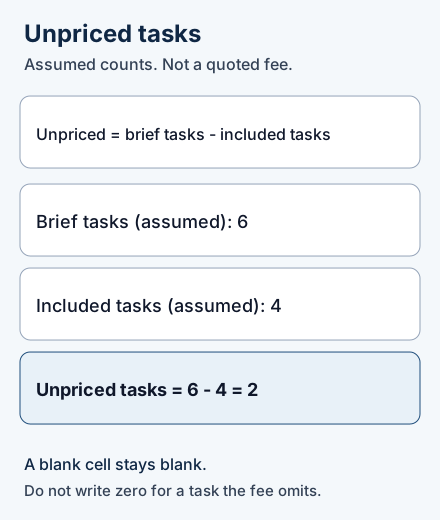
Unpriced tasks = brief tasks - included tasks
Rule of thumb. If unpriced tasks exceed 0, do not rank the fee totals.
Worked arithmetic, with assumed counts, not a quoted fee. The brief names 6 tasks. The written fee marks 4 of them as included. Unpriced tasks = 6 - 4 = 2. Those two stay blank on the comparison sheet. A blank cell stays blank. Do not write zero for a task the fee text omits.
Write the task list on the wholesale RFQ template before a candidate prices it. Read the charging base, the included work, and the separate lines in China sourcing agent fees.
The hidden cost of ranking a percentage first is the work that percentage does not name. Count a repeat inspection, storage past the period the quote writes down, relabeling, and a second sample shipment as tasks. If the quote does not name them, they stay in the unpriced count. This page assigns no dollar figure to them.
Takeaway: Rank the written task list, and leave the rate cell blank until the candidate writes both the rate and the base.
Which report and sample should the candidate show?
Ask for one inspection report from a previous order of a similar product, with the client name removed. Check that it names the specification revision, the checks performed, and the defects found. A set of finished-goods photos with no defect list does not show an acceptance plan.
Dominant failure mode: the lot is released on photographs. Prevention: release waits for a report that uses the checks written into the brief. Timing and the hold are in pre-shipment inspection in China. Defect classes and the sampling limits you agree belong in quality control inspection. This page does not restate a sampling table. The registry sources do not print one.
The sample that later bulk goods have to follow needs a revision mark and a named custodian. If the candidate cannot say who holds the approved sample, or the production specification differs from that sample with no written change, pause that candidate. The shortlist length belongs in your brief. This page does not set a required number of factories.
What does a trial have to prove?
Pick a trial whose loss you can carry, and write the evidence required before a larger order. The useful evidence is ordinary and on paper: the supplier name on the quotation, the sample revision, the inspection findings, and the one person allowed to release the goods or the balance.
Rule of thumb. If named release authorities exceed 1, and the agreement does not say which one controls, pause.
Dominant failure mode: two people can release the lot, and each treats the other as the one who is waiting. Prevention: one named release authority in the agreement before the trial payment. Record the pass, add-evidence, or pause result on the supplier scorecard.
When should you skip a search agent?
If the factory, the inspector, and the forwarder are already named, and the open job is the inspection, hire that inspection. A search mandate adds a supplier the file can then hide. The scope split is on how a China sourcing agent works, and the narrower inspection job is the pre-shipment inspection page.
The BRN rules on this page apply to a Hong Kong contracting company. They do not identify a mainland market entity. Use the supplier verification guide for that license and code.
A company search does not choose the goods. You still approve the specification, the sample, and the release. Once a candidate clears the name match and the written task list, the buying sequence around the order is how to source products from China.
Method and sources
Checked 18 October 2026 against the Companies Registry e-Search page, the BRN mapping page, the Unique Business Identifier flyer dated October 2023, and External Circular No. 4/2023 dated 10 November 2023. The HK$130 figure is the flyer’s application fee for a Letter of Confirmation. C0012345 and F0001234 are the flyer’s examples. Zeros added = 8 - 5 = 3 and Zeros added = 8 - 4 = 4 are arithmetic on those examples. The task counts 6 and 4, and the name-difference count of 1, are assumed arithmetic. They are not a quotation and not a company on the register.
www.gsxt.gov.cn returned HTTP 521 on 18 October 2026. This page does not describe that screen. No customs-credit page was opened. The library search returned no primary text of these Registry documents. No new search-results page was purchased.
Sources
- Companies Registry e-Search : Companies Registry, Hong Kong Special Administrative Region Accessed October 18, 2026.
- Lists for the mapping of former company numbers with business registration numbers : Companies Registry, Hong Kong Special Administrative Region Accessed October 18, 2026.
- Implementation of Unique Business Identifier (UBI flyer, October 2023) : Companies Registry, Hong Kong Special Administrative Region Accessed October 18, 2026.
- Companies Registry External Circular No. 4/2023 : Companies Registry, Hong Kong Special Administrative Region Accessed October 18, 2026.