Supplier Scorecard
A blank factor fails the supplier scorecard. It records seven responsibility standards and rates each applicable factor with five named ratings.
Updated

Copy the seven standards and rate only the factors that apply. Keep the sheet with the other buyer resources.
A supplier scorecard on this page copies two public lists. FAR 9.104-1, in FAC Number 2026-01 with effective date 13 March 2026, states seven standards a prospective contractor must meet before a responsibility determination. FAR 42.1503(b)(4) rates each past-performance factor on one five-scale system: exceptional, very good, satisfactory, marginal, and unsatisfactory. Table 42-1 defines those five ratings. Cost control is not applicable for a firm-fixed-price arrangement or a fixed-price arrangement with economic price adjustment. A lack of relevant performance history, by itself, does not decide responsibility or nonresponsibility, except as provided in FAR 9.104-2. Agencies use CPARS narratives within three years of completion, or six years for construction and architect-engineer contracts. Hold the comparison while any applicable factor still lacks a rating and a supporting narrative.
Copy the seven responsibility standards
FAR 9.104-1 says a prospective contractor must meet these standards to be determined responsible. Copy the table. A blank cell stays open. This sheet records evidence for a private comparison. The contracting officer's determination stays with the agency.
Scroll horizontally to see all columns →
| Standard | Record this | Dominant failure mode | Prevention |
|---|---|---|---|
| (a) Financial resources | Adequate financial resources to perform, or the ability to obtain them | A promise with neither resources nor a way to obtain them | Record one of the two, or leave the row open |
| (b) Schedule | Ability to meet the required or proposed delivery or performance schedule, considering all existing commercial and governmental business commitments | A date that ignores those commitments | Name the commitments that were considered |
| (c) Performance record | A satisfactory performance record. See FAR 9.104-3(b) and subpart 42.15 | Treating a missing history as the whole decision | Do not decide responsibility or nonresponsibility solely on a lack of relevant performance history, except as provided in FAR 9.104-2 |
| (d) Integrity and business ethics | A satisfactory record of integrity and business ethics | An ethics claim with no record | Record the check, or leave the row open |
| (e) Controls and skills | Organization, experience, accounting and operational controls, and technical skills, or the ability to obtain them. Where they apply: production control, property control, quality assurance, and safety programs, including subcontractors | Skipping a control that applies to the work | Name the controls that apply |
| (f) Equipment and facilities | Production, construction, and technical equipment and facilities, or the ability to obtain them | A capacity sentence with no equipment and no way to obtain it | Record the equipment or the ability to obtain it |
| (g) Eligibility | Otherwise qualified and eligible under applicable laws and regulations. The text points to the inverted domestic corporation prohibition at FAR 9.108 | Closing the row before the eligibility check is written | Record the check, or leave the row open |
Close the seller name and the account you pay in the supplier verification guide before a deposit. Standard (d) still needs its own record of integrity and business ethics.
Rate each applicable factor on five named ratings
FAR 42.1503(b)(2) sets the minimum evaluation factors. FAR 42.1503(b)(4) rates every factor and subfactor that you use, and it requires a supporting narrative. The rating words are exceptional, very good, satisfactory, marginal, and unsatisfactory. Table 42-1 defines them. Note 2 says to use N/A when a rating will not be applied to that area.
Scroll horizontally to see all columns →
| Factor | When it applies | Dominant failure mode | Prevention |
|---|---|---|---|
| Technical (quality of product or service) | Every assessment | A quality sentence with no narrative | Write the narrative. Record what you opened on the quality-control checklist |
| Cost control | Not applicable for firm-fixed-price or fixed-price with economic price adjustment | A cost-control rating on a firm-fixed-price order | Mark N/A |
| Schedule/timeliness | Every assessment | A date with no narrative of adherence | Record adherence, including the administrative aspects of performance |
| Management or business relations | Every assessment | A blank management factor hidden by the other ratings | Leave the factor open until the narrative is written |
| Small business subcontracting | When FAR 19.702(a) requires a subcontracting plan. When FAR 52.219-9 is used, rate it from Table 42-2 | Using Table 42-1 for a Table 42-2 factor | Use Table 42-2 when 52.219-9 is used. Otherwise mark N/A |
| Other | As applicable. Examples in FAR 42.1503(b)(2)(vi) include trafficking violations, tax delinquency, failure to report under the contract, defective cost or pricing data, terminations, suspension and debarment, and failure to comply with limitations on subcontracting | A silent row after one of those events | Record the event, or mark N/A |
Rule of thumb. If significant weaknesses on a factor sit above 0, do not assign Exceptional, Very Good, or Satisfactory. Table 42-1 requires no significant weaknesses for each of those three ratings.
Marginal means performance does not meet some contractual requirements. Unsatisfactory means performance does not meet most contractual requirements and recovery is not likely in a timely manner. Table 42-1 states that contractors will not be evaluated lower than Satisfactory solely for not performing beyond the requirements of the contract or order. Note 1 allows a plus or a minus to show an improving or worsening trend that is not enough to change the rating.

FAR 42.1501(a) gives eight examples of what a past-performance record can cover: conforming to requirements and to standards of good workmanship; forecasting and controlling costs; adherence to schedules, including the administrative aspects of performance; reasonable and cooperative behavior and commitment to customer satisfaction; the small business subcontracting plan; reporting into databases; integrity and business ethics; and business-like concern for the interest of the customer. CPARS is the official source for past performance information. FAR 42.1503(g) tells agencies to use CPARS information within three years of completion, and within six years for construction and architect-engineer contracts. Write the completion date on the narrative so that window is visible.
FAR 42.1503(d) affords the contractor up to 14 calendar days from the notification to submit comments, rebutting statements, or additional information. FAR 42.1503(f) makes the evaluation available for source selection officials not later than 14 days after that notification. Those 14 calendar days are the comment window in a federal evaluation.
Hold the ranking while an applicable factor is open
A factor counts as answered only when it carries one of the five ratings and a supporting narrative, or when it is marked N/A under Note 2. Bring the reply across from the wholesale RFQ template once that sheet's required rows are closed.
Worked example. Named minimum factors M = 6. A firm-fixed-price order marks cost control N/A. This example also marks small business subcontracting N/A and other N/A. Applicable factors A = 6 - 3 = 3: technical, schedule/timeliness, and management or business relations. Technical and schedule each have a rating and a narrative, and management is blank, so answered factors S = 2 and open factors O = A - S = 1. Coverage C = S / A = 2 / 3. If open applicable factors stay above 0, hold the ranking.
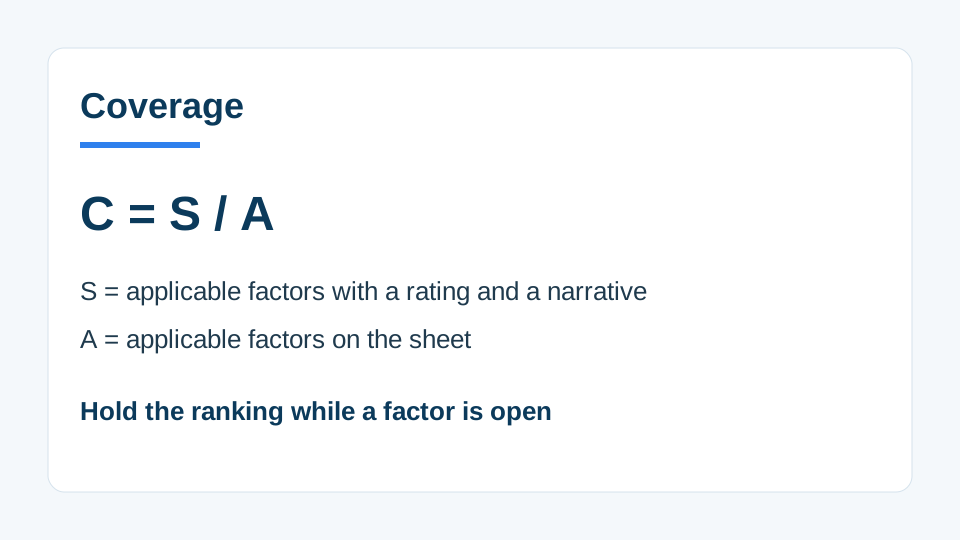
This fraction counts rows on the sheet. The five ratings stay the words in Table 42-1. Exceptional still requires that narrative: performance meets contractual requirements and exceeds many to the Government's benefit, with few minor problems, highly effective corrective actions, and no significant weaknesses.
Leave cost control off a firm-fixed-price order
FAR 42.1503(b)(2)(ii) removes cost control from firm-fixed-price arrangements and from fixed-price arrangements with economic price adjustment. FAR 42.1501(a)(2) still lists forecasting and controlling costs as one example inside a past-performance record. On a firm-fixed-price order the rating row is N/A, and the money question moves to the charges you already named.
Carry each named charge into the landed-cost calculation. Leave the amount cells blank on this sheet. The FAR pages used here do not print a price, a defect rate, or a production lead time for a wholesale order.
Method and sources
Checked 18 October 2026. Facts on this page come from FAR 9.104-1 (seven responsibility standards, and the rule on a lack of relevant performance history), FAR 42.1501 (eight example past-performance records, and CPARS as the official source), and FAR 42.1503 including Table 42-1 and Table 42-2 (minimum factors, the five ratings, N/A, the 14-calendar-day comment window, and the three-year or six-year CPARS window). FAC Number 2026-01, effective 13 March 2026, as published on Acquisition.gov. No price, defect rate, or production lead time is stated, because those pages do not print one for this sheet.