Shipping China-manufactured goods into the United States with country-of-origin markings printed only on the master export carton, abbreviated as "Made in PRC", or applied with low-tack paper stickers causes port examination holds, costly warehouse rework, and a mandatory 10% ad valorem marking duty. Under 19 U.S.C. § 1304(a) and 19 CFR § 134.11, every imported article of foreign origin must be marked in a conspicuous place as legibly, indelibly, and permanently as the nature of the article permits so the ultimate purchaser in the United States can read the English name of the country of origin.
Product Body vs. Master Carton Marking: The Ultimate Purchaser Test (19 U.S.C. 1304 & 19 CFR 134.11)
The single most frequent country-of-origin compliance failure in China wholesale procurement occurs when a factory stencils "MADE IN CHINA" on the corrugated master shipping carton but leaves the individual retail units inside unmarked. Whether U.S. Customs and Border Protection (CBP) releases or detains that shipment turns on who qualifies as the ultimate purchaser under 19 CFR Part 134.
Scroll horizontally to see all columns →
| Statutory Dimension | Controlling Citation | Operational Rule for China Imports | Dominant Violation Triggering CBP Form 4647 |
|---|---|---|---|
| Core Marking Mandate | 19 U.S.C. § 1304(a) & 19 CFR § 134.11 |
Every foreign-origin article must be marked conspicuously, legibly, indelibly, and permanently with its English country name at the time of importation. | Goods arrive at a U.S. port with no unit-level origin mark and no valid 19 CFR § 134.32 container exception. |
| Retail Ultimate Purchaser | 19 CFR § 134.1(d)(3) |
If an article is sold at retail in its imported form, the retail consumer is the ultimate purchaser. | "Made in China" is printed only on the outer master carton discarded at an Amazon FBA center, 3PL, or retail backroom. |
| Manufacturing Ultimate Purchaser | 19 CFR § 134.1(d)(1)-(2) & § 134.1(b) |
A U.S. processor is the ultimate purchaser only if the imported input undergoes a substantial transformation in the U.S. (new name, character, or use). | Importer performs simple kitting, repacking, or screw-assembly in the U.S. without marking the underlying Chinese components. |
| Container-Only Exception | 19 U.S.C. § 1304(a)(3)(D), 19 CFR § 134.32(d) & § 134.22(a) |
Individual articles are excepted when a sealed retail container ordinarily reaches the ultimate purchaser unopened, or when listed on the § 134.33 J-List. |
Article is unmarked, and the inner retail box, polybag, or blister card reaching the buyer also omits "Made in China". |
| Mandatory Permanent Methods | 19 CFR § 134.41(a) & 19 CFR § 134.43(a) |
Cutlery, razors, shears, surgical/lab instruments, pliers, hinged tools, and vacuum tumblers require die-stamping, cast-in-mold, etching, or engraving. | Factory applies a removable bottom paper sticker or hangtag to stainless-steel insulated tumblers or hand tools. |
| Apparel Center-Neck Rule | 16 CFR § 303.15(b) & 16 CFR § 303.33 |
Garments with a neck must carry a durable origin label at the inside center of the neck midway between shoulder seams. | Factory sews the "Made in China" tag only into the lower left side seam alongside the wash-care label. |
| U.S. Locality & Brand Address Trigger | 19 CFR § 134.46 |
Any U.S. city, state, ZIP code, or "U.S.A." on the product or box requires "Made in China" or "Product of China" in close proximity and comparable font size. |
Packaging prints "Distributed by Brand LLC, Austin, TX" in 12 pt type on the back and hides "Made in China" in 6 pt type on a bottom flap. |
| Acceptable English Country Name | 19 CFR § 134.45(a)-(b) |
Must use the full English name ("China" or "People's Republic of China"). |
Supplier prints "Made in PRC" or "P.R.C.", which CBP rejects as an unauthorized abbreviation. |
1. Why Master Shipping Carton Marks Fail for Retail and E-Commerce Goods (19 CFR § 134.1(d)(3))
Under 19 CFR § 134.1(d), the ultimate purchaser is defined as the last person in the United States who will receive the article in the form in which it was imported:
- Retail Distribution (
19 CFR § 134.1(d)(3)): Whenever an imported product is intended to be sold at retail in its imported form, the retail buyer (end consumer) is the statutory ultimate purchaser. A wholesale importer, distributor, retail chain warehouse, or Amazon FBA fulfillment center that breaks open master export cartons to stow or display individual units is an intermediate handler, not the ultimate purchaser. - Substantial Transformation Boundary (
19 CFR § 134.1(b)and§ 134.1(d)(1)-(2)): A U.S. company that imports Chinese components qualifies as the ultimate purchaser under§ 134.1(d)(1)only if its U.S. manufacturing process effects a substantial transformation–creating a new and different article of commerce with a distinctive name, character, or use. Under§ 134.1(d)(2), if the U.S. operation is minor (such as inserting a Chinese power adapter into a box, attaching a handle, or repacking bulk items into retail polybags) and leaves the identity of the imported article intact, the ultimate consumer remains the ultimate purchaser and each imported unit must carry its China origin mark before entering U.S. customs territory.
When coordinating multi-supplier orders or mixed-carton loads, pair unit-level origin checks with the receiving controls in our retailer and distributor sourcing workflow and verify that the country of origin declared under 19 CFR § 141.86(a)(10) on your commercial invoice and packing list cross-check matches the physical product markings.
2. When Container-Only Marking Is Legally Permitted (19 CFR § 134.32, § 134.33, and § 134.22)
Under 19 U.S.C. § 1304(a)(3) and 19 CFR § 134.32, an individual article is exempt from direct physical marking only when a specific statutory exception applies:
- Incapable of Being Marked (
19 CFR § 134.32(a)): Liquids, powders, raw materials, or micro-components whose physical surface cannot hold a legible mark. - Injury to the Article (
19 CFR § 134.32(b)): Delicate glass, finished optical lenses, or fine decorative surfaces that would be permanently marred or ruined by direct marking. - Prohibitive Expense (
19 CFR § 134.32(c)): Articles where direct unit marking prior to shipment would incur an expense economically prohibitive of their importation. - Sealed Container Reasonably Indicates Origin (
19 CFR § 134.32(d)): Articles imported in sealed retail containers (such as heat-sealed blister packs, printed retail window boxes, or sealed polybags) that reach the ultimate retail purchaser unopened. - The J-List Exceptions (
19 CFR § 134.33): Specific commodities exempted by Treasury decision, including bolts, nuts, washers, nails, wood screws, natural sponges, raw timber, and Christmas trees.
Crucially, under 19 CFR § 134.22(a), whenever an article is excepted from individual unit marking under § 134.32 or § 134.33, the outermost container or holder in which the article ordinarily reaches the ultimate purchaser must be marked with the English name of the country of origin. Furthermore, if you import empty packaging, containers, or adhesive labels from China to fill or attach to domestic goods in the U.S., 19 CFR § 134.14(b) requires the mark to distinguish the packaging from its contents–such as "Container Made in China" or "Label Made in China"–so consumers are not misled into thinking the finished product inside was made in China.
Selection takeaway: Trace every SKU to the exact physical handoff where the U.S. consumer receives it; if a master export carton or inner master bag is opened at any warehouse or fulfillment center before retail sale, the individual article or its sealed unit package must carry its own permanent "Made in China" mark.
Permanent Indelible Marking Methods vs. Paper Sticker Rejection (19 CFR 134.41, 134.43 & FTC 16 CFR 303.15)
Even when a Chinese supplier marks every individual unit, CBP port inspectors routinely detain cargo because the factory chose a temporary marking method that fails the statutory permanence standard.
1. The Permanence Hierarchy (19 CFR § 134.41(a)-(b))
Under 19 CFR § 134.41(a), U.S. Customs establishes that country-of-origin marking requirements are best met by marking worked into the article at the time of manufacture:
- Metal articles: Die-sinking, cast-in-the-mold lettering, or acid/laser etching.
- Earthenware, ceramic, or chinaware: Glazing the country-of-origin mark into the body during kiln firing (cold-applied bottom stickers on ceramic mugs frequently peel during dishwashing or unpacking).
- Molded plastics and rubber: Cavity mold-in relief or debossed lettering cut directly into the injection mold tool (
>= 0.25 mmto0.30 mmdepth). - Paperboard and printed packaging: Direct offset or flexographic imprinting on the dieline.
Under 19 CFR § 134.41(b), the degree of permanence must ensure that, unless deliberately removed, the mark remains on the article (or its retail container) throughout international ocean or air transit, distribution center sorting, and retail store handling until it is delivered to the ultimate purchaser. Under 19 CFR § 134.1(k), the mark must also be conspicuous–capable of being easily seen with normal handling of the article without disassembling the product or straining to read low-contrast lettering.
2. Mandatory Permanent-Only Merchandise (19 CFR § 134.43(a))
For specific product categories, paper stickers, hangtags, and pressure-sensitive labels are strictly illegal as the sole origin mark. Under 19 CFR § 134.43(a), the following classes of imported goods must be marked legibly and conspicuously ONLY by die-stamping, cast-in-the-mold lettering, etching (acid or laser), engraving, or by means of metal plates securely attached by welding, screws, or rivets:
- Knives, forks, steels, and cleavers (
HTSUS 8211,8214,8215); - Clippers, shears, scissors, and safety razors / blades (
HTSUS 8212,8213,8214); - Surgical, dental, scientific, and laboratory instruments (
HTSUS Chapter 90); - Pliers, pincers, nippers, and hinged hand tools for holding and splicing wire (
HTSUS 8203); - Vacuum containers (including double-wall stainless-steel insulated tumblers, vacuum flasks, and carafes under
HTSUS 9617).
Private-label drinkware and kitchenware importers frequently trigger port holds by ordering stainless-steel vacuum tumblers from Yongkang or Chaozhou factories with only a paper barcode sticker on the base or a printed retail gift box. Under 19 CFR § 134.43(a), the stainless-steel vacuum body itself must be laser-etched, die-stamped, or engraved with "Made in China".
3. Apparel and Textile Neck-Label Rules (16 CFR §§ 303.15 & 303.33)
Under 19 CFR § 134.31, compliance with general customs marking rules does not exempt an importer from specialized labeling statutes enforced by the Federal Trade Commission (FTC) or Consumer Product Safety Commission (CPSC). For textile and apparel imports, 16 CFR § 303.15(b) and 16 CFR § 303.33 under the Textile Fiber Products Identification Act mandate that:
- On any textile product containing a neck (such as T-shirts, polo shirts, sweaters, hoodies, jackets, and dresses), the country of origin must be disclosed on the front of a label affixed to the inside center of the neck midway between the shoulder seams (or in close proximity to another label affixed to the inside center of the neck).
- While fiber content (
"100% Cotton"), care instructions, and the importer’s RN number may be placed on a conspicuous interior side-seam label, the country of origin ("Made in China") cannot be moved to the side seam on a garment with a neck. Both sewn woven labels and durable heat-transfer (“tagless”) neck prints are permitted provided they remain legible through transport and retail sale.
4. Why Factory Paper Stickers Fail 19 CFR § 134.44(b)
For general merchandise not restricted by § 134.43, 19 CFR § 134.44(b)-(c) permits paper stickers, pressure-sensitive labels, or hangtags only if affixed in a conspicuous place so securely that, unless deliberately removed, they will remain on the article while it is in storage or on display and until it is delivered to the ultimate purchaser. Standard low-cost factory thermal paper stickers applied over mold-release oil, textured polypropylene, silicone, or powder-coated metal routinely curl and detach inside 40°C / 85% relative humidity ocean containers. When a CBP officer opens sample cartons at a Centralized Examination Station (CES) and finds loose stickers in the bottom of the polybag, the entire shipment fails 19 CFR § 134.44(b).
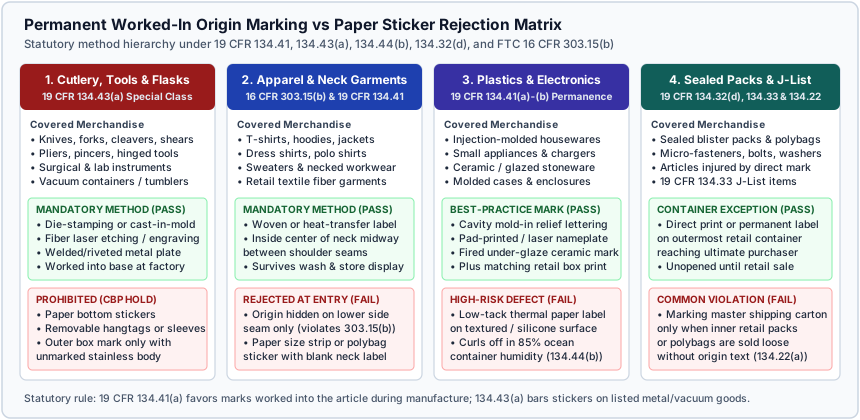
Engineering takeaway: Specify worked-in manufacturing marks (cavity mold-in relief >= 0.3 mm, fiber laser etching, or sewn center-neck woven labels) in your purchase order tooling sheet rather than relying on post-production paper stickers that fail 19 CFR § 134.44(b) adhesion checks.
The U.S. Locality and Trademark Trigger (19 CFR 134.46) and Why CBP Rejects “Made in PRC” (19 CFR 134.45)
Private-label brands selling on Amazon FBA or through U.S. retail chains almost always print their U.S. company name, city, state, and ZIP code on the retail box, instruction manual, or product rating plate. Doing so activates the strictest typography and layout rule in U.S. customs law: 19 CFR § 134.46.
1. The Three Mandatory Conditions of 19 CFR § 134.46
Under 19 CFR § 134.46, whenever the words "United States", "American", the letters "U.S.A.", or the name of any city or location in the United States (or any foreign country/locality other than the country of origin) appears on an imported article or its container in a context that could mislead or deceive the ultimate purchaser as to the actual country of origin, the article or container must be marked with the English name of the country of origin under three simultaneous requirements:
- Mandatory Prefix Phrase (
"Made in"or"Product of"): While19 CFR § 134.45(a)normally permits the standalone word"China"when no other locality appears, triggering19 CFR § 134.46requires the country name to be preceded by the words"Made in","Product of", or other words of similar meaning (e.g.,"Made in China"or"Product of China"). - Close Proximity (Same Panel, Same Viewing Glance): The
"Made in China"marking must appear in close proximity to the U.S. address, city, or"U.S.A."reference. In CBP administrative rulings, close proximity means printed on the exact same surface panel or label face so a buyer looking at"Designed in Austin, TX"or"Distributed by Brand LLC, Los Angeles, CA 90012"sees"Made in China"in the same viewing glance without rotating the box or lifting a flap. - At Least a Comparable Font Size (
Origin Height >= U.S. Locality Height): The letter height (point size / millimeter cap height) of"Made in China"must be at least as large as the letter height of the U.S. city, state, or country name:Origin_Font_Height (mm or pt) >= Max(US_City_State_Country_Font_Height)- Worked Typography Example: If your retail packaging back panel prints
"Distributed by Apex Home LLC, Austin, TX 78701 USA"in11 pttype (3.9 mmcapital letter height), then"MADE IN CHINA"must be printed immediately adjacent on that same panel in at least11 pt(>= 3.9 mmcapital letter height). If the front panel also displays a badge reading"AUSTIN, TEXAS"in16 pt(5.6 mm) lettering, a second"MADE IN CHINA"mark of at least16 pt(5.6 mm) must appear in close proximity on the front panel as well.
2. Why "Made in PRC" and "Assembled in China" Misuse Fail (19 CFR § 134.45 & § 134.43(e))
Chinese factories frequently offer to print "Made in PRC" or "Made in P.R.C." (“People’s Republic of China”) to soften consumer perception. Under 19 CFR § 134.45(a)-(b), abbreviations are lawful only if they unmistakably indicate the name of the country of origin to the U.S. ultimate purchaser (such as "Gt. Britain" or "U.K."). CBP consistently rules that "Made in PRC" and "P.R.C." are unacceptable and trigger a CBP Form 4647 marking hold. Only "China" or the unabbreviated "People's Republic of China" satisfies 19 CFR § 134.45.
Similarly, under 19 CFR § 134.43(e), the phrase "Assembled in China" (or "Assembled in China from components of [Country]") is authorized only when China is the country of origin by virtue of final assembly from formed components. Do not allow a supplier to substitute "Designed in USA" alone without an adjacent, equal-sized "Made in China" disclosure.
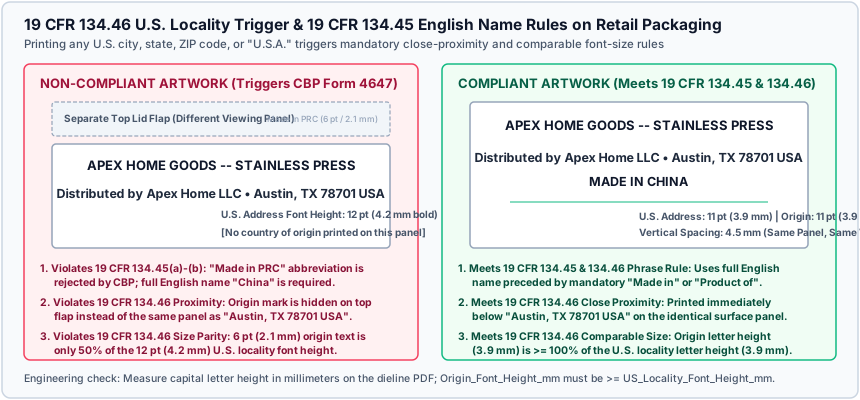
Selection takeaway: Audit every panel of your PDF packaging dieline before releasing print plates: wherever a U.S. city, state, ZIP code, or "U.S.A." appears, place "MADE IN CHINA" on the same panel within 5 mm to 10 mm at >= 100% of the U.S. locality font height.
CBP Form 4647, CES Remarking Costs, the 10% Marking Duty (19 U.S.C. 1304), and 100% Liquidated Damages
When U.S. Customs discovers unmarked articles, peeling paper stickers, "Made in PRC" labels, or 19 CFR § 134.46 font/proximity violations during a cargo exam, enforcement follows a strict statutory sequence under 19 U.S.C. § 1304 and 19 CFR Subpart F (§§ 134.51-134.55). Even if a Chinese supplier quoted “All-In DDP” shipping, the U.S. Importer of Record bears direct legal and financial liability–a critical boundary detailed in our DDP China Importer of Record checklist and Alibaba Express vs DDP sea freight customs entry comparison.
Core Statutory Penalty & Remediation Formulas
- Mandatory 10% Ad Valorem Marking Duty (
19 U.S.C. § 1304(f)/(i)&19 CFR § 134.2):Additional Marking Duty ($) = 0.10 × Final Appraised Value ($)- Codified at
19 U.S.C. § 1304(i)(and referenced in19 CFR § 134.2under its prior designation§ 1304(f)), this10%ad valorem duty applies to any imported article or container not legally marked at the time of importation unless the article is exported, destroyed, or properly marked under CBP supervision prior to liquidation of the entry. The statute explicitly dictates that this10%duty is in addition to all regular HTSUS and Section 301 duties, is not construed to be penal, and shall not be remitted wholly or in part.
- Supervised Remarking & Rework Cost (
19 U.S.C. § 1304(j)&19 CFR §§ 134.52-134.55):Total Port Rework Cost ($) = CES Drayage & Devanning + (N_units × Per_Unit_Rework_Labor_&_Labels) + Port Storage Demurrage + CBP Officer Supervision Reimbursement (19 CFR § 134.55)
- 30-Day Redelivery Default / Liquidated Damages (
19 CFR § 134.54(a)&19 CFR § 113.62):Bond Liquidated Damages ($) = 1.00 × Entered Value of Unremarked / Unredelivered Merchandise ($)
- Criminal Penalties for Intentional Removal or Concealment (
19 U.S.C. § 1304(l)&19 CFR § 134.4):- Under
19 U.S.C. § 1304(l)(formerly§ 1304(h)/(i)), any person who intentionally removes, obliterates, destroys, or alters a country-of-origin mark with intent to conceal the origin from the ultimate purchaser faces criminal fines up to$100,000(first conviction) or$250,000(second or subsequent conviction), imprisonment for up to1 year, or both.
- Under
Worked Financial Escalation on a $50,000 Wholesale Shipment (10,000 Units @ $5.00 FOB)
To see how a factory marking error compounds into landed-cost loss, trace a 10,000-unit wholesale order of stainless-steel kitchen tools with a Final Appraised / Entered Value of $50,000 ($5.00 per unit):
Scroll horizontally to see all columns →
| Enforcement Stage | Statutory Trigger & Timeline | Formula / Cost Components | Dollar Impact on $50,000 (10,000-Unit) Lot |
Impact Per Unit ($5.00 Base) |
|---|---|---|---|---|
| Stage 0: Factory Prevention (Baseline) | Pre-shipment mold-in / laser etch + compliant box dieline (19 CFR §§ 134.41-134.46) |
$0.00 to $0.03/unit laser marking during mass production |
$0 - $300 |
+$0.00 to +$0.03 |
| Stage 1: Port Exam Hold & CBP Form 4647 | 19 U.S.C. § 1304(j), 19 CFR § 134.3(a) & § 134.51(a) (Day 0 Notice to Mark/Redeliver) |
Container drayage to CES + devanning/re-palletizing exam fee | $950 - $1,600 |
+$0.10 to +$0.16 |
| Stage 2: 30-Day Supervised Remarking | 19 CFR § 134.52 (Certificate of Marking) & § 134.55 (CBP officer compensation & per diem) |
Unpack cartons + apply compliant marks (10,000 × $0.22) + CES storage + § 134.55 officer time |
$2,800 - $4,500+ (including Stage 1 CES charges) |
+$0.28 to +$0.45 |
| Stage 3: Unmarked at Entry Liquidation | 19 U.S.C. § 1304(f)/(i) & 19 CFR § 134.2 (Goods released without supervised remarking before liquidation) |
0.10 × $50,000 Final Appraised Value (non-remittable statutory duty stacked on regular tariffs) |
+$5,000.00 mandatory marking duty |
+$0.50 (+10.0% tariff jump) |
| Stage 4: Day 31+ Failure to Redeliver | 19 CFR § 134.54(a) (Importer fails to mark or return conditionally released goods within 30 days) |
1.00 × $50,000 Entered Value bond claim + $5,000 (10%) marking duty |
$55,000.00 ($50,000 liquidated damages + $5,000 duty) |
+$5.50 (110% of goods value) |
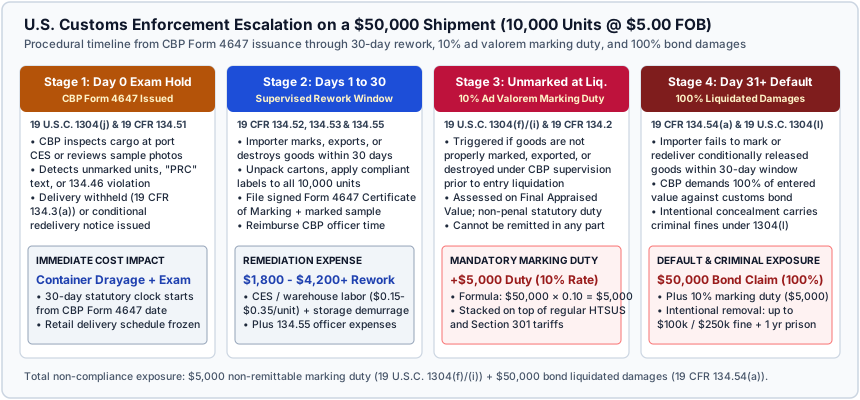
Calculation takeaway: Model a marking violation not as a minor clerical warning, but as an immediate $0.28 to $0.45 per-unit U.S. warehouse rework expense or a mandatory +10.0% ad valorem duty surcharge in your landed cost calculation formula and landed cost calculator.
Pre-Shipment Factory Spec Sheet and AQL Inspection Protocol in China
Preventing a CBP Form 4647 notice requires locking down origin artwork before production starts and verifying physical adhesion and typography before the container is sealed in China. Integrate these controls into your pre-shipment inspection in China workflow, quality control inspection standard, and quality control checklist. When shipping into Amazon fulfillment centers, combine 19 CFR Part 134 origin checks with FNSKU and carton label verification in our shipping from China to Amazon FBA guide and consumer safety certificate checks in our CPSC eFiling supplier-broker data checklist.
Engineering Rules of Thumb for Origin Marking Verification
- Rule of Thumb 1 (The
100%Font-Height Parity Rule under19 CFR § 134.46): Whenever any U.S. city, state, ZIP code, or"U.S.A."appears on a product, hangtag, or retail box panel, measure the capital letter height in millimeters (mm). SetOrigin_Cap_Height_mm >= US_Locality_Cap_Height_mmon the exact same surface panel within<= 10 mmspacing, and always include the prefix"Made in"or"Product of". - Rule of Thumb 2 (The
>= 0.30 mmWorked-In Relief / Laser Etch Rule for Hardgoods): For injection-molded plastics, die-cast alloys, and19 CFR § 134.43(a)metal tools, cutlery, and stainless-steel vacuum tumblers, ban adhesive paper origin stickers entirely. Specify cavity mold-in lettering (>= 0.30 mmrelief depth) or permanent fiber laser engraving so unit marking cost approaches$0.00after tooling and peel failures drop to zero. - Rule of Thumb 3 (The 15-Second Rub & Corner-Peel Test under
19 CFR § 134.44(b)): Where pressure-sensitive labels are legally permitted on general merchandise or sealed inner polybags, require the pre-shipment inspector in China to perform a 15-second firm thumb-rub test (checking ink smearing) and a fingernail corner-peel test across20random sample units. If any label lifts cleanly without tearing the paper fiber or delaminates from a textured surface, classify the lot as a Critical compliance defect (AQL 0) and hold shipment for factory rework before export. - Rule of Thumb 4 (The Three-Layer Marking Check: Unit + Retail Pack + Master Carton): Require time-stamped inspection photos across all three packaging layers before releasing the
70%balance wire: (a) the physical product body mark (19 CFR § 134.11/16 CFR § 303.15(b)), (b) the immediate retail box or sealed polybag (19 CFR § 134.22(a)&§ 134.46), and (c) the corrugated master shipping carton (19 U.S.C. § 1304(b)).
Copyable Buyer PO Spec & Pre-Shipment Origin Marking Audit Worksheet
Copy the verification worksheet below into your procurement and pre-shipment inspection file for each SKU run. Record the verified marking method, measured letter height in millimeters, U.S. locality proximity check, and customs entry identifiers before authorizing container loading. Explore our shipping and customs compliance guides and full China sourcing guide library for companion verification templates.
Scroll horizontally to see all columns →
| Verification Checkpoint | Controlling Statute / Regulation | SKU / Product Unit Body | Inner Retail Box / Polybag | Outer Master Shipping Carton |
|---|---|---|---|---|
| Statutory ultimate purchaser identified (Retail consumer vs U.S. manufacturer) | 19 CFR 134.1(d)(1)-(3) | |||
| Exact English origin wording printed (“Made in China” / “Product of China” – zero “PRC”) | 19 CFR 134.45(a)-(b) | |||
| Physical marking method (Mold-in, laser etch, sewn neck label, direct box print, or high-tack label) | 19 CFR 134.41(a) & 134.44(b) | |||
| Special permanent-only class check (Cutlery, tools, surgical/lab instruments, vacuum tumblers) | 19 CFR 134.43(a) (No stickers allowed) | |||
| Apparel neck-label placement check (Inside center of neck midway between shoulder seams) | 16 CFR 303.15(b) & 303.33 | |||
| U.S. city, state, ZIP code, or “U.S.A.” printed on surface panel (Yes / No & exact text) | 19 CFR 134.46 trigger check | |||
| Measured U.S. locality cap height (mm / pt) vs “Made in China” cap height (mm / pt) on same panel | 19 CFR 134.46 (Origin height >= U.S. height) | |||
| Measured distance (mm) between U.S. locality text and “Made in China” on same viewing panel | 19 CFR 134.46 close proximity rule | |||
| Empty container / domestic-fill label distinction check (“Container/Label Made in China”) | 19 CFR 134.14(a)-(b) | |||
| 15-second thumb-rub & corner-peel adhesion test result across 20 random units (Pass / Fail) | 19 CFR 134.41(b) & 134.44(b) | |||
| Commercial invoice country-of-origin line item matches physical unit and carton marks | 19 CFR 141.86(a)(10) |
Frequently asked questions
Is printing Made in China on the outer shipping carton enough for U.S. Customs?
No, not for merchandise sold by the individual unit at retail. Under 19 U.S.C. 1304(a), 19 CFR 134.11, and 19 CFR 134.1(d)(3), the mark must reach the ultimate purchaser in the United States--which for retail goods is the consumer who buys the item. If a distributor, 3PL warehouse, or Amazon FBA fulfillment center opens the master export carton and discards it, each individual unit (or its sealed retail box/polybag delivered unopened to the consumer under 19 CFR 134.32(d) and 134.22(a)) must bear its own permanent country-of-origin mark.
Can we mark products 'Made in PRC' instead of 'Made in China'?
No. Under 19 CFR 134.45(a)-(b), imported articles must be marked with the full English name of the country of origin unless an abbreviation unmistakably indicates that country to the ultimate purchaser. U.S. Customs and Border Protection (CBP) rulings and Informed Compliance guidance explicitly reject 'Made in PRC' and 'P.R.C.' because retail consumers do not universally recognize the initials. Acceptable markings are 'China', 'Made in China', 'Product of China', or 'Made in People's Republic of China'.
When does 19 CFR 134.46 require 'Made in China' in comparable font size on retail packaging?
Under 19 CFR 134.46, whenever the words 'United States', 'American', 'U.S.A.', or any U.S. city or state name (such as 'Distributed by Brand LLC, Austin, TX 78701' or 'Designed in California') appears on an imported article or its retail packaging, three mandatory conditions apply: (1) the origin mark must include the prefix 'Made in', 'Product of', or words of similar meaning, (2) it must appear in close proximity on the same viewing panel as the U.S. locality text, and (3) its letter height must be at least as large as the U.S. locality text.
Are adhesive paper stickers acceptable for Made in China marking?
Only on general merchandise outside the 19 CFR 134.43 mandatory permanent-marking list, and only if the sticker passes the permanence test of 19 CFR 134.41(b) and 134.44(b). The pressure-sensitive label must be affixed so securely that it survives ocean humidity, warehouse handling, and retail display without curling or peeling unless deliberately removed. For knives, forks, shears, razors, surgical/scientific instruments, pliers, hinged hand tools, and stainless-steel vacuum containers, 19 CFR 134.43(a) prohibits paper stickers entirely and mandates die-stamping, cast-in-mold lettering, etching, engraving, or welded/riveted metal plates.
What happens after CBP issues Form 4647 (Notice to Mark and/or Notice to Redeliver)?
Under 19 CFR 134.51(a) and 134.54(a), CBP Form 4647 gives the Importer of Record 30 days to properly mark the goods, export them, or destroy them under CBP supervision (or return conditionally released goods to CBP custody). If the Center director accepts a Certificate of Marking under 19 CFR 134.52, the importer reworks the units and submits signed certification with marked samples; if CBP officers supervise the rework, the importer reimburses officer salary and expenses under 19 CFR 134.55. Failure to remedy before liquidation triggers a mandatory 10% ad valorem marking duty (19 U.S.C. 1304(f)/(i)), and failure to redeliver within 30 days triggers liquidated damages equal to 100% of entered value under 19 CFR 134.54(a).
Where must the Made in China label be placed on T-shirts, hoodies, and other apparel?
Under Federal Trade Commission (FTC) regulations at 16 CFR 303.15(b) and 303.33, enforced alongside 19 CFR Part 134 at U.S. ports of entry, any textile garment with a neck must display its country-of-origin label on the inside center of the neck midway between the shoulder seams (or in close proximity to another label affixed at the inside center of the neck). While fiber content and RN numbers may be placed on an interior side seam, moving the country-of-origin disclosure exclusively to the side seam violates 16 CFR 303.15(b).
Sources
- 19 U.S.C. 1304 - Marking of imported articles and containers : Legal Information Institute, Cornell Law School Accessed October 25, 2026.
- 19 U.S.C. 1304 - Tariff Act of 1930, Section 304 (Official U.S. Code PDF) : U.S. Government Publishing Office (GovInfo) Accessed October 25, 2026.
- 19 CFR Part 134 - Country of Origin Marking : National Archives and Records Administration (eCFR) Accessed October 25, 2026.
- 19 CFR 134.11 - Country of origin marking required : National Archives and Records Administration (eCFR) Accessed October 25, 2026.
- 19 CFR 134.32 - General exceptions to marking requirements : National Archives and Records Administration (eCFR) Accessed October 25, 2026.
- 19 CFR 134.41 - Methods and manner of marking : National Archives and Records Administration (eCFR) Accessed October 25, 2026.
- 19 CFR 134.46 - Marking when name of country or locality other than country of origin appears : National Archives and Records Administration (eCFR) Accessed October 25, 2026.
- 19 CFR 134.51 - Procedure when articles are not legally marked (CBP Form 4647) : National Archives and Records Administration (eCFR) Accessed October 25, 2026.
- 16 CFR 303.15 - Required label and method of affixing (FTC Textile Act Rules) : National Archives and Records Administration (eCFR) / Federal Trade Commission Accessed October 25, 2026.