Accepting an Alibaba Express air courier or bundled DDP quote on its headline per-kilogram rate without calculating outer carton volumetric weight and verifying the U.S. Importer of Record can inflate chargeable weight by up to 92% and leave the buyer with a costly customs hold. Compare each freight quote across two independent axes before cargo leaves the factory: the carrier billing formula (÷5000 cm3/kg vs ÷6000 cm3/kg vs 1 CBM = 1,000 kg Weight or Measure) and the statutory entry chain (19 U.S.C. § 1484, 19 CFR § 141.86, and 19 CFR § 142.3).
Mode Routing and Divisor Comparison: Express Courier vs Air DDP vs LCL Sea Freight
Small and mid-sized wholesale orders moving from China to the United States generally route through one of three transport structures: International Express Air Courier, Air DDP Consolidation (air linehaul plus final-mile ground parcel delivery), or LCL Sea Freight / DDP Sea Consolidation. Even when two quotes state the same per-kilogram price, their billing formulas and transport documents differ fundamentally.
Scroll horizontally to see all columns →
| Routing Attribute | International Express Air Courier (Alibaba Express / DHL / FedEx / UPS) |
Air DDP Consolidation (Air Linehaul + Final-Mile UPS / FedEx Ground) | Formal LCL Sea Freight / DDP Sea Consolidation |
|---|---|---|---|
| Volumetric / Billing Formula | (L x W x H cm) / 5,000 per kg (1 CBM = 200.00 kg) |
(L x W x H cm) / 6,000 per kg (1 CBM = 166.67 kg) on standard air cargo; verify if quote reverts to ÷5000 |
Formal LCL: 1 CBM = 1,000 kg Weight or Measure (W/M) per Revenue Ton. Sea-Parcel DDP: often bills per kg at ÷6000 |
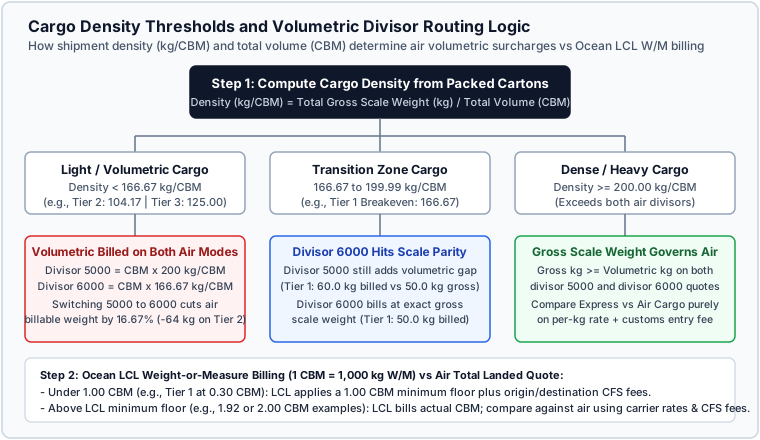
| Density Breakeven Threshold | 200.00 kg/CBM (any cargo lighter than 200 kg/CBM pays volumetric weight) |
166.67 kg/CBM (reduces volumetric weight by 16.67% vs ÷5000 for light goods) |
1,000.00 kg/CBM on formal LCL (virtually all general merchandise bills purely by CBM volume) |
Primary Transport Document (trade.gov, 19 CFR § 142.3) |
Direct Courier Air Waybill (AWB) tracking origin pickup through U.S. door delivery | Consolidated Master Air Waybill (MAWB) to U.S. gateway airport + domestic ground parcel tracking label | Ocean Bill of Lading (House B/L + Master B/L) for formal LCL; pooled Master B/L + ground label for Sea-UPS DDP |
| Typical Minimum Billable Floor | 0.5 kg to 1.0 kg (with per-carton dimensional rounding) |
21 kg, 45 kg, or 100 kg per shipment lot depending on consolidator tariff |
1.00 CBM or 2.00 CBM on formal LCL (or 100 kg minimum on sea-parcel DDP lines) |
U.S. Customs Entry Visibility (19 U.S.C. § 1484, 19 CFR § 142.3) |
High when cleared under buyer’s EIN/bond with CBP Form 7501 issued to buyer |
Opaque if pooled under an unnamed third-party Master AWB consignee without CBP Form 7501 |
High on direct House B/L with buyer’s 19 U.S.C. § 1641 broker; opaque on bundled multi-shipper DDP lines |
| Best-Fit Shipment Profile | Urgent samples, high-density hardware, and trial runs under 50 kg / 0.30 CBM |
Medium restocks (50 kg to 200 kg) when IOR, broker license, and ÷6000 divisor are confirmed in writing |
Multi-carton restocks clearing the 1.00 or 2.00 CBM LCL minimum floor (such as the 1.92 and 2.00 CBM examples below) where ocean rates and CFS fees beat air volumetric surcharges |
Selection takeaway: Never compare an Express Air Courier rate against an Air DDP or LCL quote using factory net weight. Convert packed outer carton dimensions into both ÷5000 and ÷6000 volumetric kilograms first, then confirm whether the customs filing provides an individual CBP Form 7501 entry summary.
Volumetric Weight Formulas and Worked Math Across 50 kg, 200 kg, and 2.00 CBM Tiers
Carriers charge for the physical space a carton occupies inside an aircraft fuselage or ocean container whenever that space exceeds the carton’s actual scale weight. International express couriers apply a metric divisor of 5,000 cm3/kg under published DHL Express volumetric weight calculation rules, whereas standard air cargo tariffs apply 6,000 cm3/kg under the IATA air cargo volumetric weight standard.
Core Engineering Formulas
- Total Shipment Volume (
CBM):Total CBM = (N_cartons x Length_cm x Width_cm x Height_cm) / 1,000,000
- Cargo Density (
kg/CBM):Cargo Density (kg/CBM) = Total Gross Scale Weight (kg) / Total CBM
- Express Air Courier Volumetric Weight (
Divisor 5,000 cm3/kg):Volumetric Weight_5000 (kg) = (N_cartons x Length_cm x Width_cm x Height_cm) / 5,000 = Total CBM x 200 kg/CBM
- Air Cargo / Air DDP Volumetric Weight (
Divisor 6,000 cm3/kg):Volumetric Weight_6000 (kg) = (N_cartons x Length_cm x Width_cm x Height_cm) / 6,000 = Total CBM x 166.67 kg/CBM
- Air Mode Chargeable Weight (
kg):Chargeable Weight (kg) = max(Total Gross Scale Weight (kg), Volumetric Weight (kg))
- Ocean LCL Billable Revenue Tons (
W/M):Billable W/M = max(Total CBM, Total Gross Scale Weight (kg) / 1,000, Minimum LCL Floor (1.00 or 2.00 CBM))
Worked Carton Calculations: Tier 1 (50 kg), Tier 2 (200 kg), and Tier 3 (2.00 CBM)
Scroll horizontally to see all columns →
| Shipment Tier Profile | Carton Count & Outer Dimensions (L x W x H cm) |
Total Gross Weight (kg) |
Total Volume (CBM / cm3) |
Cargo Density (kg/CBM) |
Express Courier Chargeable Weight (÷5000) |
Air DDP / Air Cargo Chargeable Weight (÷6000) |
Formal Ocean LCL Billable Unit (1 CBM = 1,000 kg W/M) |
|---|---|---|---|---|---|---|---|
Tier 1: 50 kg Trial / Sample Batch |
10 cartons @ 40 x 30 x 25 cm, 5.0 kg each (or 5 cartons @ 50 x 40 x 30 cm, 10.0 kg each) |
50.0 kg |
0.30 CBM (300,000 cm3) |
166.67 kg/CBM |
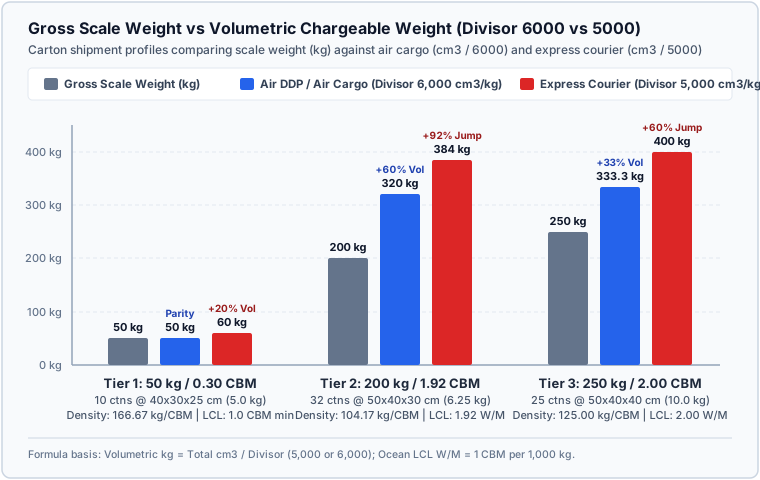
60.0 kg (300,000 / 5,000 = +20.0% volumetric gap) |
50.0 kg (300,000 / 6,000 = exact breakeven with scale weight) |
1.00 CBM minimum (0.30 CBM actual is below standard 1.00 CBM LCL floor) |
Tier 2: 200 kg Light Volumetric Restock |
32 cartons @ 50 x 40 x 30 cm, 6.25 kg each (or 20 cartons @ 60 x 40 x 40 cm, 10.0 kg each) |
200.0 kg |
1.92 CBM (1,920,000 cm3) |
104.17 kg/CBM |
384.0 kg (1,920,000 / 5,000 = +92.0% chargeable jump) |
320.0 kg (1,920,000 / 6,000 = +60.0% jump; saves 64.0 kg vs ÷5000) |
1.92 W/M (CBM) (0.20 MT < 1.92 CBM; eliminates air volumetric multiplier) |
Tier 3: 2.00 CBM Wholesale Replenishment |
25 cartons @ 50 x 40 x 40 cm, 10.0 kg each |
250.0 kg |
2.00 CBM (2,000,000 cm3) |
125.00 kg/CBM |
400.0 kg (2,000,000 / 5,000 = +60.0% jump, +150.0 kg over gross) |
333.33 kg (2,000,000 / 6,000, rounded to 333.5 or 334.0 kg; saves 66.67 kg vs ÷5000) |
2.00 W/M (CBM) (meets standard 2.00 CBM LCL consolidation tier cleanly) |
Step-by-Step Arithmetic Breakdown
- Tier 1 (
50.0 kg,0.30 CBM, The166.67 kg/CBMBreakeven Point):- Each
40 x 30 x 25 cmcarton displaces30,000 cm3(0.03 CBM) and weighs5.0 kgon the scale (10 cartons=300,000 cm3=0.30 CBMand50.0 kggross; an identical300,000 cm3/50.0 kgratio holds for5 cartonsat50 x 40 x 30 cmweighing10.0 kgeach). - Under an Alibaba Express courier quote (
÷5000),300,000 cm3 / 5,000 = 60.0 kg. Because60.0 kg > 50.0 kg, the buyer pays for 60.0 kg (10.0 kgof air space, or+20.0%). - Under a
÷6000air cargo divisor,300,000 cm3 / 6,000 = 50.0 kg, matching the50.0 kgscale weight exactly. Because0.30 CBMsits far below the1.00 CBMocean LCL minimum and incurs fixed port handling charges, express air courier or direct air cargo remains the standard operational choice for Tier 1.
- Each
- Tier 2 (
200.0 kg,1.92 CBM, The+92%Volumetric Penalty Zone):- Packed as
32 cartonsat50 x 40 x 30 cmand6.25 kgeach (or20 cartonsat60 x 40 x 40 cmand10.0 kgeach), total volume reaches1,920,000 cm3(1.92 CBM) against200.0 kggross scale weight, yielding a low cargo density of104.17 kg/CBM. - Under Express Courier (
÷5000), chargeable weight surges from200.0 kgto 384.0 kg (1,920,000 / 5,000), a +92.0% increase (+184.0 billable kg). - Under Air DDP (
÷6000), chargeable weight drops to 320.0 kg (1,920,000 / 6,000), saving 64.0 billable kg (16.67%less chargeable weight than÷5000), but still adding+120.0 kg(+60.0%) over scale weight. - Under formal Ocean LCL (
1 CBM = 1,000 kgW/M),200.0 kgequals0.20 metric tons, so the shipment bills strictly on its volume of 1.92 W/M (CBM).
- Packed as
- Tier 3 (
250.0 kg,2.00 CBM, The2.00 CBMLCL Consolidation Profile):- Across
25 cartonsmeasuring50 x 40 x 40 cm(80,000 cm3each) at10.0 kggross per carton, shipment volume equals2,000,000 cm3(2.00 CBM) and density equals125.00 kg/CBM. - Express Courier (
÷5000) bills 400.0 kg (+150.0 kgover gross); Air Cargo / Air DDP (÷6000) bills 333.33 kg (rounded by carrier tariff to333.5 kgor334.0 kg); formal Ocean LCL bills 2.00 CBM W/M on a dedicated House Bill of Lading.
- Across
- Carton Bulge and Per-Carton Rounding Sensitivity:
- Depot laser scanners measure the outermost bowed point of corrugated walls. If a
60 x 40 x 40 cmcarton (96,000 cm3) bulges by+2 cmper axis during stacking to62 x 42 x 42 cm(109,368 cm3), its÷5000volumetric weight rises from19.20 kgto21.87 kg(rounded to22.0 kgper carton), adding +56.0 extra billable kg across a 20-carton lot (440.0 kgvs384.0 kg).
- Depot laser scanners measure the outermost bowed point of corrugated walls. If a
Calculation takeaway: Always insert carton counts, outer dimensions, and scale weight into your own spreadsheet before accepting a forwarder’s quote, and carry the verified freight total into the landed cost calculation formula and landed cost calculator.
Statutory U.S. Customs Entry Boundaries: 19 U.S.C. 1484, 19 CFR 141.86, and 19 CFR 142.3
Choosing between Alibaba Express Courier, Air DDP, and LCL Sea Freight is not solely a freight-math calculation. Every commercial shipment entering the United States must satisfy federal entry, invoice itemization, and recordkeeping requirements under the U.S. Code and Code of Federal Regulations.
1. Importer of Record Qualification (19 U.S.C. § 1484 and 19 U.S.C. § 1641)
Under 19 U.S.C. § 1484(a)(1), one of the parties qualifying as Importer of Record under paragraph (a)(2)(B) must execute and file the entry documentation and electronic data required to release merchandise from U.S. Customs and Border Protection (CBP) custody and complete the entry using reasonable care (declaring value, HTSUS classification, and rate of duty).
Under 19 U.S.C. § 1484(a)(2)(B), the Importer of Record must be:
- The owner or purchaser of the merchandise; or
- When appropriately designated by the owner, purchaser, or consignee, a person holding a valid U.S. customs broker license issued under 19 U.S.C. § 1641(b)(1).
Furthermore, under 19 CFR § 141.19(a), the declaration of entry on CBP Form 3461 or CBP Form 7501 must be signed by the consignee or by an agent of the consignee authorized under a valid Power of Attorney. When an Alibaba supplier or freight consolidator advertises an “All-In DDP” (“tax-included” air or sea parcel) rate but refuses to identify who will sign the entry declaration or hold the Importer of Record role, the U.S. buyer faces severe compliance exposure. Run the role-by-role verification on our DDP China Importer of Record checklist before authorizing dispatch.
2. Commercial Invoice Itemization (19 CFR § 141.86(a)(8))
Under 19 CFR § 141.86(a), every commercial invoice filed for U.S. customs entry must state the port of entry (a)(1), the buyer and seller (a)(2), a detailed merchandise description (a)(3), physical weights and measures (a)(4), unit purchase prices in the currency of sale (a)(5), and country of origin (a)(10).
Crucially, 19 CFR § 141.86(a)(8) requires the invoice to set forth all charges upon the merchandise, itemized by name and amount when known to the seller or shipper, specifically including commissions, insurance, freight, cases, containers, coverings, and cost of packing. Bundled DDP invoices that collapse product price, China export drayage, international air or ocean freight, insurance, and U.S. duties into a single unitemized lump sum fail the itemization standard of 19 CFR § 141.86(a)(8) and distort customs valuation. Cross-verify carton counts, weights, and SKU lines using the commercial invoice and packing list cross-check.
3. Entry Release and Summary Documentation (19 CFR § 142.3)
Under 19 CFR § 142.3(a) and the U.S. International Trade Administration Common Export Documents standards, the required entry file consists of:
- Entry (
CBP Form 3461orCBP Form 7501), or their electronic ACE equivalents (19 CFR § 142.3(a)(1)). Under 19 CFR § 142.3(b), Entry Summary (CBP Form 7501) is required when entry summary documentation is filed at the time of entry to serve as both the entry and the entry summary (without a separateCBP Form 3461), or following release to establish final declared value, HTSUS classification, and duty assessment; - Evidence of the right to make entry (
19 CFR § 142.3(a)(2)and19 CFR § 141.11), such as a carrier Air Waybill or Ocean Bill of Lading; - Commercial Invoice meeting
19 CFR § 141.86(19 CFR § 142.3(a)(3)); - Packing List, where appropriate, showing package-by-package weights, dimensions, and marks (
19 CFR § 142.3(a)(4)).
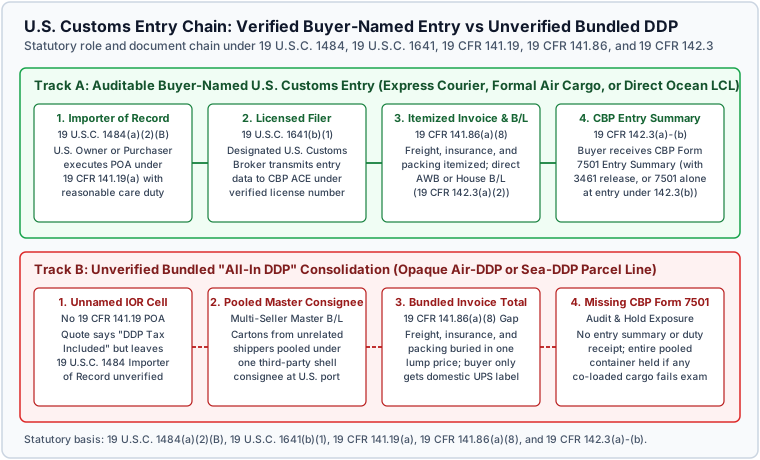
Failure Modes and Customs Compliance Boundary Table
Scroll horizontally to see all columns →
| Failure Mode | Root Cause in Forwarder Quote or Packing File | Statutory / Carrier Mechanism Violated | Operational & Financial Impact on Buyer | Preventive Verification Control |
|---|---|---|---|---|
| Volumetric Divisor Shock (+20% to +92% Weight Jump) | Buyer budgets freight from factory net scale weight or assumes ÷6000 on an Express Courier quote |
Express Courier ÷5000 cm3/kg formula (200 kg/CBM threshold) vs ÷6000 (166.67 kg/CBM) |
Tier 2 (200 kg, 1.92 CBM) bills at 384.0 kg under ÷5000 instead of 200.0 kg scale weight |
Require written carton dimensions (L x W x H cm) and explicit divisor (5000 vs 6000) on the quote |
| Laser Scanner Carton Bulge Surcharge | Weak single-wall cartons bow +1 cm to +2 cm outward per axis after palletization |
Carrier depot optical dimensioning + per-carton rounding up to next 0.5 kg or 1.0 kg |
A +2 cm bulge on twenty 60 x 40 x 40 cm cartons adds +56.0 billable kg (440 kg vs 384 kg) |
Specify double-wall export cartons and add a +1.5 cm axis tolerance when modeling volumetric weight |
| Unnamed Importer of Record on Bundled DDP | Consolidator pools multiple unrelated buyers under one third-party shell consignee on a Master B/L or MAWB | 19 U.S.C. § 1484(a)(2)(B), 19 U.S.C. § 1641(b)(1), and 19 CFR § 141.19(a) POA rule |
Buyer receives no CBP Form 7501; if any co-loaded shipper’s goods trigger a CBP exam, the entire container is held |
Require the named Importer of Record, 19 U.S.C. § 1641 broker license number, and individual House B/L or AWB |
| Bundled “All-In” Commercial Invoice Distortion | Seller writes a single DDP unit price with freight, insurance, and packing omitted or hidden | 19 CFR § 141.86(a)(5) and (a)(8) mandatory itemization of freight, insurance, cases, and packing |
Either inflates dutiable value by taxing international freight or triggers a CBP valuation hold | Separate FOB/EXW goods value from itemized freight, insurance, and packing lines on the commercial invoice |
Missing CBP Form 7501 Entry Summary |
Forwarder hands over only a domestic UPS/FedEx ground tracking number after port deconsolidation | 19 CFR § 142.3(a)-(b) entry release (CBP Form 3461 or 7501) and entry summary (CBP Form 7501) rules |
Buyer lacks legal proof of customs clearance, HTSUS classification record, and duty payment receipt | Make final freight settlement contingent on receipt of the ACE CBP Form 7501 entry summary PDF |
Engineering Rules of Thumb and Copyable Quote Audit Worksheet
Use these three threshold rules of thumb to screen any China-to-U.S. shipping quote before requesting booking paperwork:
- Rule of Thumb 1 (Density Threshold
< 166.67 kg/CBM): If shipment cargo density is below166.67 kg/CBM(such as Tier 2 at104.17 kg/CBMor Tier 3 at125.00 kg/CBM), both air modes charge by volume rather than scale weight. Switching from a÷5000Express Courier quote to a verified÷6000Air Cargo quote reduces chargeable weight by exactly 16.67% (64.0 kgsaved on Tier 2;66.67 kgsaved on Tier 3). - Rule of Thumb 2 (Transition Zone
166.67 kg/CBMto200.00 kg/CBM): If cargo density sits between166.67 kg/CBMand200.00 kg/CBM(such as Tier 1 at166.67 kg/CBM), a÷6000air quote bills at exact scale weight (50.0 kg), whereas a÷5000courier quote still applies a volumetric surcharge (60.0 kg). Once density reaches or exceeds200.00 kg/CBM, scale weight governs both air modes. - Rule of Thumb 3 (Ocean LCL W/M Crossover Evaluation): Once shipment volume clears the carrier’s
1.00 CBMor2.00 CBMLCL minimum floor (illustrated by the1.92 CBMand2.00 CBMcarton profiles above), formal LCL Sea Freight (1 CBM = 1,000 kgW/M) removes the+60%to+92%air volumetric weight multiplier. Compare total landed LCL cost (base ocean W/M rate + origin/destination CFS port fees + customs brokerage) against the volumetric air quote alongside your required inventory lead time.
Copyable Buyer Quote and Customs Entry Audit Worksheet
Copy the blank worksheet below into your procurement file for each shipment lot. Leave every cell blank until a written forwarder quote, packing list, or customs broker confirmation supplies the exact figure or identifier. Explore our shipping and logistics guides and full China sourcing guide library for related buyer verification checklists.
Scroll horizontally to see all columns →
| Verification Field | Statutory or Engineering Basis | Quote A: Express Air Courier | Quote B: Air DDP / Air Cargo | Quote C: Ocean LCL / Sea DDP |
|---|---|---|---|---|
| Carton count and outer dimensions (L x W x H cm) | 19 CFR 142.3(a)(4) Packing List | |||
| Total gross scale weight (kg) and total volume (CBM) | 19 CFR 141.86(a)(4) weights and measures | |||
| Calculated cargo density (Gross kg / Total CBM) | Thresholds: 166.67 and 200.00 kg/CBM | |||
| Quoted volumetric divisor or W/M rule | 5,000 cm3/kg vs 6,000 cm3/kg vs 1 CBM = 1,000 kg | |||
| Per-carton rounding rule and minimum billable floor | 0.5 kg / 1.0 kg rounding; 1.0 or 2.0 CBM LCL floor | |||
| Resulting chargeable weight (kg) or billable W/M (CBM) | max(Gross kg, Volumetric kg) or LCL W/M | |||
| Primary transport document issued to buyer | 19 CFR 142.3(a)(2) Direct AWB vs House B/L | |||
| Itemized freight, insurance, and packing on invoice | 19 CFR 141.86(a)(8) mandatory charge itemization | |||
| Named U.S. Importer of Record (Owner / Purchaser) | 19 U.S.C. 1484(a)(2)(B) qualified IOR | |||
| Designated U.S. Customs Broker name and license number | 19 U.S.C. 1641(b)(1) & 19 CFR 141.19(a) POA | |||
| Written commitment to deliver CBP Form 7501 (and 3461 if separate) | 19 CFR 142.3(a)-(b) Entry & Entry Summary record (7501 serves as both under 142.3(b)) |
Information graphic
Frequently asked questions
What is the volumetric divisor difference between Alibaba Express courier and Air DDP freight?
International express couriers (such as DHL, FedEx, UPS Express, and Alibaba Express door-to-door courier channels) apply a volumetric divisor of 5,000 cm3/kg, which equals 200 kg per CBM. Standard IATA air cargo and many consolidated Air DDP channels apply a divisor of 6,000 cm3/kg, which equals 166.67 kg per CBM. For cargo less dense than 166.67 kg/CBM, switching from a 5,000 divisor to a 6,000 divisor reduces chargeable weight by 16.67% before comparing per-kilogram rates.
When does LCL sea freight beat air freight on chargeable weight from China to the U.S.?
Formal Less-than-Container-Load (LCL) ocean freight bills by Revenue Ton (Weight or Measure, where 1 CBM = 1,000 kg) subject to a 1.00 CBM or 2.00 CBM minimum billable floor. On a 50 kg / 0.30 CBM trial batch, LCL minimum volume floors and port Container Freight Station (CFS) fees erase ocean savings. Once shipment volume clears the LCL minimum floor (such as the 1.92 CBM or 2.00 CBM carton examples on this page), formal LCL bills by actual cubic meters and removes the 60% to 92% air volumetric multiplier, though total landed cost still depends on live per-kilogram air rates, port CFS charges, and required transit time.
Who is legally allowed to act as the U.S. Importer of Record on a China DDP shipment?
Under 19 U.S.C. 1484(a)(2)(B), the Importer of Record must be the owner or purchaser of the merchandise, or, when appropriately designated by the owner, purchaser, or consignee, a person holding a valid U.S. customs broker license under 19 U.S.C. 1641. A seller's 'All-In DDP' quote label does not satisfy 19 U.S.C. 1484 unless a qualified party and licensed broker file the entry under a valid 19 CFR 141.19 Power of Attorney.
Which U.S. customs documents prove that a shipment was properly declared and cleared?
Under 19 CFR 142.3(a), release documentation requires an entry filing (CBP Form 3461 or CBP Form 7501, or their electronic ACE equivalents), evidence of the right to make entry (an Air Waybill or Ocean Bill of Lading), a commercial invoice itemizing freight, insurance, and packing charges under 19 CFR 141.86(a)(8), and a packing list where appropriate. Under 19 CFR 142.3(b), CBP Form 7501 (Entry Summary) serves as both the entry and the entry summary when filed at the time of entry, establishing the Importer of Record, HTSUS classification, and duty calculation.
Sources
- 19 U.S.C. 1484 - Entry of merchandise : Legal Information Institute, Cornell Law School Accessed October 25, 2026.
- 19 CFR 141.86 - Contents of invoices and general requirements : Legal Information Institute, Cornell Law School Accessed October 25, 2026.
- 19 CFR 142.3 - Entry documentation required : Legal Information Institute, Cornell Law School Accessed October 25, 2026.
- 19 CFR 141.19 - Declaration of entry : Legal Information Institute, Cornell Law School Accessed October 25, 2026.
- 19 U.S.C. 1641 - Customs brokers : Legal Information Institute, Cornell Law School Accessed October 25, 2026.
- Common Export Documents : U.S. International Trade Administration Accessed October 25, 2026.
- Volumetric Weight Calculator and Terms (Divisor 5000) : DHL Express Accessed October 25, 2026.
- Air Cargo Tariffs and Rules: What You Need to Know (6,000 cm3/kg Volumetric Standard) : International Air Transport Association (IATA) Accessed October 25, 2026.