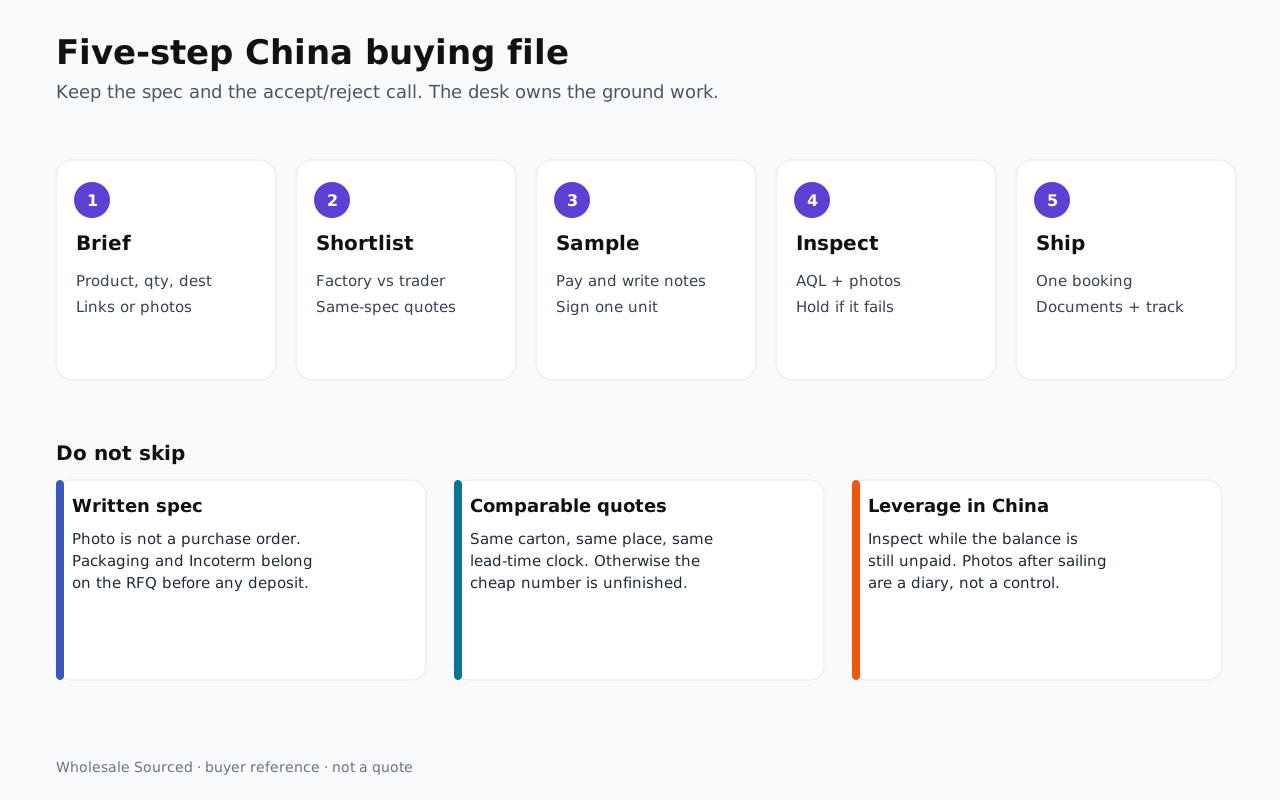
Preventing a letter of credit document discrepancy on a China wholesale order starts before the issuing bank transmits the operative instrument and continues until the exporter presents the shipping documents. Use the schedules below to audit the draft credit fields alongside your purchase order, commercial invoice, packing list, inspection record, insurance policy, and ocean bill of lading.
Begin by separating your underlying purchase order from the documentary credit text, deciding which shipping documents the bank will examine, and assigning responsibility for pre-presentation document checks. For broader procurement workflows, browse our China sourcing guides and review how documentary credits fit alongside supplier background checks in how to verify a Chinese supplier.
Understand how banks examine a documentary presentation
When buyers and suppliers structure a documentary letter of credit governed by the Uniform Customs and Practice for Documentary Credits, the bank evaluates the presented paper record rather than the physical shipment in the warehouse. Contrast this documentary review with platform-mediated product quality claims covered in our Alibaba Trade Assurance dispute evidence guide.
According to Trade.gov, a Letter of Credit is a contractual commitment by the foreign buyer’s bank to pay once the exporter ships the goods and presents the required documentation, and any document errors and discrepancies must be amended and resubmitted.
Under UCP 600 Article 2, the applicant is the party that requests the credit, and the beneficiary is the party in whose favor the credit is issued. A banking day is a day when the relevant bank is open to perform the act in question. A complying presentation is one that meets the credit terms, UCP 600, and international standard banking practice. A credit is an irrevocable undertaking by the issuing bank to honor a complying presentation.
UCP 600 Article 3 treats a credit as irrevocable even when the text does not say so. Article 4 separates the credit from the underlying sale or other contract: banks are not bound by that contract, and issuing banks should discourage embedding full contracts or proforma invoices into the credit itself.
Article 5 states that banks examine documents, not the goods, services, or performance those documents may describe. Under Article 14, a nominated bank, confirming bank, or issuing bank decides from the documents alone whether a presentation appears to comply. Extra documents that the credit does not require may be disregarded, and non-document conditions are treated as not stated. Vague issuer labels such as “first class” or “local” generally allow any issuer other than the beneficiary.
Keep your draft credit focused on clear, verifiable document requirements. Do not attach full proforma invoices or unlinked purchase-order narratives, and name the exact external agency whenever you require a specific outside issuer.
Audit the draft documentary credit fields before issuance
Before authorizing the issuing bank to transmit the documentary credit, review the mandatory and optional message tags with the beneficiary so neither side is trapped by an unworkable goods description, shipment routing, or presentation window.

In SWIFT MT 700 (Issue of a Documentary Credit), the mandatory (M) tags include 27 (Sequence of Total), 40A (Form of Documentary Credit), 20 (Documentary Credit Number), 40E (Applicable Rules), 31D (Date and Place of Expiry), 50 (Applicant), 59 (Beneficiary), 32B (Currency Code, Amount), 41a (Available With / By), and 49 (Confirmation Instructions). Tag 31C (Date of Issue) is optional (O) in the current SWIFT Category 7 standards.
In the SWIFT documentary credit standards, Tag 40A (Form of Documentary Credit) must contain IRREVOCABLE, IRREVOCABLE TRANSFERABLE, IRREVOCABLE STANDBY, or IRREVOC TRANS STANDBY, and all codes relating to revocable documentary credits have been removed.
In a SWIFT documentary credit issue message, the optional (O) shipment and transport tags are 43P (Partial Shipments), 43T (Transhipment), 44A (Place of Taking in Charge/Dispatch from…/Place of Receipt), 44E (Port of Loading/Airport of Departure), 44F (Port of Discharge/Airport of Destination), 44B (Place of Final Destination), 44C (Latest Date of Shipment), and 44D (Shipment Period).
In the SWIFT documentary credit standards, Tag 43P (Partial Shipments) and Tag 43T (Transhipment) use the valid codes Allowed, Not Allowed, or Conditional.
In a SWIFT documentary credit issue message, the optional (O) goods, document, charge, and presentation tags include 45A (Description of Goods and/or Services), 46A (Documents Required), 47A (Additional Conditions), 71D (Charges), and 48 (Period for Presentation in days).
In the SWIFT documentary credit standards, Tag 48 (Period for Presentation in Days) specifies the number of calendar days after the date of shipment within which the documents must be presented for payment, acceptance, or negotiation, with the narrative used only to specify another starting date type (such as invoice date).
Plan for formal amendments before shipment
If a field in the issued credit contains a typographical error or an unworkable shipment schedule, resolve it through an agreed amendment before the cargo sails rather than hoping the examining bank will overlook the variance.
Except as otherwise provided by article 38, a credit can neither be amended nor cancelled without the agreement of the issuing bank, the confirming bank, if any, and the beneficiary.
Partial acceptance of an amendment is not allowed and will be deemed to be notification of rejection of the amendment.
In SWIFT MT 707 (Amendment to a Documentary Credit), Tags 45B (Description of Goods and/or Services), 46B (Documents Required), and 47B (Additional Conditions) use the structured amendment codes ADD, DELETE, or REPALL.
Use the following pre-issuance schedule to verify the draft credit with your supplier and freight forwarder before issuance:
Scroll horizontally to see all columns →
| Draft field area | Pre-issuance verification question | Agreed draft wording | Sign-off owner |
|---|---|---|---|
| Applicant and beneficiary names | Do the legal names and country locations match the export documents? | ||
| Partial shipments and transhipment | Does the selected permission match the planned vessel and container booking? | ||
| Loading port and discharge port | Are the named ports aligned with the forwarder routing and export customs port? | ||
| Latest date of shipment | Does the shipment deadline leave buffer for port cut-offs and bank closures? | ||
| Goods description text | Is the goods description concise enough to reproduce accurately on the commercial invoice? | ||
| Required documents and conditions | Is every condition tied to a named document and an explicit issuer? | ||
| Presentation period and expiry | Does the presentation window allow courier transit and original transport document release? |
Match the commercial invoice description and check supporting documents
Avoiding a commercial invoice description mismatch requires separating the strict correspondence rule governing the commercial invoice from the broader non-conflict rule governing the packing list and other supporting documents. For line-item carton count and weight reconciliation worksheets, see our commercial invoice and packing list cross-check guide.

A commercial invoice must appear to have been issued by the beneficiary (except as provided in article 38), must be made out in the name of the applicant (except as provided in sub-article 38(g)), must be made out in the same currency as the credit, and need not be signed.
In ICC Official Opinion TA.818rev, an invoice showing the correct full name and address of the applicant under a header ‘Customer’ rather than ‘applicant’ was compliant with UCP 600 sub-article 18(a)(ii).
The description of the goods, services or performance in a commercial invoice must correspond with that appearing in the credit.
In documents other than the commercial invoice, the description of the goods, services or performance, if stated, may be in general terms not conflicting with their description in the credit.
According to Trade.gov’s Common Export Documents guide, a packing list may serve as a conforming document but is not a substitute for a commercial invoice, and the commercial invoice should reflect the information shown on the packing list.
Data in a document, when read in context with the credit, the document itself and international standard banking practice, need not be identical to, but must not conflict with, data in that document, any other stipulated document or the credit.
Under ISBP 745 Paragraph A23, a misspelling or typing error that does not affect the meaning of a word or the sentence in which it occurs does not make a document discrepant, whereas ‘model 123’ instead of ‘model 321’ is a conflict of data.
If a credit requires presentation of a document other than a transport document, insurance document or commercial invoice, without stipulating by whom the document is to be issued or its data content, banks will accept the document as presented if its content appears to fulfil the function of the required document and otherwise complies with sub-article 14(d).
In ICC Official Opinion R197, where a credit requested a certificate duly signed by the vessel’s captain and an inspection report was presented instead, presenting a report instead of a certificate justified claiming a discrepancy under strict compliance.
At least one original of each document stipulated in the credit must be presented, and terms such as ‘in duplicate’, ‘in two fold’ or ‘in two copies’ are satisfied by presenting at least one original and the remaining number in copies.
A document may be dated prior to the issuance date of the credit, but must not be dated later than its date of presentation.
When preparing the presentation set, copy the goods description from the credit into the commercial invoice without altering model identifiers, and verify that every supporting document uses the exact title requested by the credit.
Examine the ocean bill of lading and consignee or notify party details
Transport documents can trigger refusal notices when the freight forwarder omits carrier capacity on the signature line, leaves an intended-vessel or intended-port qualification without a dated on-board notation, or prints an applicant address in the bill of lading consignee notify party lc boxes that differs from the credit. To separate documentary credit roles from customs entry filing duties, review our DDP China importer of record checklist.

According to Trade.gov’s Common Export Documents guide, air waybills are shipper-specific and are not negotiable documents, whereas for ocean shipments there are two common types of bill of lading: a straight bill of lading, which is non-negotiable, and a negotiable, or shipper’s order bill of lading.
A bill of lading, however named, must appear to indicate the name of the carrier and be signed by the carrier or a named agent for or on behalf of the carrier, or the master or a named agent for or on behalf of the master.
The shipper or consignor of the goods indicated on any document need not be the beneficiary of the credit, and a transport document may be issued by any party other than a carrier, owner, master or charterer provided that it meets the requirements of articles 19, 20, 21, 22, 23 or 24.
A bill of lading must indicate that the goods have been shipped on board a named vessel at the port of loading stated in the credit by pre-printed wording or an on board notation indicating the date on which the goods have been shipped on board.
The date of issuance of the bill of lading is deemed to be the date of shipment unless the bill of lading contains an on board notation indicating the date of shipment, in which case the date stated in the on board notation is deemed to be the date of shipment.
If a bill of lading contains the indication ‘intended vessel’ or similar qualification in relation to the name of the vessel, an on board notation indicating the date of shipment and the name of the actual vessel is required.
If the bill of lading does not indicate the port of loading stated in the credit as the port of loading, or contains the indication ‘intended’ or similar qualification in relation to the port of loading, an on board notation indicating the port of loading as stated in the credit, the date of shipment and the name of the vessel is required.
A bill of lading must be the sole original bill of lading or, if issued in more than one original, be the full set as indicated on the bill of lading, and must contain no indication that it is subject to a charter party.
A bill of lading indicating that transhipment will or may take place is acceptable, even if the credit prohibits transhipment, if the goods have been shipped in a container, trailer or LASH barge as evidenced by the bill of lading.
A transport document must not indicate that the goods are or will be loaded on deck (though a clause stating they may be loaded on deck is acceptable), and a clause such as ‘shipper’s load and count’ and ‘said by shipper to contain’ is acceptable.
A bank will only accept a clean transport document (one bearing no clause or notation expressly declaring a defective condition of the goods or their packaging), and the word ‘clean’ need not appear on a transport document even if the credit requires it to be ‘clean on board’.
In ICC Official Opinion TA.817rev, where the credit required the bill of lading to show shipment effected in an FCL container and the presented bill of lading stated CY/CY and not FCL, the document was considered discrepant because it did not make express reference to an FCL shipment.
Check applicant addresses on transport documents versus customs entry roles
Pay close attention to how the applicant’s address is printed when the applicant appears in the consignee or notify party box of the transport document.
When the addresses of the beneficiary and the applicant appear in any stipulated document, they need not be the same as those stated in the credit or in any other stipulated document, but must be within the same country as the respective addresses mentioned in the credit.
When the address and contact details of the applicant appear as part of the consignee or notify party details on a transport document subject to articles 19, 20, 21, 22, 23, 24 or 25, they must be as stated in the credit.
Under 19 U.S.C. § 1484(a)(1) and (a)(2)(B), one of the parties qualifying as ‘importer of record’ - either the owner or purchaser of the merchandise, or, when appropriately designated by the owner, purchaser, or consignee, a person holding a valid license under section 1641 - shall make U.S. customs entry using reasonable care.
Instruct the booking agent to copy the applicant’s address and contact details from the credit into the transport document notify party or consignee box without abbreviation or street variation.
Verify shipment dates, presentation deadlines, quantity allowances, and insurance documents
Schedule production handoff and document courier dispatch around the key calendar checkpoints: the latest date of shipment, the period for presentation after shipment, and the expiry date of the credit. When comparing freight, insurance, and import cost elements across delivery terms, see our guide on how to calculate landed cost.
A credit must state an expiry date for presentation, and a credit must not be issued available by a draft drawn on the applicant.
Except as provided in sub-article 29(a), a presentation by or on behalf of the beneficiary must be made on or before the expiry date.
A presentation including one or more original transport documents subject to articles 19, 20, 21, 22, 23, 24 or 25 must be made by or on behalf of the beneficiary not later than 21 calendar days after the date of shipment, and not later than the expiry date of the credit.
If the expiry date of a credit or the last day for presentation falls on a day when the bank to which presentation is to be made is closed (other than Force Majeure), the expiry date or last day for presentation is extended to the first following banking day, but the latest date for shipment will not be extended.
The expression ‘on or about’ or similar is interpreted as a stipulation that an event is to occur during a period of five calendar days before until five calendar days after the specified date, both start and end dates included.
The words ‘to’, ‘until’, ‘till’, ‘from’ and ‘between’ when used to determine a period of shipment include the date or dates mentioned, and the words ‘before’ and ‘after’ exclude the date mentioned.
Check quantity allowances, partial shipments, and marine insurance
Verify whether quantity variations, split vessel loadings, or marine insurance documents satisfy the applicable documentary rules before submitting the package to the bank.
The words ‘about’ or ‘approximately’ used in connection with the amount of the credit or the quantity or the unit price stated in the credit are construed as allowing a tolerance not to exceed 10% more or 10% less than the amount, quantity or unit price to which they refer.
A tolerance not to exceed 5% more or 5% less than the quantity of the goods is allowed, provided the credit does not state the quantity in terms of a stipulated number of packing units or individual items and the total amount of the drawings does not exceed the amount of the credit.
Partial drawings or shipments are allowed; shipment on more than one means of conveyance within the same mode of transport is regarded as a partial shipment even if they leave on the same day for the same destination.
If a drawing or shipment by instalments within given periods is stipulated in the credit and any instalment is not drawn or shipped within the period allowed for that instalment, the credit ceases to be available for that and any subsequent instalment.
Insurance cover notes will not be accepted, and the date of the insurance document must be no later than the date of shipment, unless it appears from the insurance document that the cover is effective from a date not later than the date of shipment.
The insurance document must indicate the amount of insurance coverage and be in the same currency as the credit, and if there is no indication in the credit of the insurance coverage required, the amount must be at least 110% of the CIF or CIP value of the goods.
Copy the pre-presentation worksheet below to cross-check the assembled export document set before handing it to the bank:
Scroll horizontally to see all columns →
| Document or checkpoint | Item to verify across the presentation | Value shown on draft document | Correction owner if mismatched |
|---|---|---|---|
| Commercial invoice issuer and buyer | Beneficiary issuer name, applicant name, and credit currency match | ||
| Commercial invoice goods description | Goods description corresponds with the description in the credit | ||
| Packing list and inspection paper | Document title, model identifiers, and carton totals do not conflict | ||
| Bill of lading carrier and signature | Carrier name appears and signature states carrier or master capacity | ||
| Bill of lading on-board date and port | Named vessel, stipulated loading port, and shipment date on or before deadline | ||
| Consignee and notify party details | Applicant address and contact details match the credit as stated | ||
| Original set and clean transport status | Full set of originals included with no defective cargo or packaging notation | ||
| Insurance policy or declaration | Policy or open-cover document in credit currency with effective date on or before shipment | ||
| Presentation window and expiry | Bank submission scheduled within the presentation period and on or before expiry |
Manage bank examination, discrepancy waivers, and refusal notices
After the beneficiary presents the document package, track the bank examination window and understand how discrepancy notices, applicant waivers, and formal refusal messages operate.
A nominated bank acting on its nomination, a confirming bank, if any, and the issuing bank shall each have a maximum of five banking days following the day of presentation to determine if a presentation is complying.
Under Uniform Commercial Code (U.C.C.) § 5-108(a) and (b), an issuer shall honor a presentation that appears on its face strictly to comply with the terms and conditions of the letter of credit and shall dishonor a presentation that does not appear so to comply, within a reasonable time not beyond the end of the seventh business day of the issuer after the day of its receipt of documents.
If an issuing bank finds discrepancies, UCP 600 sub-article 16(b) allows it to ask the applicant for a waiver, but that contact does not extend the five-banking-day examination period in sub-article 14(b).
When a nominated bank, confirming bank, or issuing bank decides to refuse to honour or negotiate, it must give a single notice to the presenter stating that the bank is refusing and stating each discrepancy.
The refusal notice required in sub-article 16(c) must be given by telecommunication or, if that is not possible, by other expeditious means no later than the close of the fifth banking day following the day of presentation, failing which an issuing or confirming bank is precluded from claiming that the documents do not constitute a complying presentation.
In SWIFT documentary credit messaging, MT732 is an Advice of Discharge stating that documents with discrepancies have been taken up, MT734 is an Advice of Refusal of documents under a Documentary Credit, and MT750 is an Advice of Discrepancy.
Use these questions to coordinate discrepancy resolution between your procurement desk and the beneficiary:
- Which specific document line or field triggered the discrepancy notice?
- Can the beneficiary replace and re-present a corrected document within the remaining presentation period and before credit expiry?
- If the presentation window has passed, will the applicant submit a discrepancy waiver to the issuing bank, and will the issuing bank accept that waiver?
- Who will hold the original transport documents while the refusal notice or waiver request is pending?
Complete both verification tables for each documentary credit shipment and attach the reviewed records to your order file. Return to our China sourcing guides to prepare the rest of your import documentation.
Sources
- International Chamber of Commerce — Uniform Customs and Practice for Documentary Credits (UCP 600, ICC Publication No. 600)
- Institute of Chartered Accountants of India - Background Material on Uniform Customs and Practice for Documentary Credits
- International Chamber of Commerce Switzerland - Banking Commission Notes on Documentary Credit Examination Principles
- Nordea Bank - Documentary Credit Message Format Specifications
- Wells Fargo - Documentary Credit Message Field Series Guide
- Bureau of Foreign Trade - Telex Field Definitions for Documentary Credits
- International Trade Administration - Letters of Credit Trade Finance Guide
- International Trade Administration - Common Export Documents Reference
- Legal Information Institute, Cornell Law School - Uniform Commercial Code Letters of Credit Issuer Rights and Obligations
- Legal Information Institute, Cornell Law School - United States Code Customs Entry of Merchandise
Information graphic