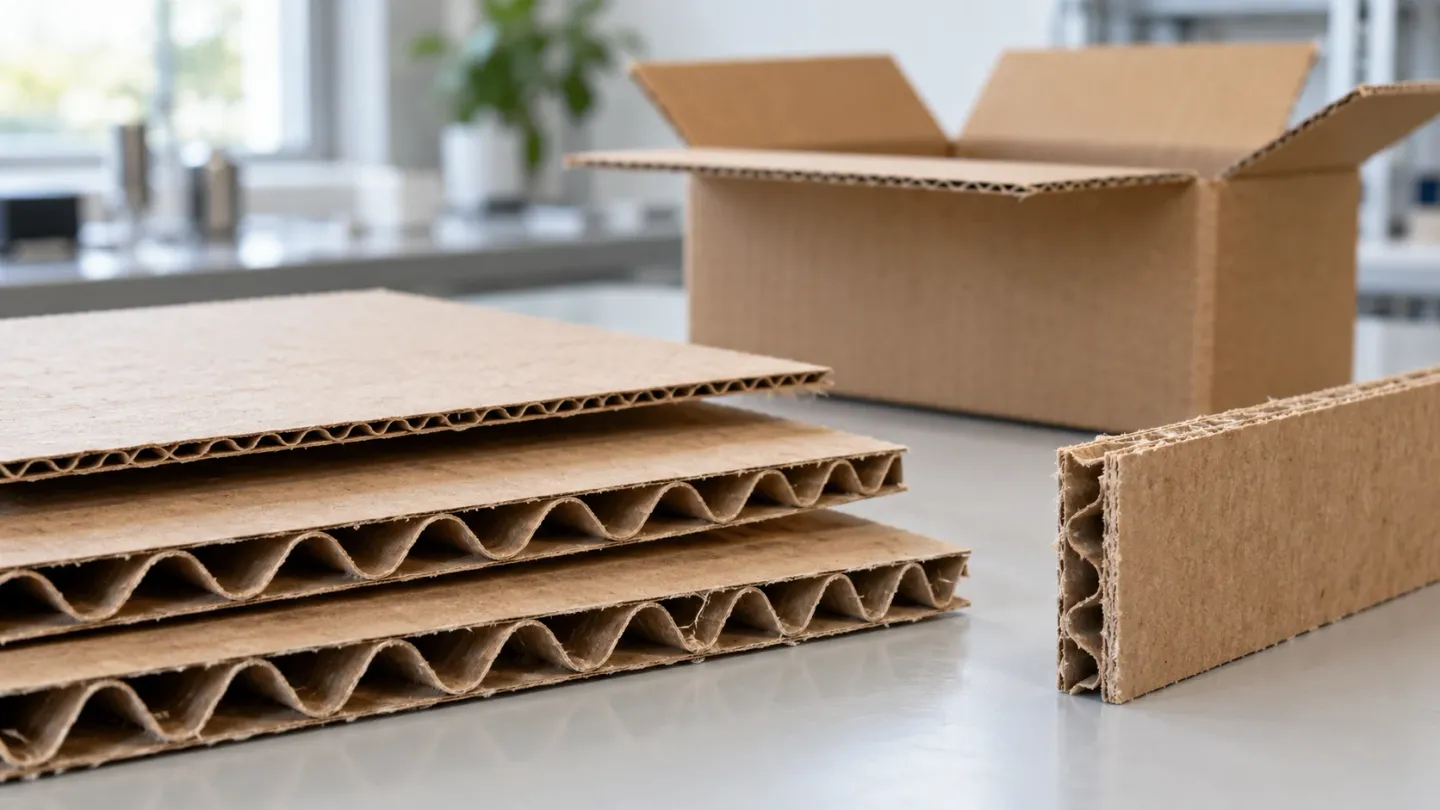
ECT is a characteristic of combined corrugated board directly related to the compressive strength of the package.
BCT alone is not sufficient to predict lifetime in all situations.
For an ocean-freight carton specification, work through the board, the compression calculation, the test conditions and the pallet layout. Use the checklist below to prepare your export packaging brief.
ECT versus Mullen burst: what to specify
The Mullen result is the force required to produce rupture, expressed in pounds per square inch (PSI).
ECT includes a medium factor, whereas the medium has virtually no impact on Mullen.
Keep ECT and Mullen as separate fields in the specification. Ask for the test method beside each reported result.
Ordering double-wall BC flute
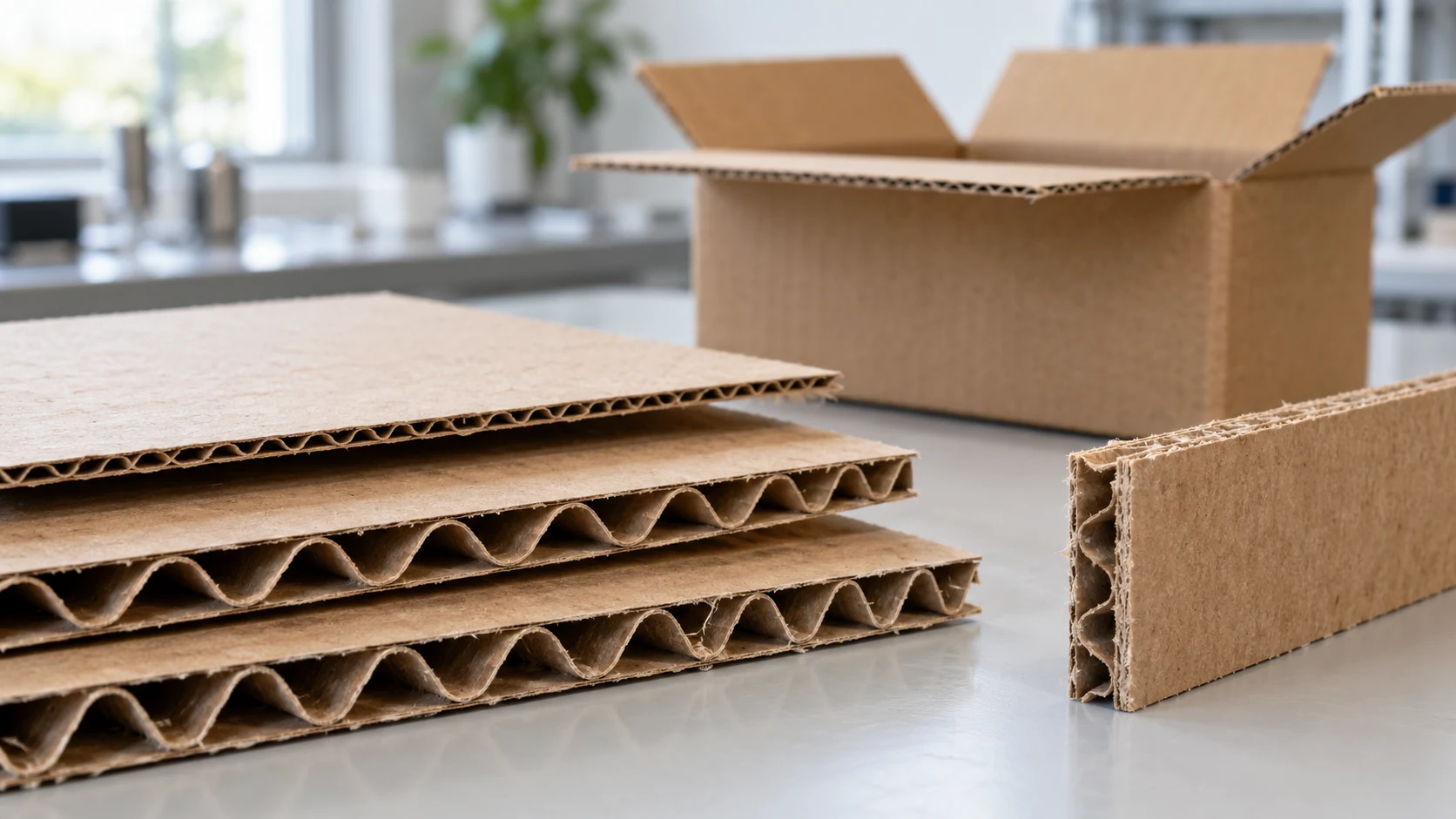
Smurfit Westrock’s Atlanta–Selig facility lists B, C and BC flute options.
The facility lists single-wall and double-wall constructions.
It also lists multiple strength grades, including ECT and Mullen test options.
When requesting double-wall BC flute, ask for the proposed construction, strength grade and measured board caliper together. Put the ECT result and its test method on the same specification sheet.
Use the McKee formula with the carton inputs
The simplified McKee equation is P = k Pm √(h Z).
The simplified formula uses cardboard thickness instead of bending stiffness.
- Pm denotes the ECT value.
- h denotes corrugated-board caliper.
- Z denotes box perimeter.
The formula applies to relatively typical box containers without holes or cutouts.
In the cutout study, the manufacturer supplied a coefficient of 5.3 for the material and box type used.
Before substituting values, record the selected equation, its coefficient and unit convention beside the carton drawing. Request the measured ECT and caliper for that construction, then place the calculation alongside the compression test report. For a carton with openings, ask for a test of the specified carton.
Test the carton in its intended configuration
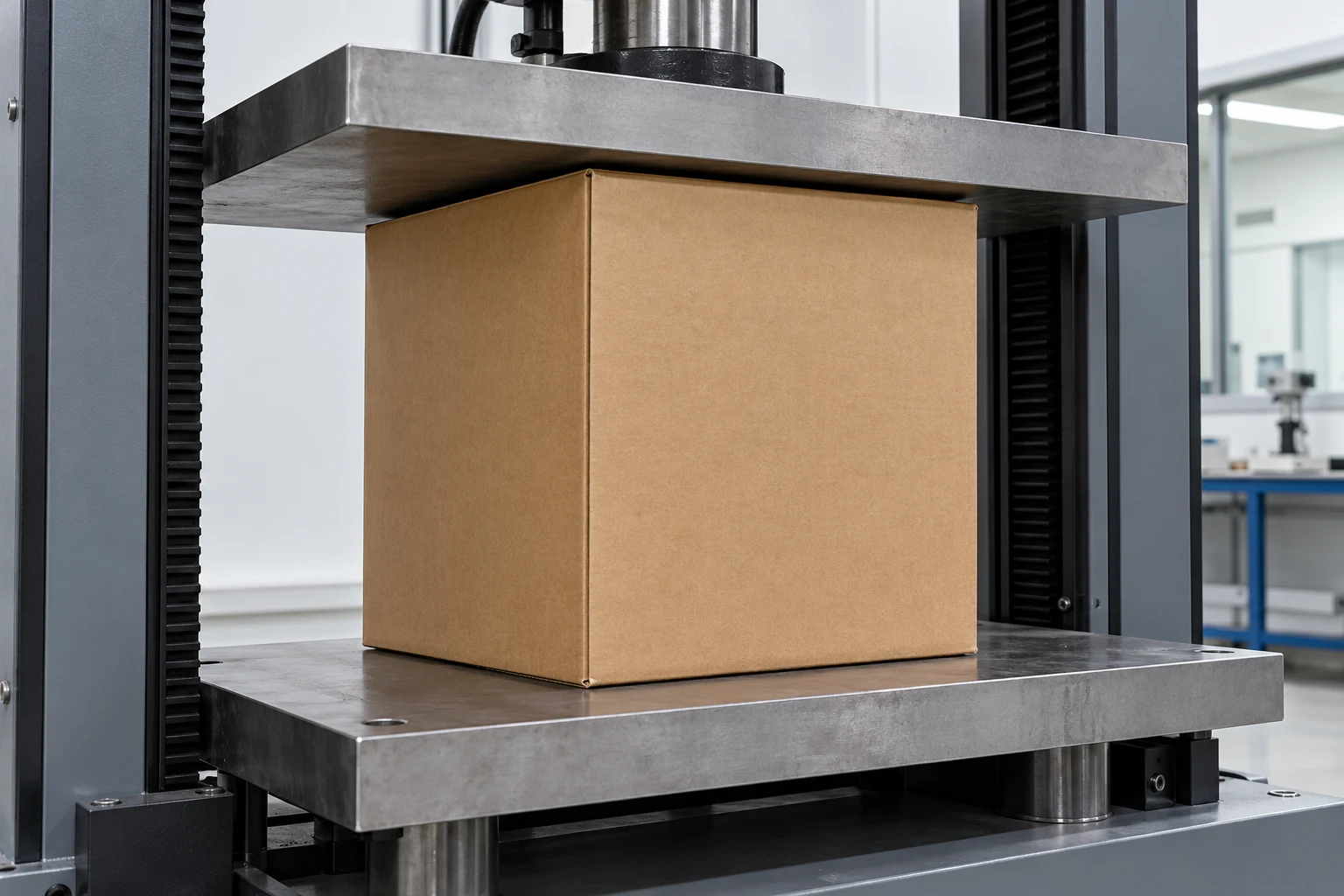
Shipping containers may be compression tested with or without contents.
The test may include contents and interior packaging when the contents share the load.
State whether the submitted sample is empty or packed. If the inner packaging is intended to share the load, include it in the test brief and identify the packing arrangement.
Account for humidity and time under load
The Clemson humidity study evaluated 3,000 industry-supplied boxes.
The study used relative humidity conditions from 30 to 90 percent.
Compression testing took place in an environmental chamber at the test conditions.
For the tested range, compression strength decreased with increasing relative humidity following a second-order polynomial.
For ocean freight, specify the humidity conditions for the carton evaluation and keep those conditions with the reported result.
The bottom package in a stack is continually subjected to a constant compression load.
Under long-term stacked storage, bottom boxes can fail at loads far below the strength determined in a dynamic compression test.
In the short-term creep method, deflection is measured over time.
Deflection versus time data can be used to predict time to failure of corrugated shipping containers under constant load.
The boxes are tested in the orientation in which they are most likely to be stacked in a unitized or palletized load.
Put the intended loading duration, humidity conditions and stacking orientation into the test request. Ask for the sustained-load result alongside the compression result, with the contents and interior packaging identified.
Keep carton corners aligned on the pallet
Stack cartons with the corners aligned and the cartons within the pallet perimeter for maximum stacking strength.
Inspect the proposed pallet arrangement before approving the packing instruction. Check the corner alignment and pallet edges shown below.
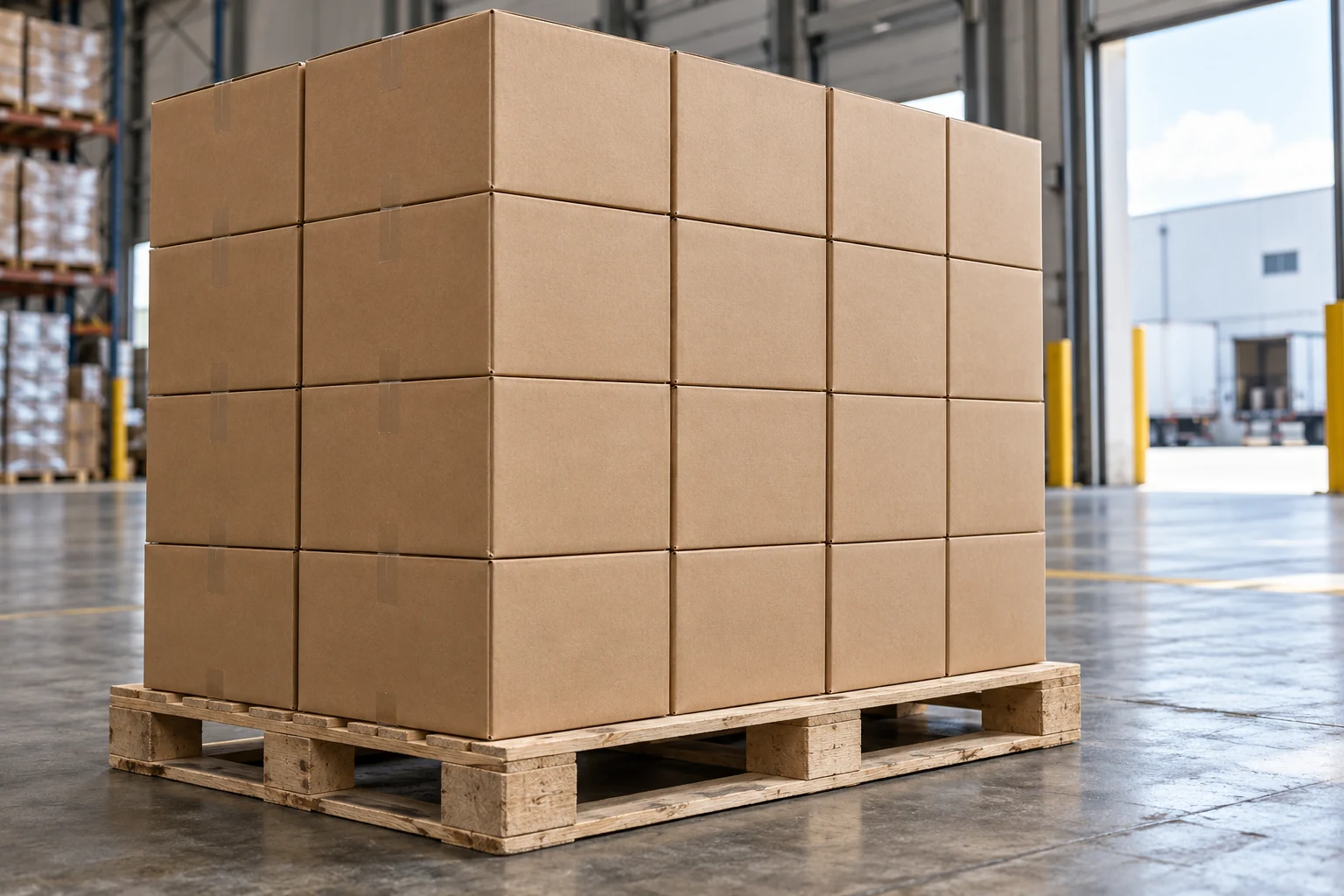
Hyster-Yale’s supplier packaging guidance states that misaligned carton corners can reduce stacking strength by up to 30%.
The guidance states that interlocked stacking patterns can reduce stacking strength by up to 50%.
The guidance states that carton overhang can reduce stacking strength by up to 32%.
Include a plan view and side view of the proposed pallet load in the packing instruction. Mark the carton orientation and the pallet boundary, then check the packed load against the drawing.
Prepare the export carton brief
Bring the following information to the packaging discussion:
- Carton drawing with outside length, width and height, plus any openings.
- Gross weight per packed carton and intended stack height.
- Proposed board construction and flute designation.
- ECT result, test method and measured caliper.
- Compression calculation with its equation, coefficient and units.
- Compression and sustained-load test reports, including humidity conditions and loading duration.
- Inner packaging arrangement and whether the contents are intended to share the load.
- Pallet dimensions, carton orientation and stacking drawing.
For a gifts and packaging order, include this brief with your packaging requirements. Continue to custom packaging to discuss the specification.
Sources
- TAPPI — Mullen vs ECT Testing Primer
- TAPPI — Links between BCT and Lifetime for Corrugated Boxes
- Smurfit Westrock — Atlanta–Selig
- MDPI — Compression Strength Estimation of Corrugated Board Boxes for a Reduction in Sidewall Surface Cutouts
- Virginia Tech — Kim, Investigation of the Environmental Effect of Unit Load Design Optimization
- ASTM International — Determining Compressive Resistance of Shipping Containers, Components, and Unit Loads
- ASTM International — Short Term Creep Performance of Corrugated Fiberboard Containers Under Constant Load Using a Compression Test Machine
- Clemson University — Brown, Relative Humidity Effects on the Compression Strength of Corrugated Boxes
- USDA Forest Products Laboratory — Strength and life criteria for corrugated fiberboard by three methods
- Hyster-Yale — Supplier Packaging Guidelines