A test summary for the wrong battery model wastes the shipping check and leaves that order unresolved. Copy the purchase-order identity first, and leave every summary cell blank until the file in front of you prints the value. Wholesale Sourced is an independent publisher, and the tables below are the order check to copy.
Copy the purchase-order model onto one identity row, then copy the ten elements in 49 CFR 173.185(a)(3) only when the summary file prints them. The eCFR text fetched October 18, 2026 displays title 49 as of October 15, 2026. Each manufacturer and subsequent distributor of lithium cells or batteries manufactured on or after January 1, 2008 must make that summary available, except button cells installed in equipment, including circuit boards. Paragraph (a)(1) requires the battery to meet UN Manual subsection 38.3 even when its cells are a tested type. Paragraph (a)(2) is the manufacturer’s completion record, with a test report as the example. Leave watt-hours, lithium content, the report number, and the report date blank when they are unprinted.
Copy the order identity record
Start with the purchase order and the identification on the goods. Use one row for each ordered configuration and each battery option. These fields are the buyer record. They sit outside the ten elements in paragraph (a)(3).
Scroll horizontally to see all columns →
| Buyer record | Value printed on your order or supplier file |
|---|---|
| Purchase order and buyer SKU | |
| Supplier legal name and the party who provided the file | |
| Ordered product model and revision | |
| Battery or cell model, or “unknown” when the file does not name one | |
| Where you saw the identity: label, approved sample record, or written model mapping | |
| Summary file name or page address, and the date you received it | |
| Row or page, when one file lists more than one model | |
| Test report identification number and report date, copied only if printed | |
| Difference still open, the person who owns it, and the reply reference | |
| Shipping provider, route, and the written response |
Copy the model exactly as the order prints it, including a suffix or revision. When the buyer SKU and the manufacturer model differ, keep both strings and ask for a written mapping. That mapping explains the purchasing name. It does not print a report number the summary lacks.
Hold the approved battery option with the rest of the product configuration. The consumer electronics sourcing page lists battery identity and matching transport paperwork among the checks for that configuration. A later battery substitution does not inherit this row.
Use the invoice and packing list cross-check before you treat an invoice model as the ordered model. Copy the model onto this sheet after the invoice line and the packing list name the same SKU.
Check the ten required information groups
Paragraph (a)(3) requires ten elements. Copy the value and the page or row where it is printed. An empty value cell means the file did not print that element.
The duty is on each manufacturer and each subsequent distributor. It covers lithium cells or batteries manufactured on or after January 1, 2008. The same sentence excepts button cells installed in equipment, including circuit boards.
Scroll horizontally to see all columns →
| Summary element | Value and page or row | Still unresolved |
|---|---|---|
| 1. Name of the cell, battery, or product manufacturer, as applicable | ||
| 2. Manufacturer contact: address, telephone number, email address, and website | ||
| 3. Test laboratory: name, address, telephone number, email address, and website | ||
| 4. Unique test report identification number | ||
| 5. Date of the test report | ||
| 6. Description: lithium ion or lithium metal; cell or battery; mass; watt-hour rating or lithium content; physical description; cell or battery model, or the product model when the summary is established for a product containing the cell or battery | ||
| 7. List of tests conducted and results (pass or fail) | ||
| 8. Reference to assembled-battery testing requirements, if applicable | ||
| 9. Revised edition of the UN Manual of Tests and Criteria used, and amendments, if any | ||
| 10. Name and title of a responsible person, as an indication of the validity of the information |
For elements 2 and 3, the saved text lists address, telephone number, email address, and website. If one of those four is absent, name the missing item. A website alone does not fill the address.
For element 6, write the unit the file prints beside mass, watt-hours, or lithium content. Paragraph (a)(3)(vi)(C) asks for the watt-hour rating or the lithium content. A capacity number in another unit does not fill that cell.
Rule of thumb. If a lithium ion summary prints no watt-hour rating, leave the rating blank. Paragraph (c)(1)(i) sets the smaller-size ceilings at 20 Wh for a lithium ion cell and 100 Wh for a lithium ion battery. Paragraph (c)(1)(ii) sets the lithium metal ceilings at 1 g for a cell and 2 g for a battery. Those ceilings do not write a missing (a)(3) rating. A cell or battery inside those ceilings still carries the (a)(3) duty when it was manufactured on or after January 1, 2008 and is not a button cell installed in equipment.
Worked example. The two lithium ion ceilings in paragraph (c)(1)(i) are the only numbers in this line.
Battery ceiling / cell ceiling = 100 / 20 = 5
The battery ceiling is five times the cell ceiling. The ratio names which ceiling you hand the carrier. It does not write a watt-hour rating into element 6.
Paragraph (c)(1)(iv) prints higher ceilings for highway or rail only: 5 g for a lithium metal cell, 25 g for a lithium metal battery, 60 Wh for a lithium ion cell, and 300 Wh for a lithium ion battery. They apply only when the outer package is marked “LITHIUM BATTERIES—FORBIDDEN FOR TRANSPORT ABOARD AIRCRAFT AND VESSEL.” This sheet does not apply that mark.
For element 7, copy the test names and the pass or fail result the summary prints. Leave the cell blank when the file prints neither. The saved section does not name the individual tests, so this page does not supply a test list or a result.
For element 8, the text says “if applicable” and does not say when a pack needs the assembled-battery reference. If the summary does not print the reference, leave the cell blank. A photograph of the housing does not decide it.
Element 10 asks for the name and title. The saved text does not add a signature line. Element 5 is the date of the test report. The day the file arrived by email is a receiving date. Put that date on the identity row if you need it, and leave element 5 blank when the summary does not print the report date.
The saved section does not prescribe a page layout. A different arrangement still serves as the summary when the ten elements are printed.
Match the listed model to the goods you ordered
Match the identifier at the level the summary covers. Element (vi)(E) accepts the cell or battery model number. When the summary is established for a product containing the cell or battery, it accepts the product model number instead. A product-level summary can name the product. That field does not also have to show a separate battery model.
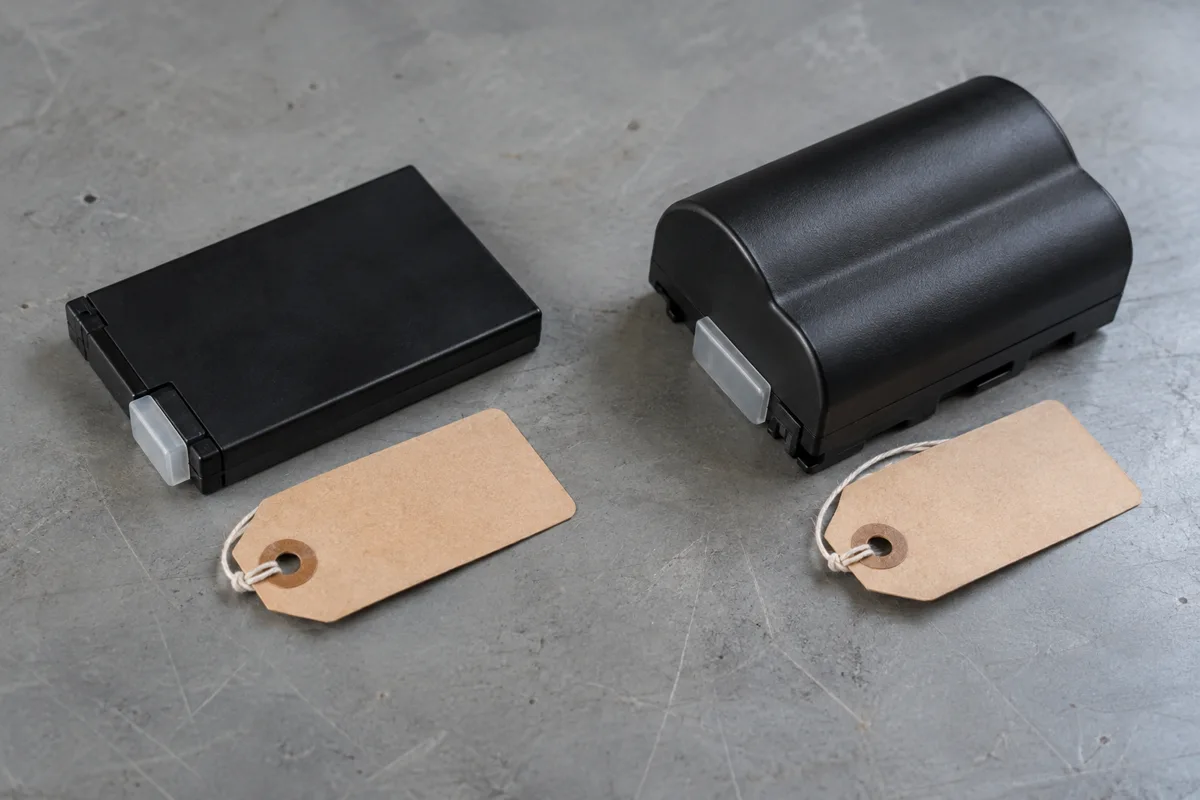
Compare three strings: the model on the purchase order, the identification on the unit or the approved sample record, and the model the summary prints. When any two differ, the match cell stays blank until the manufacturer writes which configuration the summary covers. Leave the summary text as you received it.
If the battery is inside sealed equipment, ask the manufacturer for the model the summary uses. This worksheet does not ask anyone to open the unit.
The failure mode is closing the check on the wrong row. When one file lists several models, copy the report identification number and the report date from the row that names the ordered model. When the file does not tie that number to the ordered model, leave the number blank. A neighboring row stays off this order.
A cell file does not close a battery order. Paragraph (a)(1) says lithium cells and batteries are subject to these tests regardless of whether the cells used to construct the battery are of a tested type. The same paragraph says a single cell battery, as defined in subsection 38.3, is considered a cell and must be offered for transportation under the requirements for cells. This page does not decide which definition fits a particular pack.
Resolve mismatches before closing the buyer check
Keep a difference open until the manufacturer or the subsequent distributor answers it in writing. The actions below are purchasing controls. They are separate from the ten elements.
Scroll horizontally to see all columns →
| What you find | Next action | Evidence to retain |
|---|---|---|
| Buyer SKU and manufacturer model differ | Ask for the written SKU-to-model mapping and compare it with the order | Mapping, plus the sample or label reference |
| Summary names a different product or battery | Ask for the summary that names the ordered configuration | The file that names it, and the written reply |
| A model is listed and its report number or report date is not on that row | Ask the provider to point to the row that carries both | Page or row, and the corrected file if one is issued |
| Address, telephone, email, website, or another required subfield is absent | Ask for the missing subfield and record the replacement file | Complete file, provider, and date received |
| You hold a cell summary and the order is a battery pack | Ask for the file that covers the ordered pack | Pack-specific written reply and the file it identifies |
| Supplier proposes a different battery or a design change | Reopen the identity row and ask whether the ordered configuration is the tested type | Change note, decision, and the resulting summary |
| The file looks complete and the issuing party is unclear | Ask the manufacturer, using contact details you can tie to that company | Reply, and the page or file it identifies |
Line up the manufacturer name with the company you pay. The supplier verification guide matches the legal name across the contract, the invoice, and the bank beneficiary. It does not fill the laboratory address, telephone, email, or website on this sheet.
A look at the finished lot is a different record. The quality control inspection guide defines defects against a sample. It does not write the pass or fail results in element 7.
Keep the summary, SDS, test report, and carrier review separate
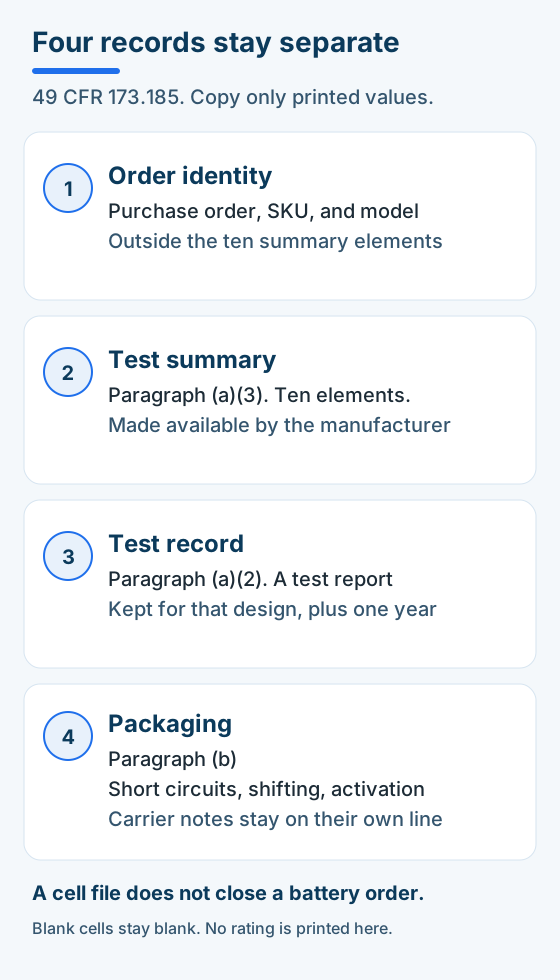
Name the document you hold before you decide which paragraph it serves. The saved text of section 173.185 does not mention a safety data sheet. If the file in hand is an SDS, record its product identity, issuer, and version on the SDS row, and fill the ten summary cells only from a file that prints them.
Scroll horizontally to see all columns →
| Record | What the saved text assigns | What you write |
|---|---|---|
| UN38.3 test summary, paragraph (a)(3) | Ten elements, made available by the manufacturer and subsequent distributor | Listed identity, the ten elements, report number, report date, and who provided the file |
| Safety data sheet | Section 173.185 does not mention an SDS | Product identity, issuer, and version. The ten cells stay blank unless a summary prints them |
| Test record, paragraph (a)(2) | A record of satisfactory completion. The text gives a test report as the example. The manufacturer maintains it for as long as that design is offered for transportation and for one year thereafter, and makes it available to an authorized federal, state, or local government representative on request | The report identifier if your copy prints one, and whether you also hold the (a)(3) summary |
| Packaging under paragraph (b), and the shipping provider’s review | The package must prevent short circuits, damage caused by shifting, and accidental activation. The cells or batteries are offered by themselves, packed with equipment, or contained in equipment | The configuration you described, the route, and the provider’s written response |
The (a)(2) record and the (a)(3) summary are different paragraphs. Holding a summary does not mean you hold the completion record. Holding a laboratory report does not mean the ten elements are printed on it. Write the paragraph each file actually serves, and leave the other row blank.

Give the shipping provider the summary that matches the order, the identity row, and whether the cells or batteries are offered by themselves, packed with equipment, or contained in equipment. Record the answer for that route. Completing this worksheet does not show that the package meets paragraph (b). The photograph shows separate objects on a bench. It is not a packing method.
Request the file and recheck design changes
Ask the manufacturer or the subsequent distributor for the summary that covers the identified cell, battery, or product. Paragraph (a)(3) requires that party to make the summary available. The saved text does not say the summary must ride inside every shipment, and paragraph (a)(3) does not print an expiration date.
The one-year period in paragraph (a)(2)(i) belongs to the manufacturer’s completion record. Do not treat that year as an expiry date for the summary. Do not set a summary aside only because the report date is old. Reopen the identity row when the supplier changes the model, the cell, or the battery the summary names.
Paragraph (a)(1) requires each lithium cell or battery to be of the type proven to meet subsection 38.3. Paragraph (a)(1)(i) allows continued transport of cells and batteries manufactured to a type that met Revision 3, Amendment 1, or any subsequent revision and amendment applicable at the date of the type testing, unless another provision in this subchapter provides otherwise. Paragraph (a)(1)(ii) says cell and battery types that only meet Revision 3 are no longer valid, while cells and batteries manufactured in conformity with such types before July 2003 may continue to be transported if all other applicable requirements are fulfilled. This page does not decide whether a design change creates a new type. Leave the match blank until the manufacturer names the ordered configuration in writing.
Beginning May 10, 2024, paragraph (a)(5) requires each lithium ion battery to be marked with the watt-hour rating on the outside case. When you can read that mark, compare it with element 6. When the case is sealed inside equipment and the mark is not readable, leave the case-mark note blank.
Close the purchasing record with three entries: identity matched, missing summary elements resolved, and shipping response recorded. If one entry is still open, name the person who owns the next file.
The lot release sits on the pre-shipment inspection guide, which records whether the buyer releases, holds, or rejects the goods. Keep that release line off this summary sheet. The other freight records for the order sit with the freight and logistics guides.
This sheet stops at a commercial lithium order under paragraph (a)(3). It does not apply these other provisions in the same section:
- Button cells installed in equipment, including circuit boards, are outside the (a)(3) sentence.
- Paragraph (d) covers a lithium cell or battery, including one contained in equipment, transported by motor vehicle to a permitted storage facility or disposal site, or for recycling. It excepts that shipment from the testing and recordkeeping requirements of paragraph (a) when the packing conditions in (d) are met.
- Paragraph (e) excepts low production runs, defined as annual production runs of not more than 100 lithium cells or batteries, and prototype lithium cells or batteries transported for testing, plus equipment containing them, from the testing and recordkeeping requirements of paragraph (a), when the conditions in (e) are met.
- Paragraph (f) covers lithium cells or batteries that have been damaged, or identified by the manufacturer as defective for safety reasons, and that have the potential of producing a dangerous evolution of heat, fire, or short circuit. It limits transport to highway, rail, or vessel and sets its own packaging and marking.
- The saved section defines lithium cells and batteries as lithium metal and lithium ion chemistries.
Method and sources
The checklist uses the eCFR text of 49 CFR 173.185, fetched October 18, 2026. That page displayed title 49 as of October 15, 2026, said title 49 was last amended October 13, 2026, and states that the eCFR is authoritative but not an official legal edition of the CFR. The ten elements in paragraph (a)(3), the January 1, 2008 manufacture date, the button-cell exception, the May 10, 2024 watt-hour mark in paragraph (a)(5), and the paragraph (c)(1) size ceilings also appear in the GovInfo PDF of the same section from the October 1, 2025 edition, labeled 49 CFR Ch. I (10-1-25 Edition). That PDF was retrieved the same day, and its Last-Modified header was July 27, 2026.
A search of the local industry library returned no PHMSA, eCFR, or UNECE document for this subject. PHMSA requests for the test-summary PDF, the lithium batteries page, the shipper guide, and interpretation 22-0044 saved Access Denied pages and were not used. The UNECE Rev. 8 file list returned a Cloudflare challenge page and was not used. Those requests were not retried. The saved section incorporates subsection 38.3 by reference. It does not reproduce the test procedures, so this page does not name individual tests or print a result.
The blank tables are the order check. This page prints no watt-hour rating, report number, or pass date of its own. Updated October 2026.
Frequently asked questions
Does a lithium ion battery of 100 Wh or less skip the test summary?
No. Paragraph (c)(1)(i) sets 100 Wh as the ceiling for a lithium ion battery under that smaller-size exception, and 20 Wh as the ceiling for a lithium ion cell. Paragraph (a)(3) still requires a test summary for lithium cells or batteries manufactured on or after January 1, 2008, except button cells installed in equipment, including circuit boards.
Does a button cell installed in equipment need this summary?
The (a)(3) sentence excepts button cells installed in equipment, including circuit boards. If the file does not say the goods are button cells installed in equipment, keep them on this sheet. The saved section prints no button-cell dimensions, so this page does not measure the cell.
Sources
- 49 CFR 173.185 — Lithium cells and batteries : Office of the Federal Register, eCFR Accessed October 18, 2026.
- 49 CFR 173.185, 10-1-25 edition : U.S. Government Publishing Office Accessed October 18, 2026.